Meta, the company operating Facebook and Instagram, dismantled a Chinese network of false accounts called “Operation K.”
by Massimo Introvigne

On June 18, 2023, Canadian Sikh separatist leader Hardeep Singh Nijjar was shot and killed in Surrey, British Columbia. Nijjar advocated for an independent Sikh state, Khalistan, separated from India, and the Canadian authorities suggested that Indian intelligence services might have been involved in the assassination, originating a major diplomatic crisis between the two countries.
While who killed Nijjar is still unclear, nor does “Bitter Winter” have a position on the issue, it is now clear that China is trying to exploit the incident to excite the international Sikh diaspora and create fake anti-Indian protests in Australia, New Zealand, and elsewhere.
Meta, the company operating Facebook, Instagram, and WhatsApp released in May as part of its “Meta’s Quarterly Adversarial Threat Report” a notice on fake social media accounts created by China with this purpose.
The notice states that the network “originated in China and targeted the global Sikh community, including in Australia, Canada, India, New Zealand, Pakistan, the UK, and Nigeria.” China even gave a name to the campaign, “Operation K.”
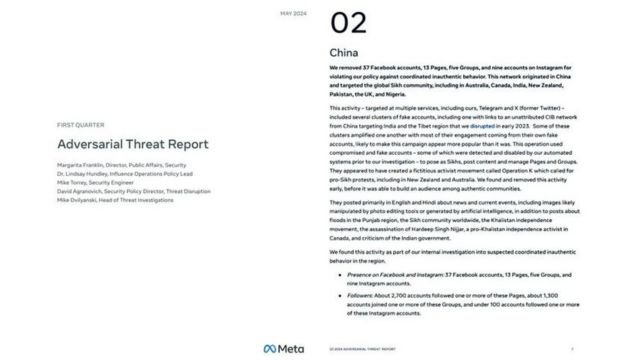
Meta reported that it removed “37 Facebook accounts, 13 Pages, five Groups, and nine accounts on Instagram. About 2,700 accounts followed one or more of these Pages, about 1,300 accounts joined one or more of these Groups, and under 100 accounts followed one or more of these Instagram accounts.” Although the figures may seem low, when detected these are normally the tip of an iceberg. Meta found a parallel behavior coming from the same Chinese source on Telegram and X.
“They appeared to have created a fictitious activist movement called Operation K which called for pro-Sikh protests, including in New Zealand and Australia,” Meta explained.
Who was behind Operation K is clear. The origin of the messages, where “the operatives posed as Sikhs and proceeded to post content as well as manage Pages and Groups,” was traced back to a “network from China targeting India and the Tibet region” that had been shut down in early 2023 but is now resurfacing.
The content included “images likely manipulated by photo editing tools or generated by AI, in addition to posts about floods in the Punjab region, the Sikh community worldwide, the Khalistan independence movement, the assassination of Hardeep Singh Nijjar, a pro-Khalistan independence activist in Canada, and criticism of the Indian government,” Meta said.
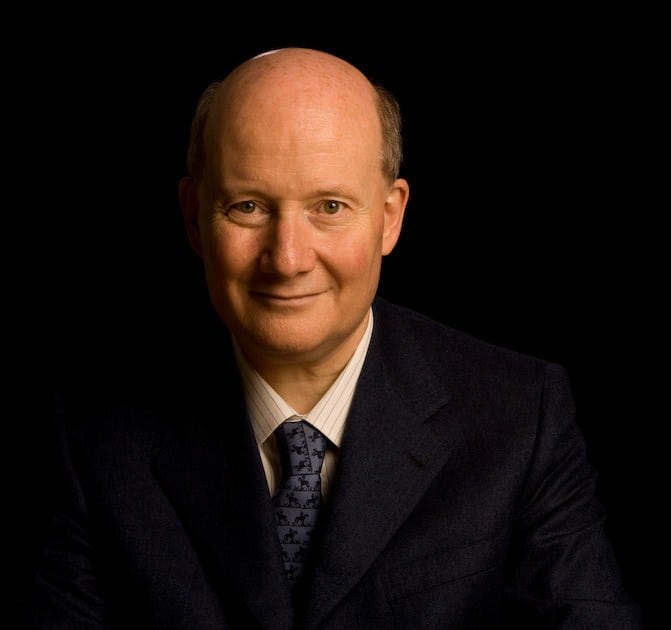
Massimo Introvigne (born June 14, 1955 in Rome) is an Italian sociologist of religions. He is the founder and managing director of the Center for Studies on New Religions (CESNUR), an international network of scholars who study new religious movements. Introvigne is the author of some 70 books and more than 100 articles in the field of sociology of religion. He was the main author of the Enciclopedia delle religioni in Italia (Encyclopedia of Religions in Italy). He is a member of the editorial board for the Interdisciplinary Journal of Research on Religion and of the executive board of University of California Press’ Nova Religio. From January 5 to December 31, 2011, he has served as the “Representative on combating racism, xenophobia and discrimination, with a special focus on discrimination against Christians and members of other religions” of the Organization for Security and Co-operation in Europe (OSCE). From 2012 to 2015 he served as chairperson of the Observatory of Religious Liberty, instituted by the Italian Ministry of Foreign Affairs in order to monitor problems of religious liberty on a worldwide scale.