An incident shows that robot vacuums made in China might regularly collect and send data back to their country.
by Massimo Introvigne
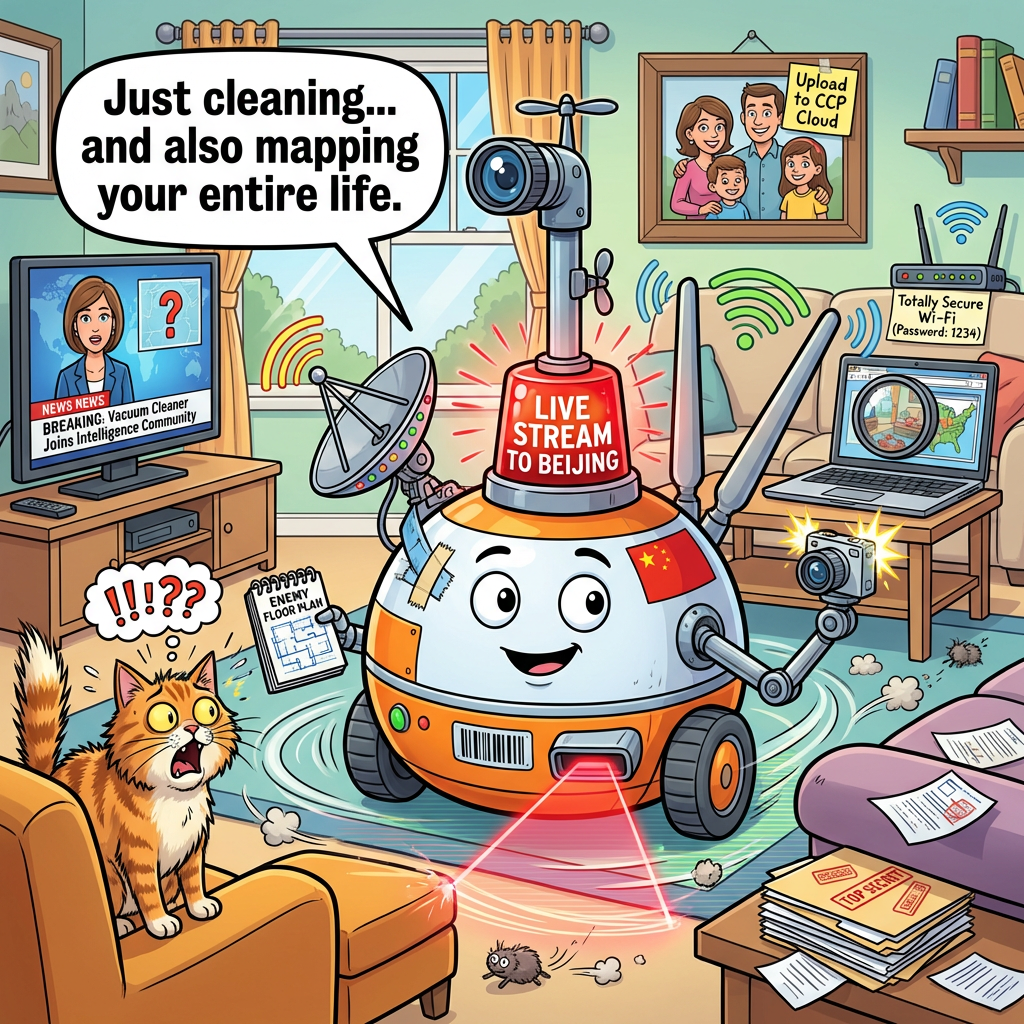
There was a time when the biggest threat in your home was the dust bunny under the sofa. Those were simple days. Now, thanks to global manufacturing and the Chinese Communist Party’s creativity, the once-humble cleaning robot has turned into something much more ambitious: a roaming, Wi-Fi-enabled, camera-equipped reconnaissance drone disguised as a household appliance.
The latest scandal began last month when a Spanish tech enthusiast, someone who can’t resist tinkering with gadgets, decided to experiment with his Chinese-made robot vacuum. Using a PlayStation controller, he managed to steer it like a small tank. This was amusing, but then he unintentionally unlocked access to thousands of similar devices worldwide. Suddenly, he was not just cleaning his living room; he was exploring the layouts of strangers’ homes in 24 countries.
It turned out the robot vacuums were not only cleaning floors but also gathering data: live camera feeds, indoor maps, device IDs, battery levels, and enough metadata to make any intelligence agency happy. The flaw was glaring. It was like leaving the front door open with a neon sign saying, “Come in; we’re spying.”
The manufacturer, a Chinese company called DJI (Shenzhen Da-Jiang Innovations Sciences and Technologies Ltd)—which, by the way, was also a defense contractor, producing drones for the Chinese army—claimed it was all a misunderstanding and quickly “fixed” the issue. Of course, they did. Nothing reassures the public like a military-connected company announcing that the backdoor you weren’t meant to know about is probably closed now.
But this story doesn’t end with one rogue vacuum. China, never satisfied with half measures, has also acquired the world’s best-known cleaning robot brand, iRobot, which manufactures the market leader, Roomba, found in more than 6 million homes. Yes, the same company whose devices have been mapping Western homes for years is now under Chinese ownership. If Beijing ever wanted to find out how many carpets you have in your home, the data is probably already stored in the cloud.
The implications are shocking. Imagine a future where your vacuum cleaner not only knows the layout of your home but also recognizes your face, your pets, your furniture, and that embarrassing pile of laundry you promised to fold last week. With higher-resolution cameras, it could casually glance at your computer screen as it rolls by. With microphones, it could listen in on your arguments about whose turn it is to take out the trash. With 3D scanning, it could create architectural-grade blueprints of your living room.
And all of this would be uploaded, helpfully and silently, to servers in China.
Some people dismiss this as paranoia. Others call it “unrestricted warfare.”
The reality is that the modern home is already a surveillance paradise. Smart speakers listen, smart TVs watch, and smart refrigerators judge your eating habits. Adding a smart vacuum that reports to Beijing is simply the next logical step in the evolution of domestic embarrassment.
Many Western countries have welcomed these devices with open arms and unsecured Wi-Fi networks. This has led to a nation where millions of households may already be unknowingly creating the world’s largest interior-design intelligence archive. Somewhere in a data center, an algorithm is probably evaluating whether you wash your underwear often enough.
We will not lose privacy in a dramatic cyberattack or a Hollywood-style hacking scene. We will lose it because people want cleaner floors without lifting a finger. The Chinese Communist Party didn’t need to infiltrate governments or corporations; it just needed to sell vacuum cleaners.
And so, as your robot moves across the room tonight, humming innocently, remember: it may not be looking for dust; it may be searching for secrets. Or worse, for your unflattering angles.
Sleep well. The vacuum is watching.

Massimo Introvigne (born June 14, 1955 in Rome) is an Italian sociologist of religions. He is the founder and managing director of the Center for Studies on New Religions (CESNUR), an international network of scholars who study new religious movements. Introvigne is the author of some 70 books and more than 100 articles in the field of sociology of religion. He was the main author of the Enciclopedia delle religioni in Italia (Encyclopedia of Religions in Italy). He is a member of the editorial board for the Interdisciplinary Journal of Research on Religion and of the executive board of University of California Press’ Nova Religio. From January 5 to December 31, 2011, he has served as the “Representative on combating racism, xenophobia and discrimination, with a special focus on discrimination against Christians and members of other religions” of the Organization for Security and Co-operation in Europe (OSCE). From 2012 to 2015 he served as chairperson of the Observatory of Religious Liberty, instituted by the Italian Ministry of Foreign Affairs in order to monitor problems of religious liberty on a worldwide scale.