She organized an underground network of women fighting for human rights and freedom, and was tortured for 27 years in the CCP jails.
by Massimo Introvigne
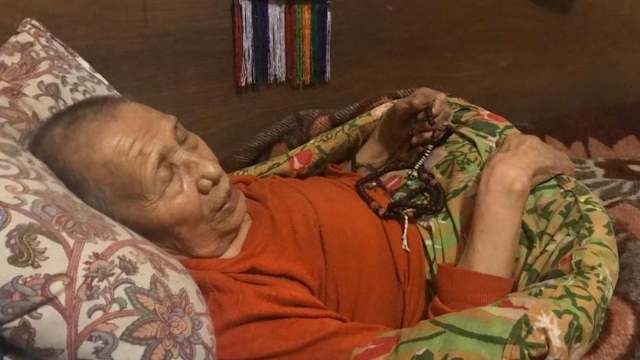
On August 3, 2020, Adhe Tapontsang, known as Ama (Mother) Adhe, died in Dharamshala, India. In the West, many know her for the book published in 1999, The Voice That Remembers (Boston: Wisdom Publications), where she told her story to Joy Blakeslee. The book reads like a novel but, unfortunately, all is true.
Adhe was born in 1932 in the region of Nyarong, then part of Tibet and today incorporated by the Chinese into the Sichuan Province. She experienced the CCP invasion of Nyarong and the Kham region in 1950, when she was 18 and newly married. While the CCP initially promised to respect the Tibetan culture and religion, soon they started closing Buddhist monasteries, humiliating monks, and persecuting believers. Those who resisted were eliminated. Adhe’s father died in a hospital under suspicious circumstances, and her husband was poisoned and died in her arms in 1954.
Although penniless, with a young son, and pregnant with her second child, a daughter, in 1955 Adhe decided to establish a clandestine network of Tibetan women who gathered information for the men who were fighting against the CCP in the mountains, and tried to tell the truth to the world outside Tibet. Eventually, her organization became legendary and also supplied the resistance with food and other provisions.
The CCP police finally managed to arrest her in 1958. Her book describes how she was savagely tortured and moved from one Chinese jail to another for 27 years, until she was freed in 1985 during the short conciliatory policy promoted by Deng Xiaoping.
Her adventures had not finished. Kept under surveillance, she nonetheless managed to escape to India, where she became a respected voice in the refugee community in Dharamshala.
With Alma Adhe, Tibet loses a voice of the resistance and a living memory of the persecution. Her example will certainly inspire new generations of fighters for freedom, human rights, and religious liberty.

Massimo Introvigne (born June 14, 1955 in Rome) is an Italian sociologist of religions. He is the founder and managing director of the Center for Studies on New Religions (CESNUR), an international network of scholars who study new religious movements. Introvigne is the author of some 70 books and more than 100 articles in the field of sociology of religion. He was the main author of the Enciclopedia delle religioni in Italia (Encyclopedia of Religions in Italy). He is a member of the editorial board for the Interdisciplinary Journal of Research on Religion and of the executive board of University of California Press’ Nova Religio. From January 5 to December 31, 2011, he has served as the “Representative on combating racism, xenophobia and discrimination, with a special focus on discrimination against Christians and members of other religions” of the Organization for Security and Co-operation in Europe (OSCE). From 2012 to 2015 he served as chairperson of the Observatory of Religious Liberty, instituted by the Italian Ministry of Foreign Affairs in order to monitor problems of religious liberty on a worldwide scale.