The source that published it makes Soyonbo Borjgin’s story even more dramatic and believable.
by Massimo Introvigne

Soyonbo Borjgin, a former journalist at the “Inner Mongolia Life Weekly” who now lives in the U.S., has published a magnificent memoir of his years at the “Xi Jinping School of Journalism” in “Equator.” “Inner Mongolia” is the somewhat colonial name Beijing gives to what local Mongolians prefer to call “Southern Mongolia.”
The most intriguing thing about Soyonbo Borjgin’s memoir is its publication. “Equator” was launched after Gaza as a platform to critique the collective West’s hypocrisies. It is not an anti-China outlet, nor a Western propaganda rag. Yet here it is, hosting one of the most devastating portraits of Beijing’s ideological machinery. Ironically, a magazine born to puncture Western myths ends up exposing Beijing’s own.
Borjgin’s memoir is a chronicle of how journalism in Inner Mongolia became a tool of assimilation. His father was jailed after Tiananmen, his mother sidelined for refusing Party membership, and he himself endured newsroom rituals that were equal parts absurd and sinister.
Reporters were dispatched on “field trips” that were really drinking contests. Subscription drives were lubricated by baiju, with circulation numbers rising in proportion to the number of bottles emptied.
Promotions went not to the talented but to those who mastered the art of sycophancy. Borjgin recalls colleagues who rose quickly because they could quote Xi’s “Golden Sentences” with theatrical fervor.
One anecdote describes a banquet where sheep tails were served as delicacies, the fatty morsels consumed in ritualistic excess while editors toasted the Party line. Journalism was less about reporting than about performing loyalty.
The memoir captures the surreal indoctrination rituals. Staff were required to recite Xi’s aphorisms daily, treating them as scripture. Children were taught to adore “Grandpa Xi,” their classrooms stripped of Mongolian-language materials. Borjgin describes the humiliation of watching Mongolian-language newspapers shrink, their pages filled with Mandarin slogans, until they disappeared altogether.
In 2020, when Mongolian-language education was dismantled, students staged protests, chanting “Mongolian is our language, and we will be Mongolian to the death!” The defiance was short-lived. Teachers were coerced, students threatened, and classrooms reverted to Mandarin-only instruction. Journalism, once a fragile space for Mongolian voices, became another arm of assimilation.
Borjgin’s anecdotes are devastating precisely because they are ordinary. Reporters were forced to sell newspaper subscriptions door-to-door, often bribing households with alcohol or cigarettes. Success was measured not in readership but in compliance. Officially billed as political education, “study sessions” devolved into endless rounds of baiju, where the ability to hold one’s liquor was a career skill.
Editors competed to praise Xi’s latest slogans, weaving them into headlines and features with a creativity that bordered on parody. Borjgin recalls one editor who insisted that every story, even about agriculture, must include a “Golden Sentence.”
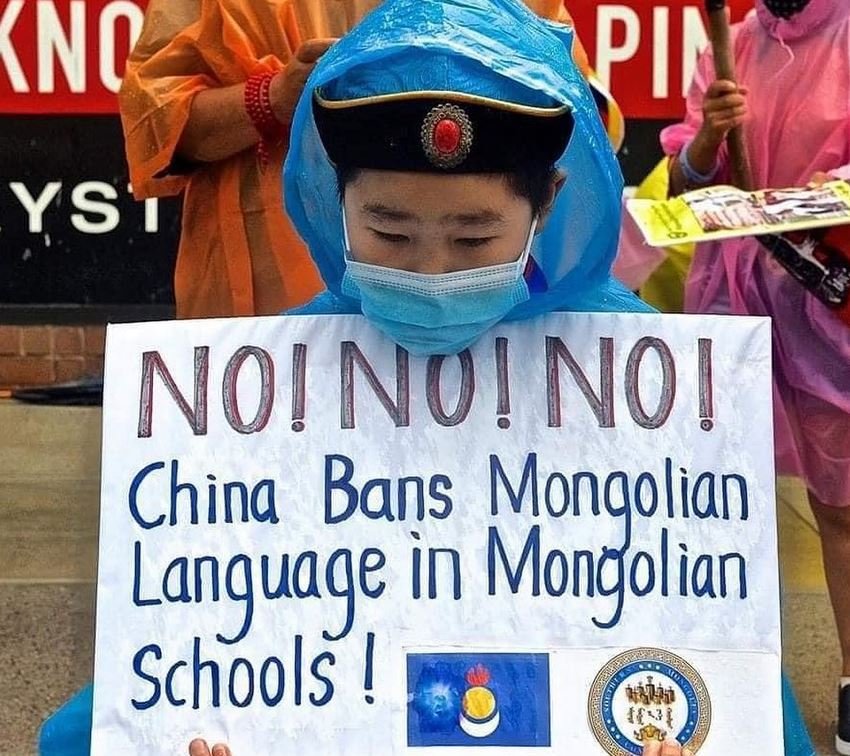
In 2020, after reporters such as Soyonbo Borjgin had protested the crackdown on the use of the Mongolian language, the “Inner Mongolia Life Weekly” was discontinued. Only the parallel “Daily” was continued, in Mandarin. Soyonbo Borjgin was summoned to a correction meeting with a Party bureaucrat. “Because of extreme political wrongdoing, he began, our media house was to receive three punishments: ‘The Inner Mongolia Daily’s’ website would be shuttered; its WeChat account would be deleted; and ‘The Inner Mongolia Life Weekly’ was to be folded, without a final issue or public statement. Several of my colleagues broke down in tears. Re-education began that afternoon, in the same conference room. It was led by a Han journalist at ‘The Daily’… she began by asking: ‘How many Han friends do you have?’ After we each gave a number in turn, she embarked on a long, fiery lecture, explaining why it was a grave error to grant our region autonomous status in 1947, why our language was ’backward’ and incapable of scientific discourse, and other abstruse matters.”
This finally led Soyongo Borjgin to leave China for the U.S. in 2021, which in turn led his parents to be harassed at home.
That “Equator” chose to publish this memoir is the real twist. The outlet was designed to critique Western double standards, not to amplify anti-China narratives. Yet Borjgin’s account forces recognition that authoritarianism is not a Western invention—it is a universal temptation. By spotlighting Inner Mongolia, “Equator” reminds readers that the victims of Beijing’s media machine are not abstract dissidents but communities whose languages, identities, and histories are being systematically erased.
This is a memoir, messy and human, full of anecdotes that sting precisely because they are ordinary. And it is devastating because it shows how the “Xi Jinping School of Journalism” is not just about controlling reporters—it is about controlling nations within the nation.
The irony remains undefeated: a magazine launched to criticize the West has inadvertently produced one of the sharpest critiques of China’s authoritarian journalism, and in doing so, given Southern Mongolia’s silenced voices a stage.
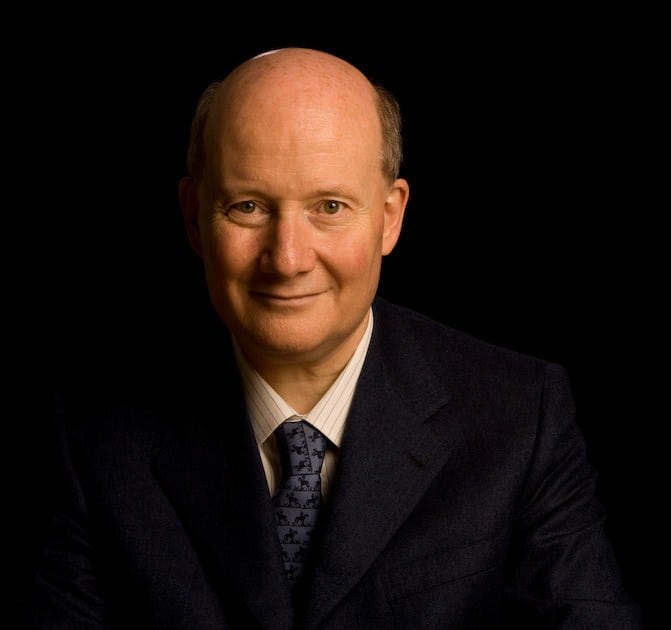
Massimo Introvigne (born June 14, 1955 in Rome) is an Italian sociologist of religions. He is the founder and managing director of the Center for Studies on New Religions (CESNUR), an international network of scholars who study new religious movements. Introvigne is the author of some 70 books and more than 100 articles in the field of sociology of religion. He was the main author of the Enciclopedia delle religioni in Italia (Encyclopedia of Religions in Italy). He is a member of the editorial board for the Interdisciplinary Journal of Research on Religion and of the executive board of University of California Press’ Nova Religio. From January 5 to December 31, 2011, he has served as the “Representative on combating racism, xenophobia and discrimination, with a special focus on discrimination against Christians and members of other religions” of the Organization for Security and Co-operation in Europe (OSCE). From 2012 to 2015 he served as chairperson of the Observatory of Religious Liberty, instituted by the Italian Ministry of Foreign Affairs in order to monitor problems of religious liberty on a worldwide scale.