The same story links the Nativity and the martyrs: those who seek to live according to conscience often face hostility. Support “Bitter Winter,” it is here to help them.
by Massimo Introvigne and Marco Respinti
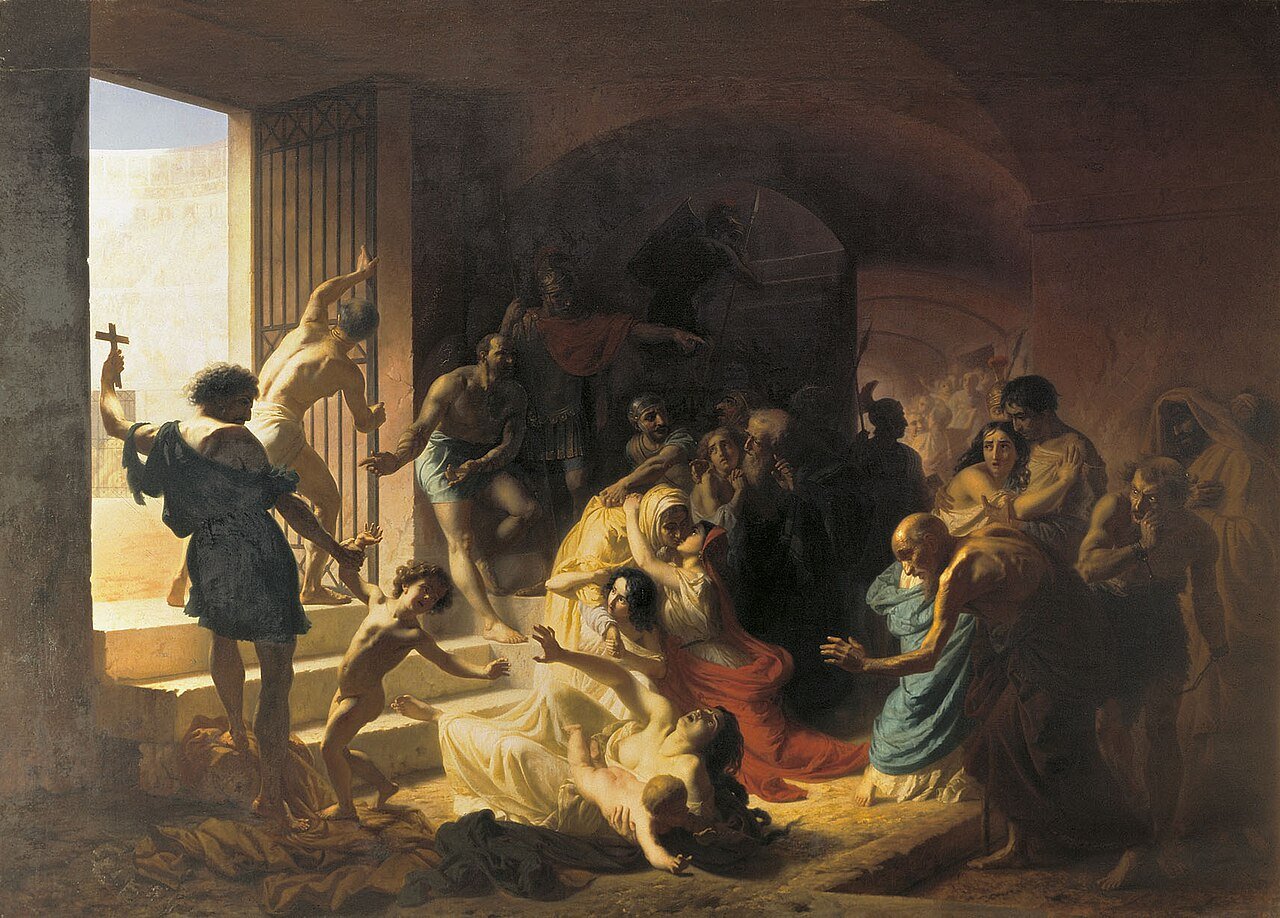
Each year, we begin our Christmas reflection with a work of art. This year, the choice falls on Konstantin Flavitsky’s nineteenth-century canvas “Christian Martyrs in the Colosseum.” The painting is not as famous as the works of Michelangelo or Caravaggio, yet it speaks with a quiet intensity that makes it unforgettable.
Flavitsky, a leading exponent of Russian romanticism, depicts a group of Christians gathered in the Roman arena. They are men, women, and children, huddled together, awaiting death. The lions are not yet released, the crowd is restless, but the martyrs are serene. Their faces are turned toward eternity, their bodies fragile yet dignified. There is no melodrama, no exaggerated gesture—only presence, endurance, and faith.
It is a scene that resonates deeply with Christmas. The Nativity itself was not staged in comfort or safety. Mary and Joseph were displaced by imperial decree, forced to register in Bethlehem. The infant Jesus was soon threatened by Herod’s violence, and the Holy Family became refugees in Egypt. Christmas, then, reminds us of vulnerability, exile, and the courage to endure.
We often sentimentalize Christmas, surrounding it with lights, gifts, and carols. Yet the Gospel narratives remind us that the birth of Christ took place under the shadow of persecution. Herod’s massacre of the innocents is part of the Christmas story. The manger is inseparable from the sword.
Flavitsky’s martyrs remind us that persecution has always accompanied faith. The Colosseum is not so far from Bethlehem. The same story links the manger and the arena: those who seek to live according to conscience often face hostility from the powers of the world. The martyrs’ quiet strength mirrors the humility of the child in the crib. Both testify that true power lies not in domination but in fidelity.
Today, persecution continues. Across continents, believers of many traditions are harassed, imprisoned, or silenced. Their plight is rarely visible in mainstream media, yet it echoes the martyrs of Rome. In China, members of house churches, believers of The Church of Almighty God, Falun Gong practitioners, Uyghur Muslims, and Tibetan Buddhists are detained, tortured, and killed. In Pakistan, blasphemy laws are used against Christians and Ahmadis. In Nigeria, attacks on churches and Christians are increasing. In Flavitsky’s own Russia, Jehovah’s Witnesses are banned and jailed, and the number of religious groups prohibited and persecuted by the Putin regime grows every day. And of course, in Ukraine, Russia’s crimes against humanity include assaults on churches, priests, and pastors.
Democratic countries do not throw believers to lions, but this does not mean that they are free from harassment. During this year 2025, “Bitter Winter” has documented the growing intolerance and discrimination against religious minorities in South Korea and Japan, two countries that are becoming similar to France, notorious for its discrimination against groups branded as “cults.” In Taiwan, the decade-old Tai Ji Men case, where taxes are used to harass a spiritual minority, is still not solved. Anti-cult campaigns, attempts to ban unpopular groups, and discrimination against their believers have extended to the Nordic Countries, the Czech Republic, Argentina, and Africa. Even in Italy, intolerant voices are heard, although they are effectively resisted.
To meditate on Christmas without remembering those persecuted for their faith would be to miss the heart of the feast. The child in the manger is already the persecuted one. The martyrs in the Colosseum are his companions. The persecuted of today, with or without blood, are their heirs.
Flavitsky’s painting reminds us that art can preserve memory when words fail. The faces of the martyrs are anonymous, yet they stand for countless individuals whose names are lost. The painting becomes a visual scripture, a testimony to endurance.
At Christmas, we need such witnesses. The nativity scenes we place in our homes are reminders of vulnerability and hope. The manger is a symbol of poverty, exile, and danger. Flavitsky’s Colosseum is a symbol of persecution, hostility, and death. Together, they tell the story of faith under pressure.
This is why “Bitter Winter” exists: to give voice to those who suffer for their beliefs, to document abuses, and to remind the world that freedom of religion or belief is not a luxury but a fundamental right. The stories we publish are the modern equivalents of Flavitsky’s martyrs.
When we report on believers imprisoned in China, on communities harassed in Pakistan or Africa, on religious leaders jailed in South Korea, or on religions at risk of legal dissolution in Japan or Northern Europe, we are continuing the work of witness. These people exist, their dignity matters, and their suffering must not be ignored.
As you gather with family and friends this Christmas, we invite you to let Flavitsky’s painting linger in your mind. See in the faces of the martyrs the faces of today’s persecuted. Hear in their silence the cry of those who cannot speak freely. And let your meditation become action.
A Christmas gift to “Bitter Winter” is solidarity with the voiceless, a way of ensuring that their stories are told, their dignity defended, and their hope sustained.
The Magi brought gifts to the child. We can bring the gifts of our testimony to those who suffer. Supporting “Bitter Winter” is one way to do so.

Massimo Introvigne (born June 14, 1955 in Rome) is an Italian sociologist of religions. He is the founder and managing director of the Center for Studies on New Religions (CESNUR), an international network of scholars who study new religious movements. Introvigne is the author of some 70 books and more than 100 articles in the field of sociology of religion. He was the main author of the Enciclopedia delle religioni in Italia (Encyclopedia of Religions in Italy). He is a member of the editorial board for the Interdisciplinary Journal of Research on Religion and of the executive board of University of California Press’ Nova Religio. From January 5 to December 31, 2011, he has served as the “Representative on combating racism, xenophobia and discrimination, with a special focus on discrimination against Christians and members of other religions” of the Organization for Security and Co-operation in Europe (OSCE). From 2012 to 2015 he served as chairperson of the Observatory of Religious Liberty, instituted by the Italian Ministry of Foreign Affairs in order to monitor problems of religious liberty on a worldwide scale.