The Chinese Communist Party spells out its program of total control: “Sinicize,” manage, guide, and punish.
by Tashi Dhargey
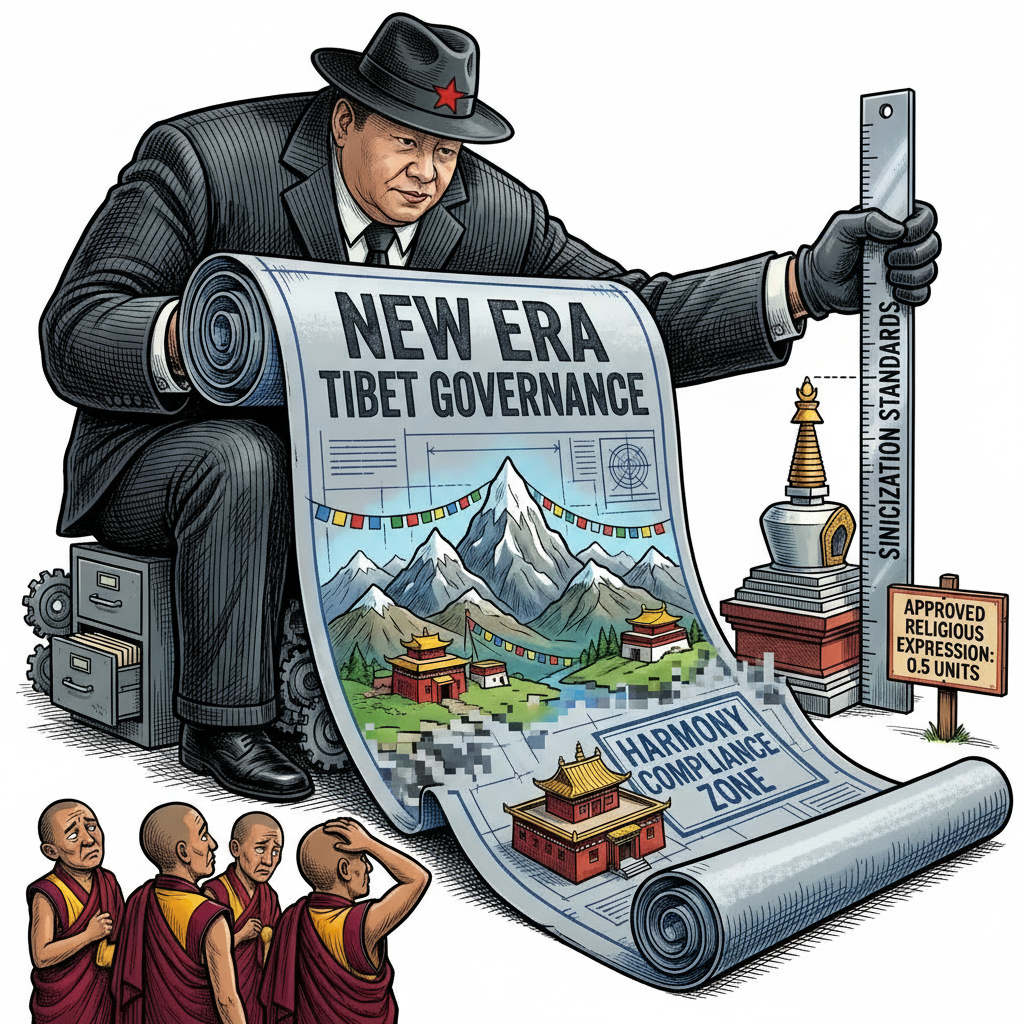
When an article appears in the “Guangming Daily,” it deserves more than a casual glance. This is not an ordinary newspaper. It serves as the official daily for the Central Propaganda Department of the Chinese Communist Party, historically aimed at intellectuals, academics, and Party supporters. In other words, it is where the Party communicates with people who will later relay the Party’s message to others. When “Guangming Daily” publishes a lengthy essay by the Executive Vice President of the Party School of the Tibet Autonomous Region, it is not just filler. It sends a significant policy signal.
Cui Luchun’s article from March 23 promises to “deeply understand the scientific connotations and practical requirements” of the Party’s Tibet strategy. It is a prime example of dry political writing. But beneath the formal language lies a significant message: the Party plans to tighten its control over Tibet, with a particular focus on religion—especially Tibetan Buddhism.
The article begins with the usual tribute to Xi Jinping, who is praised for providing direction and goals for Tibet’s future. Cui then revisits the “Ten Musts,” the ideological framework that outlines how Tibet should be governed in the “New Era.” These principles are presented as the “Four Beams and Eight Pillars” of Tibet policy, a metaphor that suggests a strong foundation but leaves little room for independent structures. The first “must” is the most telling: Tibet must follow the Party’s leadership, the socialist system, and the “ethnic regional autonomy system.” In practice, this means autonomy is allowed only as long as it aligns with central control. The article praises the “successful practice” of autonomy in Tibet, a claim that would carry more weight if the Party did not define autonomy entirely.
The section on religion brings the subtext to the forefront. Cui insists that Tibet must “adhere to the direction of the Sinicization of religion” and “manage religious affairs according to law.” These phrases have become standard in Beijing’s political lexicon, but in Tibet, they carry a specific meaning. Sinicization does not imply gentle cultural blending; it means altering Tibetan Buddhism to fit Party ideology. This includes rewriting religious doctrine, ensuring that monasteries act as extensions of the state, training clergy to be politically dependable before they are spiritually competent, and suppressing what the article describes as “negative religious factors.” In practice, this has involved banning images of the Dalai Lama, criminalizing informal religious gatherings, and introducing political education into monastic life. Cui frames all of this as modernization. Tibetans see it quite differently.
Language receives similar treatment. The article applauds the promotion of the “national common language”—Mandarin—across Tibet, presenting it as a helpful tool for development and unity. However, in light of recent crackdowns on Tibetan-language education, it reads more like a warning: linguistic assimilation is mandatory. Cui highlights the “Five Recognitions” campaign, requiring Tibetans to acknowledge the greatness of the motherland, the Chinese nation, Chinese culture, the Communist Party, and socialism. It is a broad ideological package, and the article makes it clear that it is not optional.

Cui also reports, with clear satisfaction, that Tibet’s “sense of security and satisfaction” has remained above 99% for years. This remarkable statistic would make even the happiest Scandinavian blush. It also serves as a reminder that in Tibet, stability is not just a goal but a metric—one that always needs to trend upward, regardless of how Tibetans actually feel and how unbelievable these statistics are. The repeated focus on “anti-separatism,” “stability maintenance,” and “long-term peace” indicates that security operations will stay at the forefront. The Party’s definition of stability is broad: it includes not just preventing protests but also altering culture, religion, and identity to eliminate any chance of dissent.
The article dedicates substantial space to border development, praising the creation of “well-off border villages” and the patriotic zeal of residents who now see themselves as “guardians of sacred territory.” This is part of a larger strategy: populate the frontier, integrate it economically, and ensure that loyalty to the state is woven into everyday life. Meanwhile, the ecological section presents Tibet’s environment as a national asset needing protection, even though Tibetans often face restrictions on traditional livelihoods in the name of conservation.
The conclusion calls for the full implementation of the Party’s Tibet strategy, strengthening political education, deepening ethnic integration, and ensuring that the Party’s leadership permeates every institution. This presents a comprehensive vision of governance—one where Tibetan religion, language, and identity are carefully managed variables within a larger political context.
What makes Cui Luchun’s article important is not its content—much of it has been stated before—but its timing and publication. When the “Guangming Daily” publishes a lengthy ideological essay by a senior Party School official, it signals that the Party is gearing up to intensify its efforts in Tibet, especially regarding religion. Tibet’s future, we are told, will be modern, prosperous, green, and harmonious—but only within the limits set by the Party. And those limits are tightening.

Uses a pseudonym for security reasons.