Some 450 people are in jail after a gang connected with the radical Tehreek-e-Labbaik movement first falsely accused them, then asked for money to retract the allegations.
by Massimo Introvigne

There is a new business in Pakistan, and it plays with the life and death of innocent people. It goes like this: hackers post online contents blaspheming Islam in the name of persons who do not even know what is going on. Then they report their victims to the police, who arrest them based on the fabricated blasphemy charges. At this stage, the hackers offer to retract the allegations and tell the police they were based on a “mistake” if the victim pays a significant sum of money. If victims do not pay, cases go on and they face blasphemy charges which may lead to the death penalty under Pakistani law.
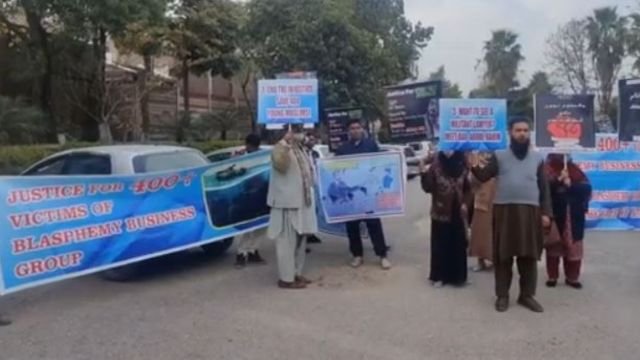
The racket was denounced on January 10 at a press conference organized at the National Press Club in Islamabad by relatives of the jailed victims and lawyers representing them. They revealed the existence of a report of the Special Branch, the Pakistani police intelligence unit, about the racket, which they said has not been followed by appropriate action.
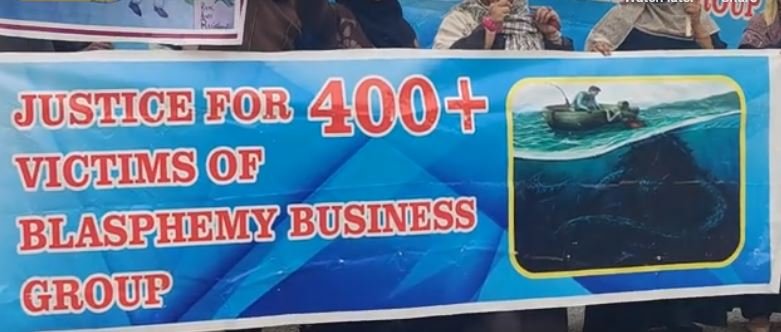
According to statistics supplied at the press conference, there are currently 450 victims, of whom 150 are imprisoned in Adiala Jail, 170 in Lahore’s Camp Jail and Kot Lakhpat Jail, and 55 in Karachi Central Jail.
A woman called Saeeda Bibi testified that the hackers targeted her son, Muhammad Zamzam, who is blind in both eyes and has never posted on social media. Despite this, he was arrested. His mother paid the blackmailers, but they asked for more money and the son is still in jail.
The gang and certainly his leader, revealed to be one Sheraz Ahmed Farooqi, appear to be connected with the extremist group Tehreek-e-Labbaik Pakistan, although those who spoke in the press conference said it is unclear whether this is an initiative of the movement or of some rogue and criminal members.
What is clearer is that the criminal business of fabricated blasphemy serves a dual purpose. It helps some extremists make good money, and at the same time perpetuates the lie that hundreds of blasphemers are active in Pakistan, thus justifying the existence and even the reinforcement of anti-blasphemy laws.
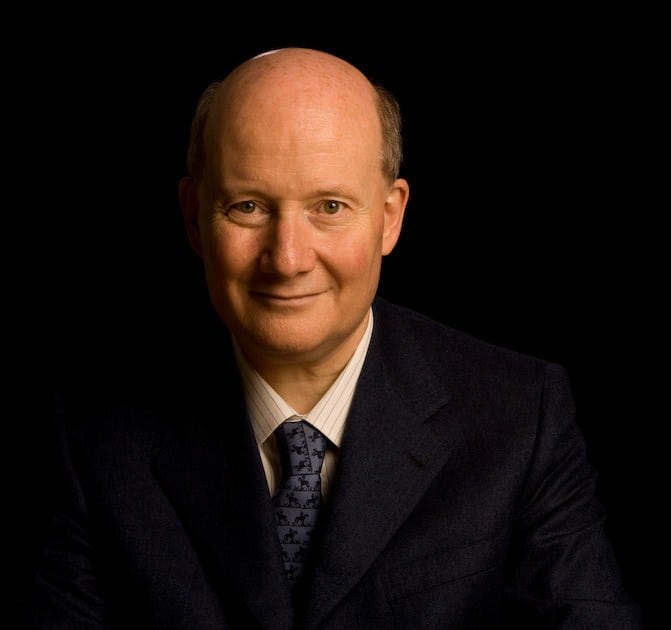
Massimo Introvigne (born June 14, 1955 in Rome) is an Italian sociologist of religions. He is the founder and managing director of the Center for Studies on New Religions (CESNUR), an international network of scholars who study new religious movements. Introvigne is the author of some 70 books and more than 100 articles in the field of sociology of religion. He was the main author of the Enciclopedia delle religioni in Italia (Encyclopedia of Religions in Italy). He is a member of the editorial board for the Interdisciplinary Journal of Research on Religion and of the executive board of University of California Press’ Nova Religio. From January 5 to December 31, 2011, he has served as the “Representative on combating racism, xenophobia and discrimination, with a special focus on discrimination against Christians and members of other religions” of the Organization for Security and Co-operation in Europe (OSCE). From 2012 to 2015 he served as chairperson of the Observatory of Religious Liberty, instituted by the Italian Ministry of Foreign Affairs in order to monitor problems of religious liberty on a worldwide scale.