Why I fell in love with a little-known artist (and member of the Theosophical Society) who was once at the crossroads of Paris’ esoteric life.
by Massimo Introvigne
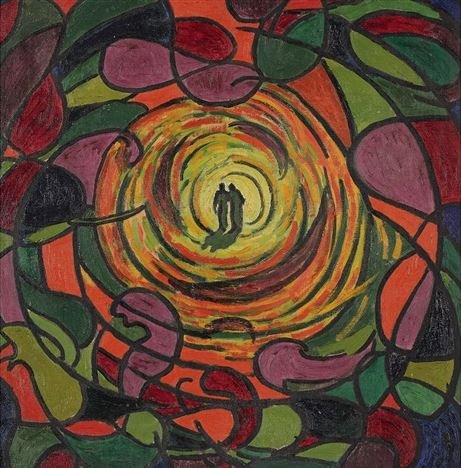
Several years ago, I fell unexpectedly and irrevocably in love—with a painter. Not the kind whose name fills auction catalogues or museum banners, but one who lived at the crossroads of mysticism, Symbolism, and the restless spiritual experimentation of fin-de-siècle France. Maurice Chabas entered my life quietly, through a single canvas, “Marche à deux vers l’au-delà,” and then refused to leave. That most iconic of Chabas’ works was at the Musée du Petit Palais in Geneva, which at one stage downsized his collection and decided to sell. I bought.
Today, a dozen of Chabas’ works surround me, including precisely “Marche à deux vers l’au-delà,” a painting that seems to breathe, to shimmer, to whisper its way into the room.
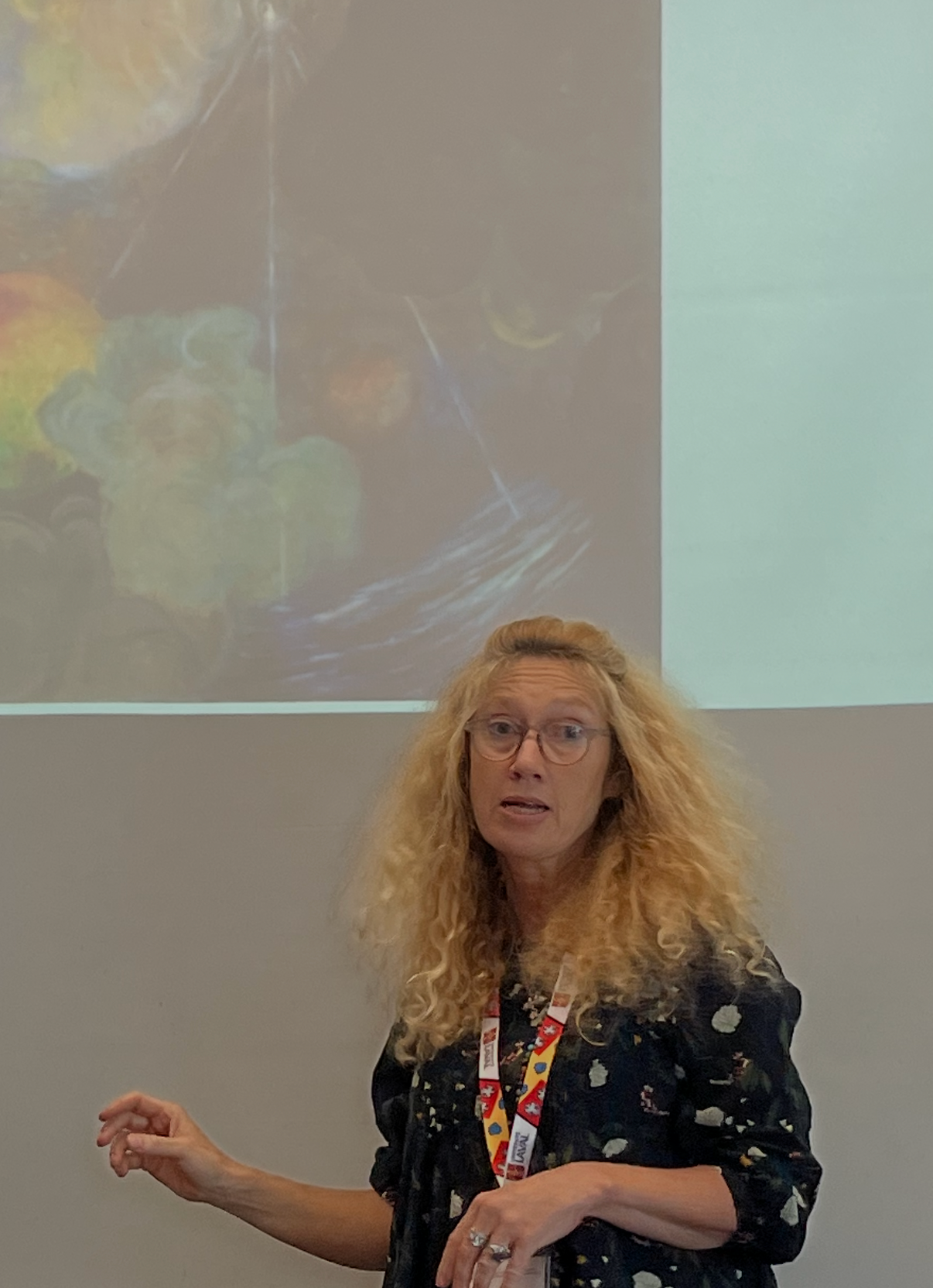
But my real initiation into Chabas’ world came through the person who knows him best: Myriam de Palma. Her scholarship, her archival tenacity, and her instinctive understanding of Chabas’ spiritual universe have shaped everything I know about him. What follows is deeply indebted to her guidance, her hospitality in Québec City, and her ability to make a long-dead painter feel startlingly present.
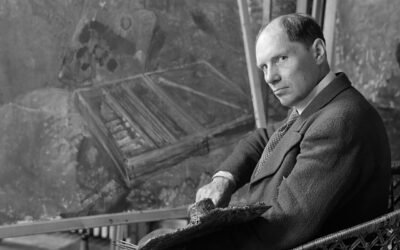
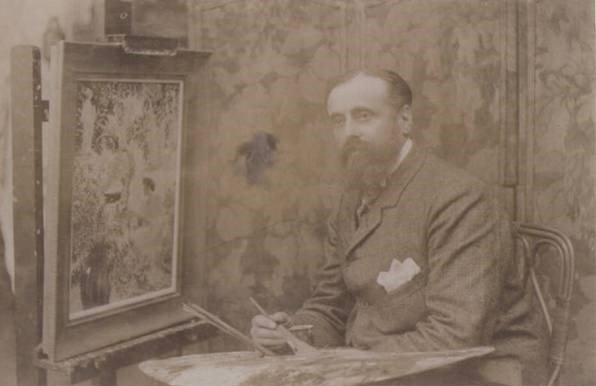
Maurice Chabas (1862–1947) was born into a cultivated family in Nantes, trained in the rigorous academic tradition of Bouguereau and Robert-Fleury, and then—almost immediately—began drifting upward. While his classmates perfected anatomy and drapery, Chabas was already peering into the astral world.
By the early 1890s, he had become a fixture in the Symbolist and esoteric circles that were transforming European art. He exhibited with Jean Delville’s idealist group in Brussels, where critics noted that Chabas seemed to paint not landscapes but “journeys through stars and clouds.” He was equally at home in Joséphin Péladan’s flamboyant Rosicrucian Salons, where incense, Wagnerian trumpets, and mystical manifestos mingled with canvases depicting souls, angels, and cosmic forces. Chabas was one of the few painters who embraced the occult dimension of Symbolism without irony or hesitation.
What set him apart was his conviction that art was a spiritual technology. A painting, for Chabas, was a living organism—a vessel through which higher forces could act upon the viewer. He believed that the artist, properly purified and attuned, could become a conduit for divine energies. It was a demanding vision, and he lived it with almost monastic seriousness.
Success came quickly. Chabas’ home in Neuilly-sur-Seine became one of the most unusual salons in Paris. On any given evening, one might find astronomer and Theosophist Camille Flammarion discussing life on other planets, sociologist Lucien Lévy-Bruhl debating the nature of consciousness, or Maurice Maeterlinck—future Nobel laureate—murmuring about the invisible worlds that obsessed them all.
Esotericists drifted in and out: Édouard Schuré, whose “Great Initiates” had electrified Europe; Péladan, in full Rosicrucian regalia; and a young René Guénon, already convinced that modern science was merely the broken remnant of ancient wisdom. Chabas absorbed it all. He read voraciously, meditated obsessively, and painted as if the canvas were a threshold between dimensions.
This was the period when he created “Marche à deux vers l’au-delà,” a work that distills his belief that the soul’s journey continues beyond the body. Two figures advance toward a luminous horizon—not in fear, but in serenity. It is a painting that refuses to be merely looked at; it must be entered and lived in.
Chabas’ spiritual commitments deepened during World War I. He flirted with Christian Science, joined the Theosophical Society, and delivered lectures that blended metaphysics with a kind of cosmic sociology. In 1914, speaking to the Order of the Star in the East, created to promote Krishnamurti’s mission as the World Teacher, he argued that artists are “energetic centers,” channels through which the universe nudges humanity toward evolution. Art, he insisted, is not decoration but initiation.
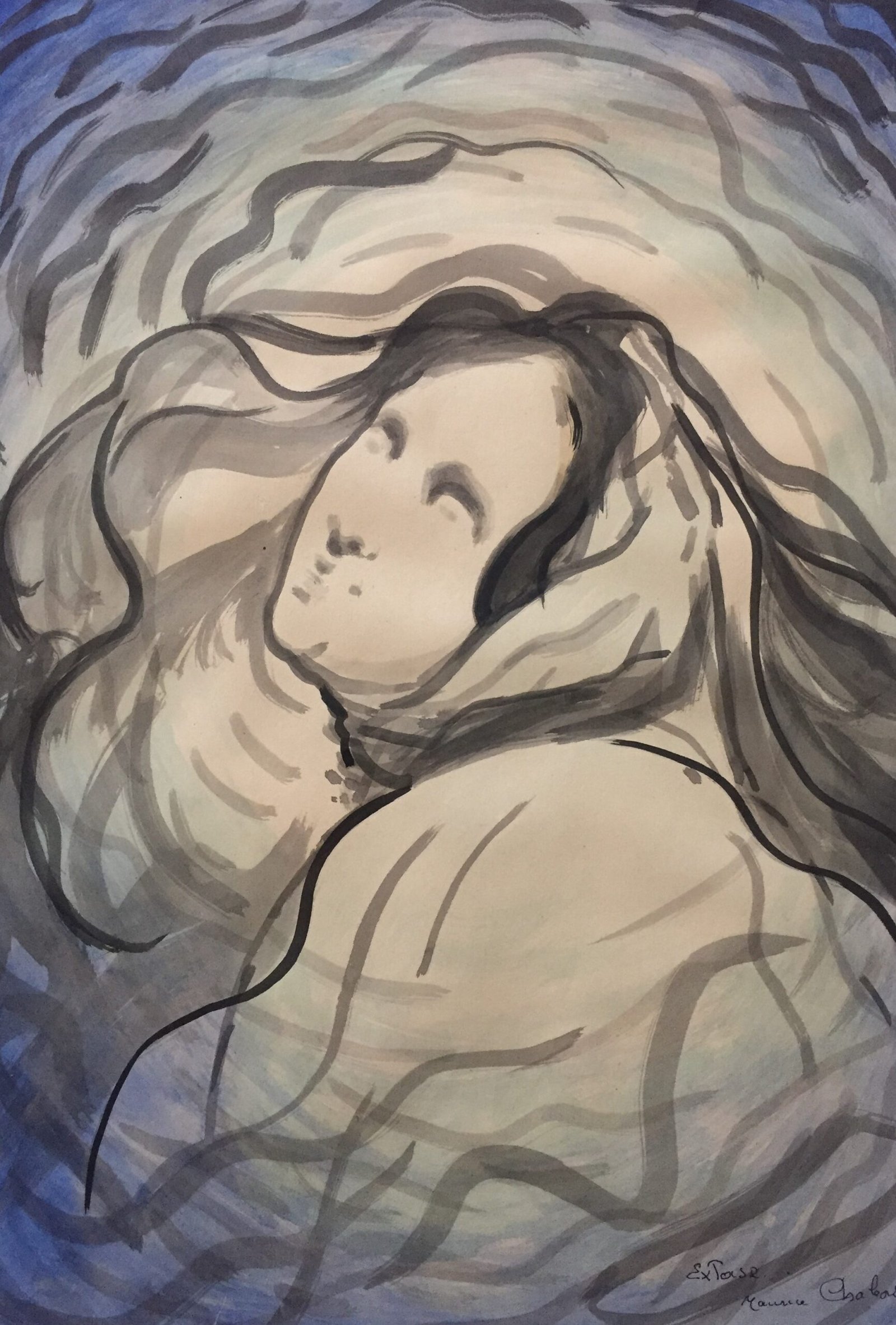
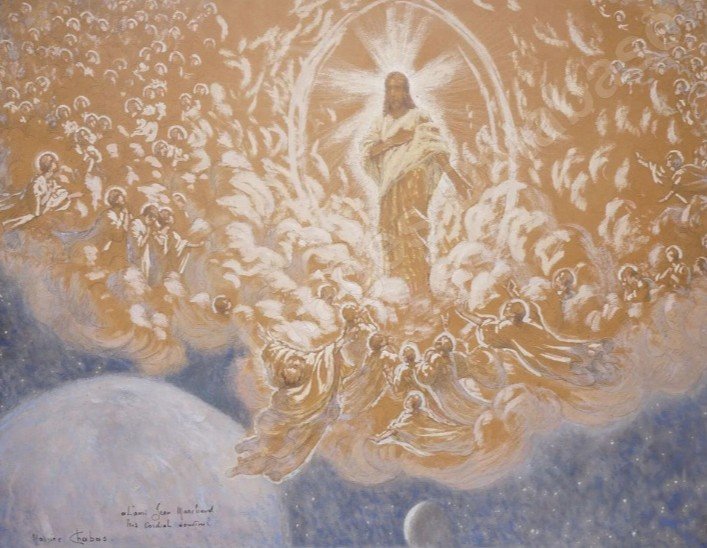
Some listeners found him excessive. Others found him electrifying. But no one doubted his sincerity. Chabas believed that the artist’s mission was to capture infinity within the finite, to make the invisible palpable. His later works—progressively more abstract, luminous, and immaterial—attempt exactly that. Long before abstraction became fashionable, Chabas was stripping away form to reveal pure spiritual vibration.
In the 1920s, he lectured at the Sorbonne, exhibited widely, and continued to attract both Catholic theologians and esoteric thinkers. Yet as he aged, he withdrew. Friends described him as a voluntary hermit, intent on unlearning everything he knew to begin again from a place of pure contemplation. He painted less, meditated more, and sought what he called “the Unique Law,” the hidden rhythm of the universe.
Maurice Chabas died in 1947, alone in Versailles, far from the salons and admirers who had once surrounded him. But his paintings—those luminous thresholds—remain. They are not fashionable. They are not easily categorized. They are, in the best sense, inconvenient: reminders that art can be a spiritual discipline, that beauty can be a form of knowledge, and that the invisible still has its prophets. The circle of Chabas’ scholars and admirers is admittedly small. I am grateful to Myriam de Palma for having introduced me there, and proud to be part of it.

Massimo Introvigne (born June 14, 1955 in Rome) is an Italian sociologist of religions. He is the founder and managing director of the Center for Studies on New Religions (CESNUR), an international network of scholars who study new religious movements. Introvigne is the author of some 70 books and more than 100 articles in the field of sociology of religion. He was the main author of the Enciclopedia delle religioni in Italia (Encyclopedia of Religions in Italy). He is a member of the editorial board for the Interdisciplinary Journal of Research on Religion and of the executive board of University of Pennsylvania Press’ Nova Religio. From January 5 to December 31, 2011, he has served as the “Representative on combating racism, xenophobia and discrimination, with a special focus on discrimination against Christians and members of other religions” of the Organization for Security and Co-operation in Europe (OSCE). From 2012 to 2015 he served as chairperson of the Observatory of Religious Liberty, instituted by the Italian Ministry of Foreign Affairs in order to monitor problems of religious liberty on a worldwide scale.