The triumphant Florence exhibition highlights the surprising ferocity of his Hell.
by Massimo Introvigne

Florence, a city that has never lacked for pilgrims of the aesthetic sort, is experiencing a new kind of devotional crush. The exhibition dedicated to Fra Angelico—Dominican friar, painter of ineffable tenderness, and unofficial artistic director of paradise—has drawn record crowds to Palazzo Strozzi and the Museum of San Marco. Visitors arrive expecting the usual: the soft‑spoken lyricism of his Annunciations, the angelic pastels, the devotional hush that seems to emanate from his panels like a kind of painted incense.
And yet the most photographed work in the show is not one of the celestial scenes that made him famous. It is “The Last Judgment,” the large panel originally painted for the church of Santa Maria degli Angeli and now housed permanently in San Marco, but moved to Palazzo Strozzi for the exhibition. Not to be confused with the later, more compact “Last Judgment” in Berlin’s Gemäldegalerie, this Florentine version is a sprawling, almost theatrical composition—half radiant promise, half metaphysical threat. And it is the latter half that has become one of the exhibition’s unexpected gravitational centers.
Fra Angelico, the “sweet painter” of Vasari’s affectionate description, turns out to have had a startlingly vivid imagination for damnation.
Scholars have long noted that Angelico’s vision of Hell did not emerge from a vacuum. The friar lived in a city and a region where Dante’s “Commedia” was a sort of civic scripture, and where the visual culture of the afterlife had been shaped by the macabre frescoes of Buonamico Buffalmacco in the Camposanto of Pisa. Those frescoes—“The Triumph of Death,” “The Last Judgment,” “Hell”—were among the most influential images of terror in 14th‑century Italy, a kind of proto‑cinematic universe of demons, torments, and moral reckoning.

Angelico, though temperamentally inclined toward the luminous, absorbed these precedents with surprising intensity. His Hell is not the feverish grotesquerie of later Northern painters, nor the architectural labyrinth of Dante’s nine circles. Instead, it is a carefully staged moral drama, Dominican in its clarity, theological in its logic, and yet unmistakably shaped by the imaginative vocabulary of both Dante and Buffalmacco.
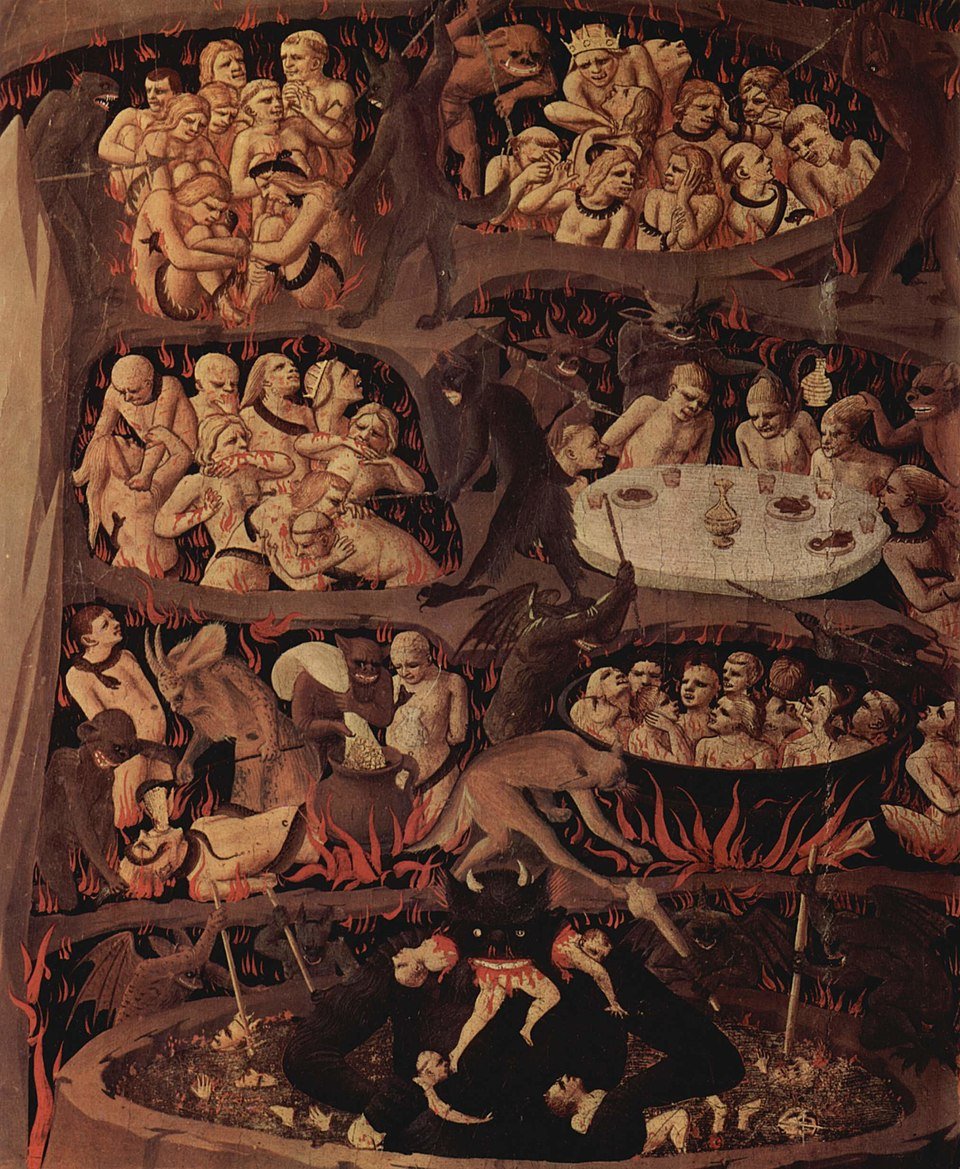
In “The Last Judgment,” Christ presides over the cosmic tribunal with the serenity of a judge who has no need to raise his voice. To his right, the blessed advance in orderly procession toward a garden of crystalline bliss. But to his left—always the sinister side in medieval iconography—Hell yawns open like a wound.
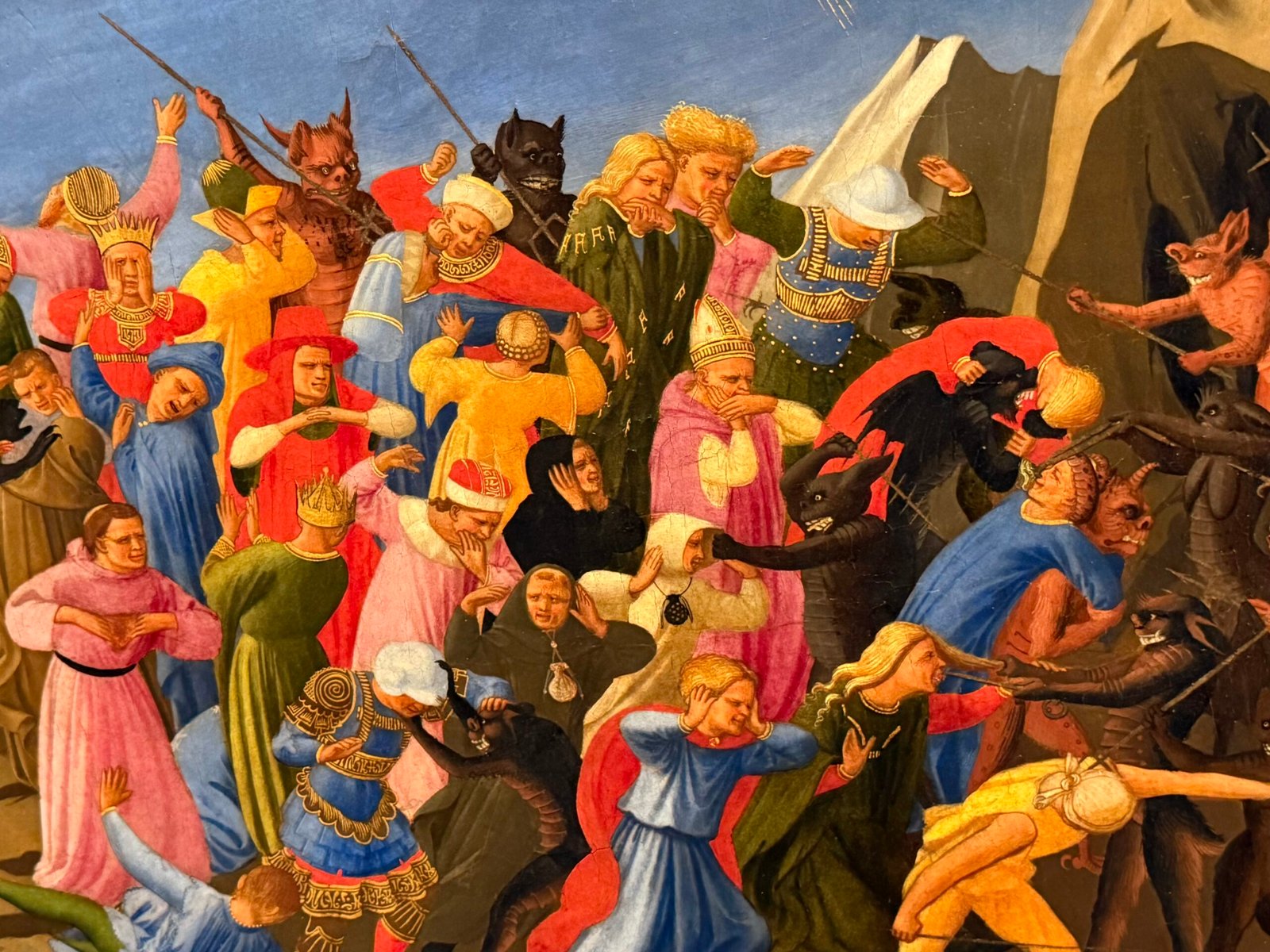
Angelico’s Hell is a vertical descent, a cascade of punishments rendered with a precision that belies the painter’s reputation for gentleness. At the top, demons seize the newly damned with a kind of bureaucratic efficiency, dragging them downward by hair, limbs, or sheer gravitational despair. Their bodies twist in attitudes of panic that feel almost modern in their psychological acuity.
Further down, the torments become more specific. A sinner is devoured by a horned beast whose expression is disturbingly neutral, as if performing a routine task. Another is bound to a wheel of fire, a motif that echoes both Dante’s contrapasso logic and Buffalmacco’s Camposanto inventions. In one of the most chilling vignettes, a demon calmly forces a soul into a furnace-like cavity, the flames licking upward with a strangely domestic glow—Hell as a perverse household.

At the very bottom sits the great demon, enthroned like a parody of Christ Pantocrator. His massive form consumes the damned whole, excreting them into a pit of renewed torment. The image is more than grotesque; it is theological satire, a reminder that sin inverts the order of creation.
Angelico’s palette, usually so airy, becomes a study in sulfurous reds and bruised blacks. Yet even here, the painter’s hand remains controlled, almost delicate. The horror is clarified but never sensationalized.
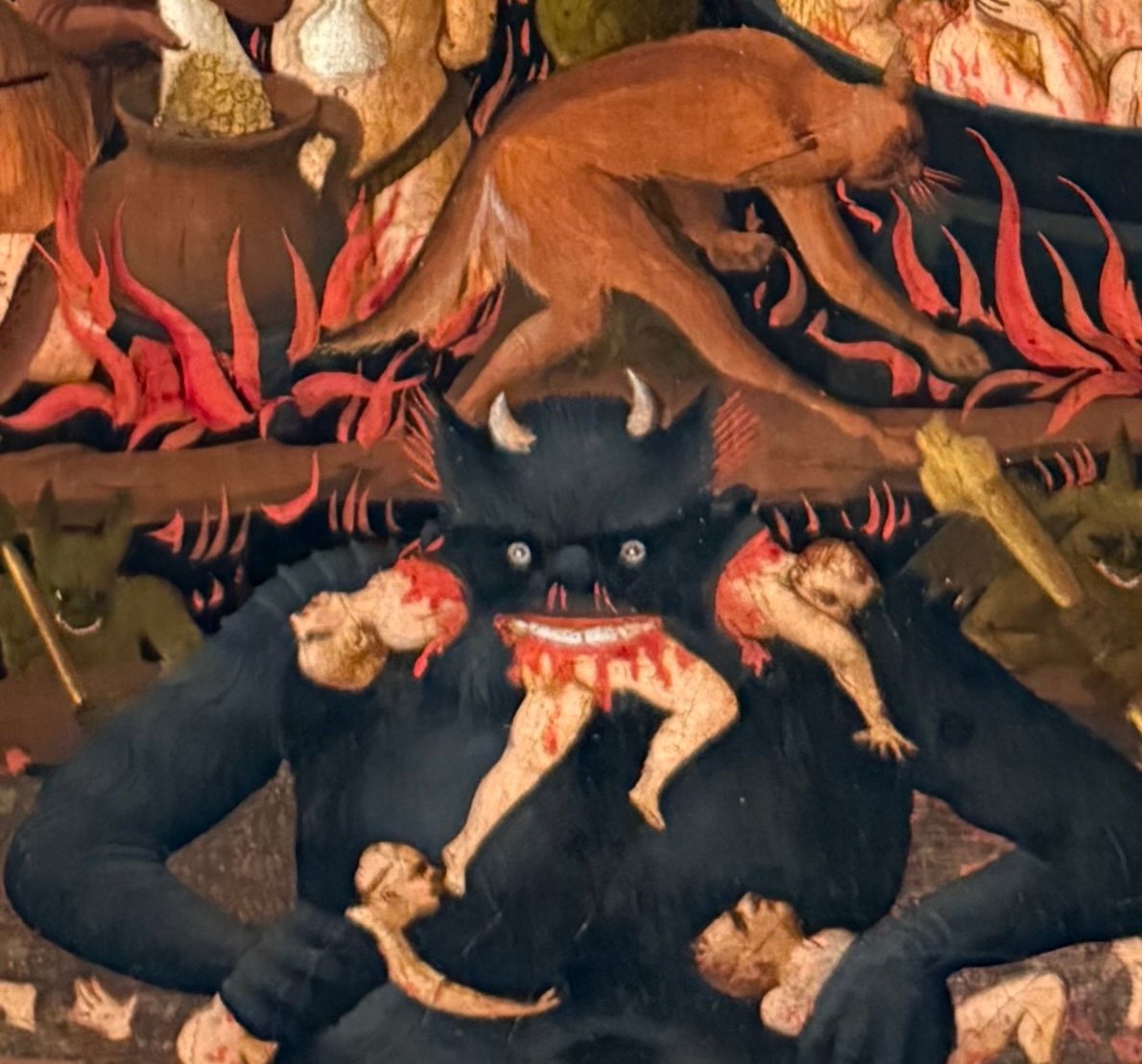
What makes this Hell so compelling—so worthy of the crowds that now gather before it—is its intellectual coherence. Angelico was painting at a moment when demonology was becoming systematized, when theologians and preachers were refining the taxonomy of devils, sins, and punishments. His panel is a visual summa, a Dominican attempt to map the moral universe with the same precision he brought to the folds of the Virgin’s mantle.
In a culture that passionately debated the afterlife’s geography, Angelico’s Hell offered viewers a kind of spiritual cartography. Today, it offers us a reminder that even the gentlest artists contain multitudes, and that the Renaissance imagination was as comfortable with terror as with grace.
The Florence exhibition is worth visiting for many reasons—the restored brilliance of the works, the rare loans, the chance to stand inches from works usually mediated by textbooks. But “The Last Judgment” alone justifies the pilgrimage. It reveals a Fra Angelico who is both the painter of angels and the chronicler of their fallen counterparts, a man who understood that salvation has no meaning without the shadow it overcomes.
In the crowded rooms of San Marco, amid the soft glow of gold leaf and the murmurs of visitors, Angelico’s Hell opens a window onto the 15th century’s demonology. Even in an age of radiant faith, the demons were never far away.
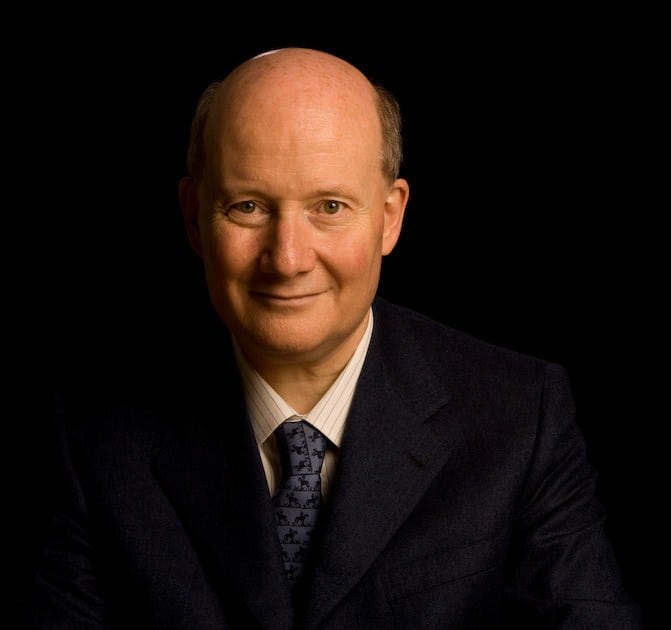
Massimo Introvigne (born June 14, 1955 in Rome) is an Italian sociologist of religions. He is the founder and managing director of the Center for Studies on New Religions (CESNUR), an international network of scholars who study new religious movements. Introvigne is the author of some 70 books and more than 100 articles in the field of sociology of religion. He was the main author of the Enciclopedia delle religioni in Italia (Encyclopedia of Religions in Italy). He is a member of the editorial board for the Interdisciplinary Journal of Research on Religion and of the executive board of University of Pennsylvania Press’ Nova Religio. From January 5 to December 31, 2011, he has served as the “Representative on combating racism, xenophobia and discrimination, with a special focus on discrimination against Christians and members of other religions” of the Organization for Security and Co-operation in Europe (OSCE). From 2012 to 2015 he served as chairperson of the Observatory of Religious Liberty, instituted by the Italian Ministry of Foreign Affairs in order to monitor problems of religious liberty on a worldwide scale.