The persecution of Tai Ji Men warrants at least an apology from Taiwan’s current government for past injustices that have so far been impossible to redress.
by Willy Fautré*

*A paper presented at the webinar “Entering the 30th Year of the Tai Ji Men Human Rights Case,” co-organized by CESNUR and Human Rights Without Frontiers on December 10, 2025, UN Human Rights Day, and in preparation for entering the 30th year of the Tai Ji Men case.
I have been involved in the fight against religious persecution worldwide for more than thirty years. Still, I have never come across a case other than the Tai Ji Men’s case in which a democratic State refuses to recognize that one of its administrations took a wrong decision three decades ago, even though a Supreme Court decision confirmed this.
The use of taxation as a tool of statecraft is as old as organized governance itself, to provide public services to its population. However, it can also be a weapon misused by the State to oppress and silence individuals, civic associations, human rights organizations, and religious communities. This usually happens in non-democratic countries that do not like to be criticized. This occurred at a time when Taiwan was not a democratic country. However, in cases of transition from a dictatorial to a democratic regime, the restoration of victims’ honor, apologies, and financial compensation are quickly put on the agenda of new governments under pressure from victims who have regained their freedom of expression. For almost thirty years, Taiwan has failed to translate the words of its Supreme Court into concrete acts of moral and material redress.
Discriminatory taxation, when employed to single out a spiritual movement for punitive treatment, functions as a mechanism of persecution. This form of coercion is both subtle and powerful: it allows authorities to suppress, marginalize, or even dismantle religious communities without resorting to overt violence. Examining the dynamics and consequences of such fiscal discrimination reveals how deeply taxation can shape religious freedom, social hierarchy, and state control.
Historically, taxation has frequently been wielded as an instrument to reinforce the dominance of a preferred religious or political order. One classic example is the specific tax called “jizya” imposed on non-Muslims in particular Islamic polities, which served not merely as a financial obligation but also as a marker of the “dhimmi” subordinate status.

Although interpretations and implementations varied widely across eras and regions of the world, the symbolism of fiscal inequality often signaled a larger system of discrimination. Similarly, early modern European states sometimes levied heavier fines, property fees, or marriage taxes on groups such as Jews, Anabaptists, and other dissenters to curtail their influence and integrate the population under an established church. In such contexts, discriminatory taxation functioned as a socially sanctioned method of exclusion.
The mechanisms of fiscal persecution usually fall into several identifiable patterns. First, authorities may impose higher tax rates or special levies on the targeted group. These may take the form of licensing requirements for worship spaces, increased fees on property or inheritance, or even mandatory contributions that do not apply to the majority religion. By raising the cost of participation in a minority faith, states can create economic pressure that discourages adherence and limits the community’s ability to sustain itself.
Second, governments may apply tax laws selectively, enforcing existing regulations more stringently against minority religions than against majority groups. In such cases, the discriminatory element lies not in the written law but in its administration—through arbitrary audits, inflated assessments, or punitive fines. Selective enforcement offers authorities plausible deniability, enabling them to pursue persecution under the guise of bureaucratic procedure.
Third, states may use taxation to restrict the organizational capacity of religious movements. By denying tax exemptions commonly granted to other religious groups, limiting charitable status, or imposing burdensome reporting requirements, governments can weaken a movement’s institutional foundations. This approach is especially effective against new or small communities whose survival depends heavily on financial stability and legal recognition.
As can be seen, taxation can be weaponized in many ways to discriminate against minority religious groups.
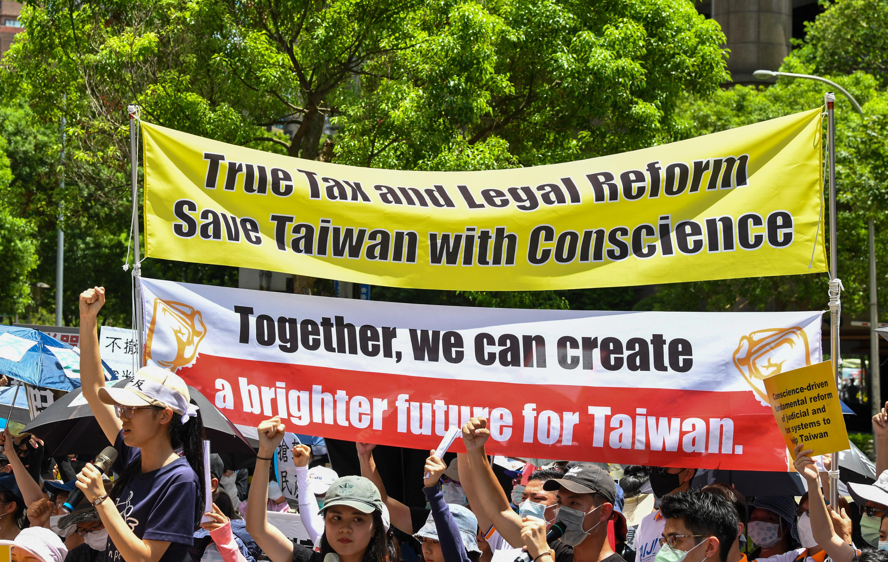
The effects of discriminatory taxation are profound and multifaceted. They work economically, socially, and even legally by undermining the principle of equal treatment under the law.
In conclusion, discriminatory taxation of religious movements represents a subtle yet potent form of persecution. By leveraging economic pressure and administrative mechanisms, states can suppress minority religions in ways that may appear lawful but are fundamentally coercive.
But in the Tai Ji Men case, even if the State did not manage to suppress it thanks to the resistance and the resilience of the Shifu, the Shimu, and all the dizi for almost thirty years, the movement has been sustainably stigmatized, its reputation has been at length damaged, its image has been publicly vandalized, and its honor has been tarnished.
The effective denial of justice in the Tai Ji Men case deserves at least an apology from Taiwan’s current government for past injustices committed by the State, which have so far been impossible to redress.

Willy Fautré, former chargé de mission at the Cabinet of the Belgian Ministry of Education and at the Belgian Parliament. He is the director of Human Rights Without Frontiers, an NGO based in Brussels that he founded in 1988. His organization defends human rights in general but also the rights of persons belonging to historical religions, non-traditional and new religious movements. It is apolitical and independent from any religion.
He has carried out fact-finding missions on human rights and religious freedom in more than 25 countries He is a lecturer in universities in the field of religious freedom and human rights. He has published many articles in university journals about relations between state and religions. He organizes conferences at the European Parliament, including on freedom of religion or belief in China. For years, he has developed religious freedom advocacy in European institutions, at the OSCE and at the UN.