If Taiwan’s authorities cannot ensure justice for a peaceful group like Tai Ji Men, less peaceful groups might resort to violence.
by Willy Fautré
*A paper presented at the webinar “No Peace Without Justice for Tai Ji Men,” co-organized by CESNUR and Human Rights Without Frontiers on September 21, 2025, United Nations International Day of Peace.

Peace is often portrayed as a lofty, almost utopian aspiration. Yet, history consistently shows peace is fragile and unsustainable when justice is absent.
The Tai Ji Men case is therefore a litmus test for Taiwan. If the authorities cannot guarantee that justice will be done in the case of this peaceful and law-abiding spiritual movement, less peaceful groups in the country may decide to resort to violence to resolve their disputes with the State. In this regard, Tai Ji Men contributes to social peace and stability. At the same time, the Taiwanese State risks jeopardizing them by not doing full justice to a movement teaching and preaching love and peace in society.
Tai Ji Men’s message is that sustainable peace requires a deliberate commitment to fairness, accountability, and inclusive governance.
In the domestic context, justice means more than the fair application of laws; it encompasses equality before the law, equitable access to opportunities, protection of rights, and dismantling systemic inequalities.
When justice is compromised, social peace quickly erodes, giving way to unrest, instability, and cycles of conflict.
Obviously, in the case of Tai Ji Men, the laws governing the country’s taxation system urgently need to be deeply reviewed. Indeed, they provide loopholes that allow manipulation, injustice, and corruption.
The Tai Ji Men case also highlights intentional discrimination by a state institution: the tax administration’s will to punish those who try to defend their rights and seek justice.
The leading actor behind the campaign targeting Tai Ji Men was Prosecutor Hou Kuan-Jen, who abused his mandate to persecute the spiritual movement founded by Dr. Hong. His behavior was investigated by the Control Yuan in 2002. The conclusion was that he had been guilty of eight major violations of the law concerning Tai Ji Men and other cases, which led to dramatic consequences. The “judicial Rambo,” as he was nicknamed, indicted about 200 defendants, including three prosecutors and 38 police officers, in the famous Zhou Ren-Shen case. Four of the accused police officers committed suicide during the investigation. Only eight out of 38 were convicted, and the highest-ranking police officers Prosecutor Hou had accused were declared innocent in their final court decisions.

Due to loopholes in the legislation that he could exploit, Prosecutor Hou was never prosecuted and remained unpunished—the result: judicial impunity.
It is tempting for governments to frame peace as a security matter—policing, surveillance, or military preparedness. However, peace enforced through coercion is temporary and brittle. True social peace arises from legitimacy, which depends on justice. For this reason, justice is a domestic responsibility that must be prioritized.
This includes:
- Legislative Justice: Passing laws that reflect fairness, equality, and human rights.
- Judicial Justice: Maintaining courts that operate independently and without corruption.
- Administrative Justice: Ensuring that government services are delivered equitably, without discrimination or favoritism.
When these functions are compromised—when laws are unjust, courts are biased, or government services are distributed unequally—social tensions rise. Citizens begin to view the state not as a protector but as a perpetrator of injustice, eroding the foundation of peace. This is the feeling of thousands of dizi. Fortunately for Taiwan, they are nonviolent, but the seeds of potential violence exist in other segments of society.
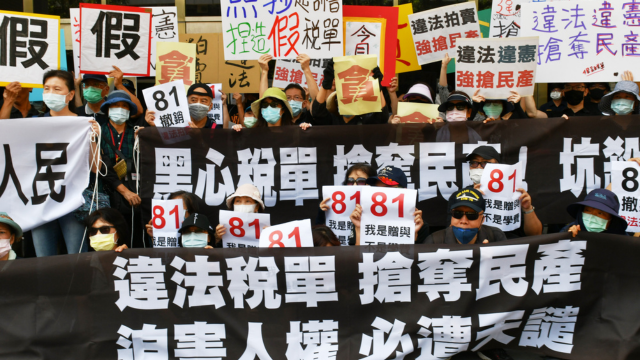
Therefore, it is urgent for the Taiwanese State to establish an inventory of dysfunctions in its taxation administration and work on deep reforms in legislative, judicial, and administrative justice. Tai Ji Men is ready to contribute to making the state healthier.

Willy Fautré, former chargé de mission at the Cabinet of the Belgian Ministry of Education and at the Belgian Parliament. He is the director of Human Rights Without Frontiers, an NGO based in Brussels that he founded in 1988. His organization defends human rights in general but also the rights of persons belonging to historical religions, non-traditional and new religious movements. It is apolitical and independent from any religion.
He has carried out fact-finding missions on human rights and religious freedom in more than 25 countries He is a lecturer in universities in the field of religious freedom and human rights. He has published many articles in university journals about relations between state and religions. He organizes conferences at the European Parliament, including on freedom of religion or belief in China. For years, he has developed religious freedom advocacy in European institutions, at the OSCE and at the UN.