The Court of Florence established the critical principle that calling a religious movement a “cult” (“setta” in Italian) is defamation in itself.
by Massimo Introvigne

On June 16, 2025, the Justice Court of Florence, in a decision whose grounds have now been published, sentenced the Italian Association of Cult Victims (AIVS), a leading Italian anti-cult association, and its two leaders, to pay Euro 35,247 to the Italian branch of Soka Gakkai for defamation.
They had settled a previous case with Soka Gakkai through a letter of apology in 2020. However, these anti-cultists are, by definition, incorrigible. In 2021, AIVS and its leaders attacked Soka Gakkai again through social media and interviews with Italian daily newspapers.
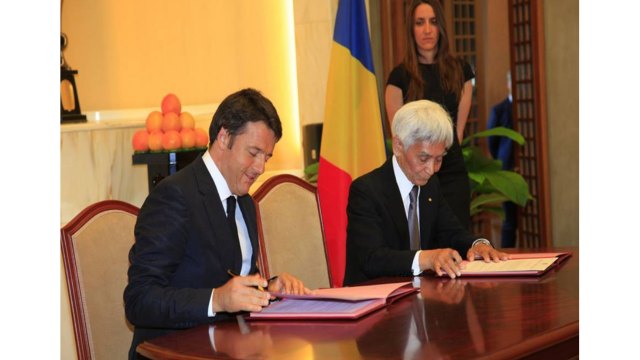
The Italian branch of Soka Gakkai entered into an “Intesa” (Agreement) with the Italian government in 2015. Intesa is the name given in Italy to concordats with religions other than the Roman Catholic Church (which has a “Concordato”). These agreements give religious organizations certain benefits, including allowing taxpayers to allocate a percentage of their taxes to them.
AIVS claimed that Soka Gakkai had obtained its “Intesa” by bribing then-Prime Minister Matteo Renzi. The court found the statement defamatory and noted no evidence of bribes. Additionally, proceedings for the “Intesa” were started before Renzi became Prime Minister. The MP who introduced the law ratifying the Intesa was part of the opposition to PM Renzi. The Parliament voted for the law unanimously, including groups and parties vehemently opposed to the Renzi government.
As a consequence of the “Intesa,” Soka Gakkai started receiving from the government its percentage of taxes based on the choices indicated by taxpayers on their tax returns. AIVS claimed that Soka Gakkai failed to report how this money was spent. The court characterized this as a blatant lie. Soka Gakkai reports regularly on how its “Intesa” money is spent. Its reports are even regarded as exemplary with respect to those of other religions.
Third, AIVS repeatedly called Soka Gakkai a “setta,” the Italian derogatory term to be translated as “cult” (not as “sect,” which has a different meaning in English). In an essential part of the decision, which may influence cases concerning other religious minorities, the court stated that “the term ‘setta’ (cult) has an undeniably negative connotation and is offensive in itself.” This aligns with the most recent case law of the European Court of Human Rights, which in 2022 in the case “Tonchev v. Bulgaria” ruled that the equivalent Bulgarian term “sekti” is inherently offensive.
The court considered AIVS’ criticism to be particularly vulgar. AIVS even posted a video on YouTube calling to burn the main object of devotion of Soka Gakkai, the “Gohonzon,” claiming it “brings bad luck.”
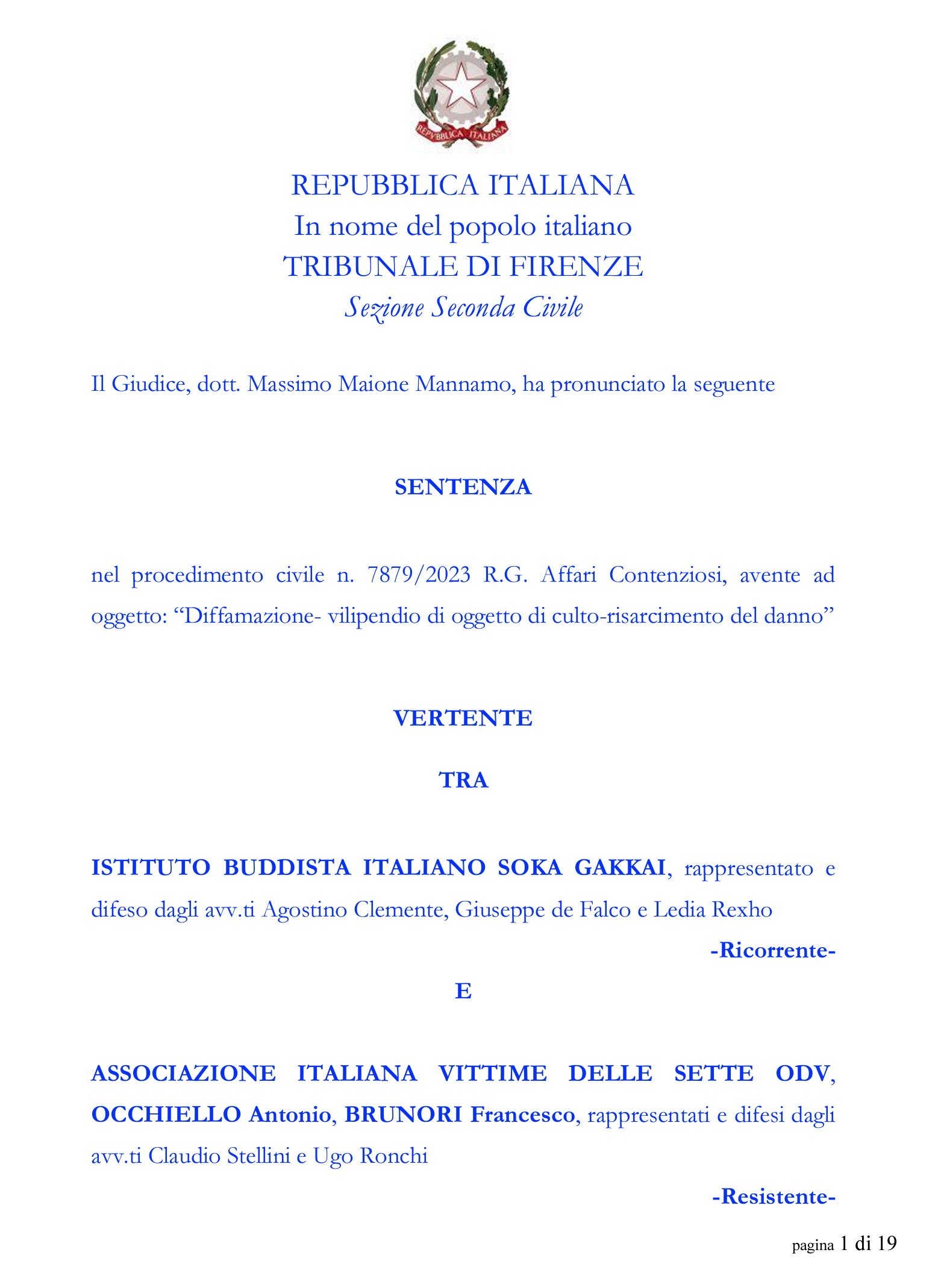
AIVS’ defense was that it did not invent its slander of Soka Gakkai but took it from foreign anti-cult sources. This defense saved AIVS from the interim measures Soka Gakkai had solicited in 2022 to stop the defamation campaign while the main proceedings were pending. The court “strongly disagrees” with this interim decision, reaffirming the principle that repeating defamation taken from another source is still defamation. The fact that the victim has not sued others who spread the defamation first does not authorize anybody to repeat their slanderous statements.
The significant amount AIVS should pay may perhaps persuade anti-cultists to be more cautious in the future. However, a leopard cannot change its spots.

Massimo Introvigne (born June 14, 1955 in Rome) is an Italian sociologist of religions. He is the founder and managing director of the Center for Studies on New Religions (CESNUR), an international network of scholars who study new religious movements. Introvigne is the author of some 70 books and more than 100 articles in the field of sociology of religion. He was the main author of the Enciclopedia delle religioni in Italia (Encyclopedia of Religions in Italy). He is a member of the editorial board for the Interdisciplinary Journal of Research on Religion and of the executive board of University of Pennsylvania Press’ Nova Religio. From January 5 to December 31, 2011, he has served as the “Representative on combating racism, xenophobia and discrimination, with a special focus on discrimination against Christians and members of other religions” of the Organization for Security and Co-operation in Europe (OSCE). From 2012 to 2015 he served as chairperson of the Observatory of Religious Liberty, instituted by the Italian Ministry of Foreign Affairs in order to monitor problems of religious liberty on a worldwide scale.