The Third World Conference on Religious Dialogue and Cooperation opened with a session discussing universal energy, conscience, freedom of belief, and the Tai Ji Men case.
by Massimo Introvigne

From June 23 to 27, 2025, the UNESCO Chair in Intercultural Studies and Research and the Center for Intercultural Studies of the Saints Cyril and Methodius University of Skopje, in collaboration with the Ministry of Culture of North Macedonia and various other institutions, hosted the Third World Conference on Religious Dialogue and Cooperation in Kruševo. These conferences in North Macedonia have established a scholarly tradition, enhanced by field excursions that allow participants to discover the nation’s rich religious heritage.
The conference’s first session, devoted to “Qigong and the Old-New Search for Universal Energy,” took place on June 24. Three Tai Ji Men dizi (disciples) participated in the session, which also discussed the Tai Ji Men case.
Lillian Lin, a graduate student in the Department of Artificial Intelligence Applications at Ming Chuan University in Taiwan, introduced a novel perspective on the session’s theme, Qigong. She discussed how Generation Z, as digital natives, is well-equipped to leverage artificial intelligence effectively. However, she noted that members of Generation Z are often “hyperconnected yet disconnected,” facing “loneliness and identity confusion.”

Lin started her Qi Gong practice with Tai Ji Men at ten. She gained more than just a technique; she understood that Dr. Hong Tao-Tze, the Shifu (Grand Master) of Tai Ji Men, primarily teaches the importance of conscience. Lin believes this principle is also crucial for artificial intelligence, which should be used with conscience and can lead to severe misuse if not. She also mentioned the fabricated Tai Ji Men case to illustrate how a lack of conscience among those in power can allow a “deep-seated darkness” to emerge, resulting in significant and unnecessary suffering.
Rosita Šorytė, associate editor of “Bitter Winter,” focused on Reiki, which shares the same principle as Qigong: mobilizing the universal energy known as Ki or Qi. She noted that groups practicing Qigong and Reiki have often faced slander and been labeled as forms of “spiritual fraud” or “cults,” similar to the media campaign that occurred in the early years of the Tai Ji Men case. She highlighted the notion of Qi in Taoism as the original substance of the universe that ensures the harmony of Yin and Yang, a concept also present in Tai Ji Men.

She then explored the history of Reiki, a technique that originated in the 1920s in Tokyo with Mikao Usui but eventually became better known in the West than in Japan, thanks to the efforts of a Japanese American woman named Hawayo Takata. Today, there may be a million Reiki practitioners worldwide, most outside of Japan.
Reiki and Qigong, Šorytė said, do not just teach techniques; they also emphasize self-cultivation and encourage creative and independent thinking. This may seem suspicious to greedy politicians and obtuse bureaucrats, as evidenced by the misdeeds of those who fabricated the Tai Ji Men case in Taiwan.
Jason Cherng, a former visiting researcher at the Massachusetts Institute of Technology, returned to the theme of conscience as a universal foundation, central in Tai Ji Men and present in all the world’s major religious traditions. Tai Ji Men, he noted, refers to the harmony between Ti, the undivided original essence, and Yong, the dynamic interplay of Yin and Yang.
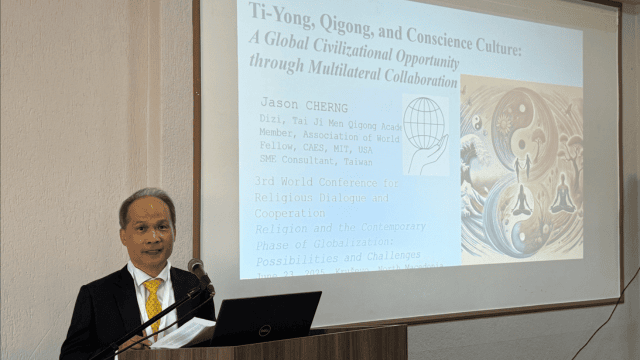
Dr. Hong, Cherng explained, also promotes a “conscience culture,” which offers hope in times of crisis and resilience when we face injustice. Tai Ji Men has direct experience of injustice, he said, as it had to confront a fabricated legal and tax case for 29 years. Rather than being a cause for despair, Cherng stated that Tai Ji Men viewed this persecution as an opportunity to launch a national conscience-driven movement advocating for tax and legal reform and promoting justice and freedom of religion or belief. Cherng concluded by summarizing the current ethical imperative for all those who prioritize conscience in three aims: “Reclaim conscience. Reform systems. Renew civilization.”
Aurora Li, a graduate student at National Taiwan Normal University in Taipei, shared a personal testimony about Tai Ji Men’s global promotion of peace, love, and conscience. She highlighted the role of the Bell of World Peace and Love, which Dr. Hong has tirelessly invited heads of state and world leaders to ring for twenty-five years. To date, 637 leaders have rung it, including eighty heads of state and fifteen Nobel Prize laureates.
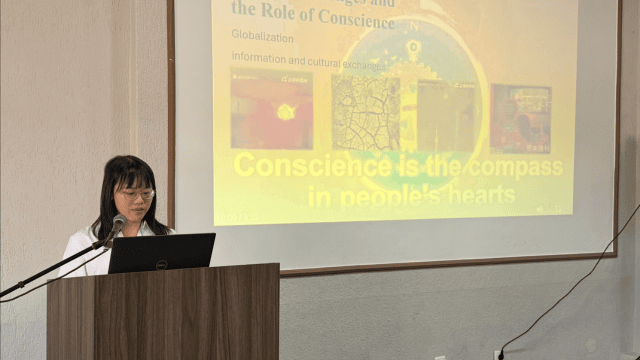
Li mentioned Dr. Hong’s proposal to establish a nonsectarian World Prayer Day, urging humanity to return to a pure heart and pray with conscience. While participating in international cultural tours, Li performed the fan dance, symbolizing the harmony between Yin and Yang and the awakening of conscience.
Li emphasized that enduring patience and cultivating harmony were necessary when Dizi confronted the unjust and fabricated Tai Ji Men case. She reviewed its main features and urged Taiwan’s government to resolve the case and restore truth and justice.
I wrapped up the session by presenting a comparative analysis of the repression faced by Tai Ji Men in Taiwan, drawing parallels with various Qigong movements that have been persecuted in Mainland China.
I brought up cases such as Zhonggong, Riyue Qigong, Xiang Gong, Bodhi Gong, and Human Universal Science, questioning why some Qigong groups faced persecution while others were accepted.

A likely explanation, aligning with other papers presented in the session, suggests that in both the People’s Republic of China and democratic Taiwan, politicians tend to disfavor movements they cannot control, especially those advocating strongly independent positions. Although this independent thinking is crucial and beneficial for society, it triggers fear and suspicion among authoritarian politicians and corrupt bureaucrats.

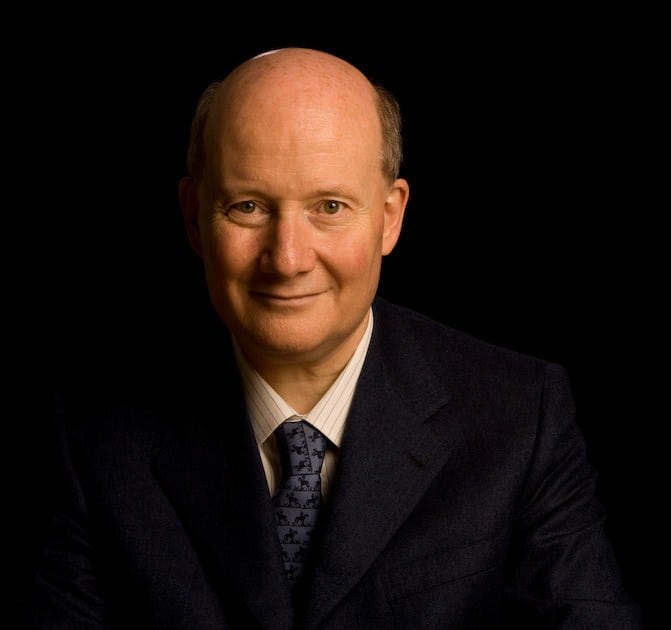
Massimo Introvigne (born June 14, 1955 in Rome) is an Italian sociologist of religions. He is the founder and managing director of the Center for Studies on New Religions (CESNUR), an international network of scholars who study new religious movements. Introvigne is the author of some 70 books and more than 100 articles in the field of sociology of religion. He was the main author of the Enciclopedia delle religioni in Italia (Encyclopedia of Religions in Italy). He is a member of the editorial board for the Interdisciplinary Journal of Research on Religion and of the executive board of University of Pennsylvania Press’ Nova Religio. From January 5 to December 31, 2011, he has served as the “Representative on combating racism, xenophobia and discrimination, with a special focus on discrimination against Christians and members of other religions” of the Organization for Security and Co-operation in Europe (OSCE). From 2012 to 2015 he served as chairperson of the Observatory of Religious Liberty, instituted by the Italian Ministry of Foreign Affairs in order to monitor problems of religious liberty on a worldwide scale.