“The Path” remains one of the most beloved Theosophical icons. Some of Machell’s other Theosophical works deserve attention, too.
by Massimo Introvigne
Article 3 of 3. Read article 1 and article 2.

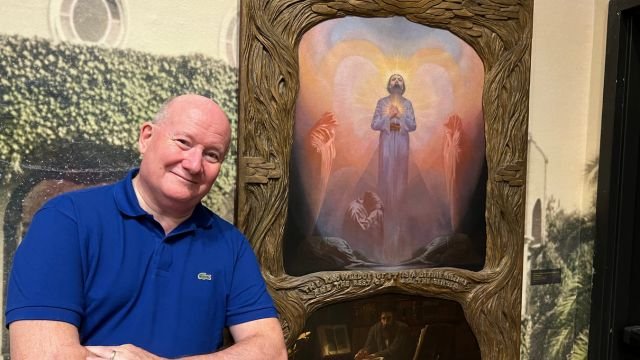
Machell’s Theosophical didactic art triumphed in “The Path.” According to some sources, the painting dates back to 1895, and Machell exhibited it in various European locations before bringing it to Point Loma. Here, it became a prominent symbol of Theosophy. “Path” had already been the title of Judge’s magazine between 1886 and 1896, but that magazine was subsequently called “Theosophy” and “Universal Brotherhood.” It became “The Universal Brotherhood Path” in 1900. In 1903, it was absorbed into the “New Century Path,” later “Century Path,” and “The Theosophical Path.” In many, if not most, of these Point Loma publications, Machell’s painting was often reproduced on the cover and commented upon. It was also widely used by other branches of the Theosophical Society and is considered by many to be the Theosophical painting par excellence.
In 1919, Machell authorized the Leeds Lodge of the Theosophical Society to produce a stained glass version to honor those dead in World War I, where the artist had lost his elder son. The Leeds Lodge had been founded by Alfred R. Orage (1873–1934), mostly known for his association with George Ivanovitch Gurdjieff (1866–1949) and Peter Demianovich Ouspensky (1878–1947), and—rather than with Tingley—was associated with Annie Besant and the Theosophical Society headquartered in Adyar. The stained glass window was realized by John James Kayll (1850–1934) and his firm Kayll & Reed, well–known for their church windows. It is in the library of the Leeds Theosophical Society, 12 Queens Square, Leeds, while the painting was in the (now destroyed) headquarters of the Tingley branch in Pasadena.
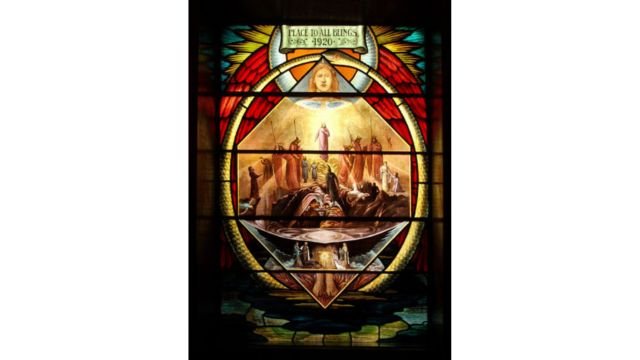
Machell described the complicated symbols of “The Path,” “the way by which the human soul must pass in its evolution to full spiritual self-consciousness.” “Self-consciousness, the goal, is symbolized by the great figure whose head in the upper triangle is lost in the glory of the Sun above, and whose feet are in the lower triangle in the waters of Space, symbolizing Spirit and Matter. His wings fill the middle region representing the motion or pulsation of cosmic life, while within the octagon are displayed the various planes of consciousness through which humanity must rise to attain to perfect Manhood.” At the top, under the head of the “great figure,” is “a winged Isis, the Mother or Oversoul, whose wings veil the face of the Supreme from those below.”

Under Isis, “there is a circle dimly seen of celestial figures who hail with joy the triumph of a new initiate, one who has reached to the heart of the Supreme.” The successful initiate “looks back with compassion upon all who are still wandering below and turns to go down again to their help as a Savior of Men.”
Below him is “the red ring of the guardians who strike down those who have not the ‘password’ symbolized by the white flame floating over the head of the purified aspirant.” At the feet of the initiate, “two children, representing purity, pass up unchallenged.” In the center of the picture, we see “a warrior who has slain the dragon of illusion, the dragon of the lower self, and is now prepared to cross the gulf by using the body of the dragon as his bridge.”
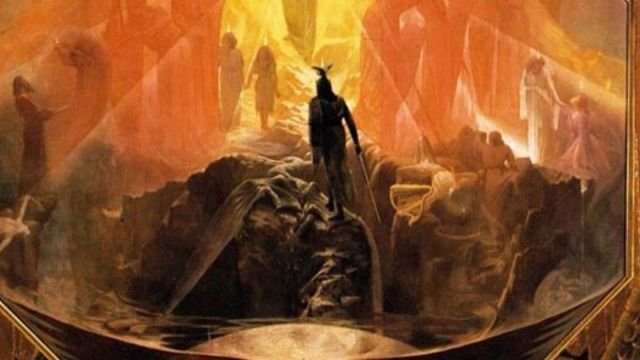
On the right side of the painting, “two women climb, one helped by the other whose robe is white and whose flame burns bright.” Near them, a man “climbs from the darkness; he has money—bags hung at his belt but no flame above his head, and already the spear of a guardian of the fire is poised above him, ready to strike the unworthy in his hour of triumph.”
Next to this man, towards the center of the painting, “is a bard whose flame is veiled by a red cloud (passion) and who lies prone, struck down by a guardian’s spear; but as he lies dying, a ray from the heart of the Supreme reaches him as a promise of future triumph in a later life.”

On the other side, on the left of the painting, “is a student of magic, following the light from a crown (ambition) held aloft by a floating figure who has led him to the edge of the precipice over which for him there is no bridge; he holds his book of ritual and thinks the light of the dazzling crown comes from the Supreme, but the chasm awaits its victim.” By his side, on the extreme left of the painting, “his faithful follower falls unnoticed by him, but a ray from the heart of the Supreme falls upon her also, the reward of selfless devotion, even in a bad cause.”

Lower still, we see “the underworld,” where “a child stands beneath the wings of the foster mother (material Nature) and receives the equipment of the Knight, symbols of the powers of the Soul, the sword of power, the spear of will, the helmet of knowledge, and the coat of mail, the links of which are made of past experiences.”

Hardly visible in any photographic reproduction, an inscription on a wooden disk attached to the lower left corner of the painting carries the following verse: “If Wisdom thou wouldst gain, Be Strong, Be Bold, Be Merciful. But when thou hast attained, then let Compassion speak. Renounce the Goal, Return to Earth, A Saviour of mankind.” This verse and the initiate’s compassion towards those still to ascend epitomize the Blavatskyan idea that the Masters do not simply enjoy their status but remain on Earth to help humanity on the Path.
In Kirkley’s feminist interpretation, “the dominant human figure in the painting is the male seeker in the center, eyes uplifted toward the light. The human females are relegated to the right and left edges,” meaning that “males are the archetypical seekers and that they stand the greatest chance of achieving success in their quest.” On the other hand, the male seeker ascends towards a female divinity, Isis. But the goddess “is indistinct, in the background, and oddly asexual. If Machell did not explain in his notes that this was Isis, it would be difficult to tell if the figure was male or female. At first glance, actually, the figure resembles stereotypical depictions of Christ (except for the wings).” Whether Theosophists noticed these gender problems with the painting in Lomaland or Leeds in the early decades of the 20th century remains doubtful.
Didacticism in Machell’s work is also evidenced in his treatment of the Grail as a Theosophical symbol in “The Holy Grail” and “The Castle of the Grail.” The artist explained that the real Castle of the Grail is the human body: “Man’s body is the castle of the ‘Holy Grail,’ with its foundations in the shadows of earth, but in its highest regions it is a temple of spiritual light.” The theme of the Grail returns in “Parsifal,” portraying the hero while he, “resisting the seduction of Kundry (the lower nature), breaks the power of the magician Klingsor (the delusive force of evil) and liberates the soul from the prison of the body. Kundry dies at the feet of her redeemer, the higher self.” This is a Theosophical interpretation of the story narrated in the opera “Parsifal” by Richard Wagner (1813–1883), a lifelong interest of Machell.

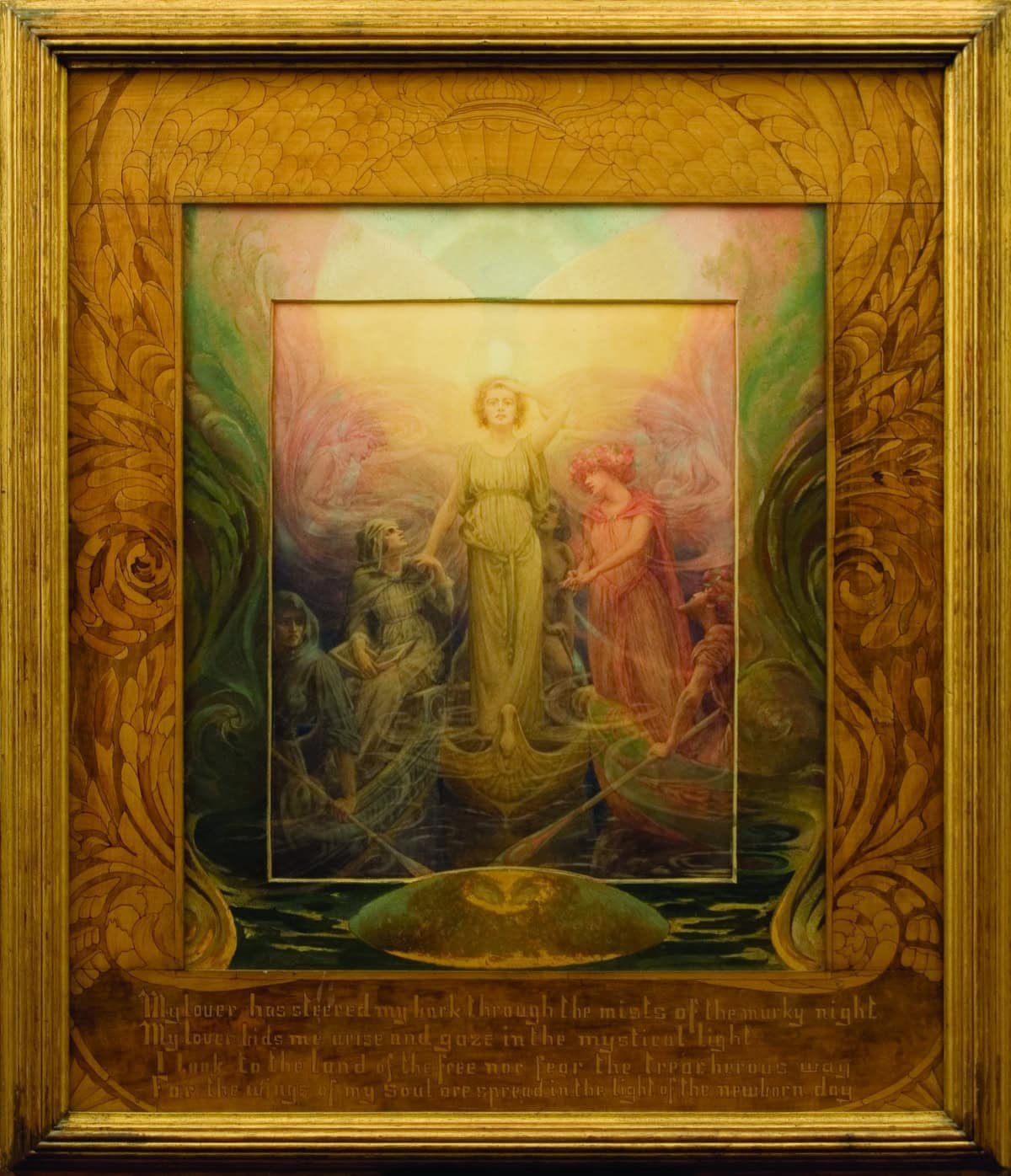
In “Vision of the New Day,” Machell elaborated on the Path, where “the enlightened soul, the seer of Truth” should avoid being deluded by the dual lure of learning and pleasure, and “go straight to the appointed goal led by the light of the New Day.” And in “Love, the Lord of Life and Death”— whose general theme and central part show influences of Watts—the painter represents death as “but a step in evolution, a going forth. At birth, a soul comes forth from the region of pure light to cross the Dark River and bring to earth some knowledge of the true and beautiful that lies beyond.”
In 1908, the poet and novelist Kenneth Vennor Morris (1879-1937), a native of Wales and a member of the Dublin Lodge of the Theosophical Society, where he befriended fellow Theosophists William Butler Yeats (1865–1939) and George William Russell, “AE,” decided to move to Point Loma and join Lomaland. He started a long and productive association with Machell, whom Morris had already known in Britain.
Morris and Machell wrote together pieces of theater to be represented in the Lomaland Greek Theatre, including “The Never-Ending Wrong” and “The Night of Calangauaf,” which Morris affectionately published after Machell’s death. Machell, who had already published with Tingley’s press an illustrated small book for children, “The Coming of the King,” employed his old skill as a book illustrator to produce in 1914 with Morris, who wrote under the Welsh version of his name, Cenydd Morus, “The Fates of the Princes of Dyfed,” a retelling of part of the Medieval Welsh epic “Mabinogion” whose success owed as much to the illustrations as it did to the text.

Morris never went out of fashion in Theosophical circles. He became popular among fans of fantasy literature in general when one popular writer of this genre, Ursula K. Le Guin (1929–2018), called attention to him and expressed the opinion that the Theosophical Welsh novelist was “one of the three master stylists” of fantasy in the 20th century, together with John Ronald Reuel Tolkien (1892–1973) and Eric Rücker Eddison (1882–1945).
After long years of illness, Machell died in Lomaland on October 9, 1927. Morris had just written a tribute to him in “The Theosophical Path,” which served as an obituary. The following year, he published a poem about his deceased friend, expanding on the sonnet he read at the memorial service held in Lomaland’s Temple of Peace on October 10, 1927, where Tingley also spoke. Lomaland students sang “The Hills of Cærsalem,” a Welsh air evoking Morris’s enchanted world, the “Pilgrims’ Chorus” from “Tannhäuser,” honoring Machell’s passion for Wagner, and “Snow” by English composer Sir Richard William Elgar (1857–1934), described as “the song he [Machell] loved best.” The same program was repeated at the chapel of the Benbough Funeral Parlors, with the addition of “Still as the Night” by the German pianist–composer Carl Bohm (1844–1920), and of verses composed by Machell himself. The painter’s body was then cremated.
While fantasy literature grew increasingly fashionable after Morris’ death, the same cannot be said for didactic art such as Machell’s. Few now remember the once popular artist outside the Tingley branch of the Theosophical Society, although many Theosophists would recognize the image of “The Path.” Machell shared the fate of other members of the Lomaland Art Colony: “It is surprising,” historian Bruce Kamerling wrote, “to check through biographical reference works that trace the careers of some of the more important Lomaland artists and have them abruptly end when the artist moved to Point Loma, as if they had disappeared from the face of the earth.”
Machell knew his Theosophical art was too complicated to be widely appreciated or understood. He connected the frequent “experience of art that is unappreciated by the people in whose midst it appears” with Theosophical theories on reincarnation. Often, an artist “may appear in a nation and display a degree of progress far in advance of his fellows, who are also in varying stages of their long evolution. The progressed soul incarnates perhaps in a body just like those of the rest of the race, because it cannot get a better; and so it is not at once recognized as an older soul.” It may also happen, Machell wrote, that, “for want of right education, the man himself may be unable to account for the difference between himself and his fellows of which he is conscious; and so, being unaware of his own inherent divinity and of his relation to his fellows, he may not recognize his responsibility to them as a natural leader.” This responsibility was one Machell tried to assume fully.
Had he remained in London, Machell would have maintained a fame as a solid portrait painter in the Watts tradition, perhaps with some limited excursion to symbolism and allegory. When he consciously decided to start a new life in Point Loma, he believed he was expressing his fundamental loyalty to that decisive encounter with Madame Blavatsky, a woman, he wrote, who “in spite of the constant failure of her professed followers to understand her, and the unscrupulous misrepresentations of avowed enemies, […] never lost faith in the cause, nor wavered in her absolute devotion to the task she had undertaken.”
As for his Lomaland friends, they no doubt shared Morris’ poetic tribute and farewell:
“Machell […]. Throned in the Deathless. For though you wing your way
Through this kind Universe now made your shrine
To the ultimate Fairylands of Wizard Peace,
Or but postpone a little while the day. –
Of your return, we know that, being divine,
Neither our love for you, nor your work, can cease.”
Massimo Introvigne (born June 14, 1955 in Rome) is an Italian sociologist of religions. He is the founder and managing director of the Center for Studies on New Religions (CESNUR), an international network of scholars who study new religious movements. Introvigne is the author of some 70 books and more than 100 articles in the field of sociology of religion. He was the main author of the Enciclopedia delle religioni in Italia (Encyclopedia of Religions in Italy). He is a member of the editorial board for the Interdisciplinary Journal of Research on Religion and of the executive board of University of Pennsylvania Press’ Nova Religio. From January 5 to December 31, 2011, he has served as the “Representative on combating racism, xenophobia and discrimination, with a special focus on discrimination against Christians and members of other religions” of the Organization for Security and Co-operation in Europe (OSCE). From 2012 to 2015 he served as chairperson of the Observatory of Religious Liberty, instituted by the Italian Ministry of Foreign Affairs in order to monitor problems of religious liberty on a worldwide scale.