Exploring the vital role of conscience in media reform and the pursuit of a fairer society based on religious liberty for all.
by Marco Respinti
*Conclusions of the international webinar “The Media Impact on FoRB and the Tai Ji Men Case,” co-organized by CESNUR and Human Rights Without Frontiers on May 8, 2025, after the United Nations World Press Freedom Day, celebrated on May 3.

Today, our new webinar in this important series dedicated to the “Tai Ji Men case” takes place after the World Press Freedom Day, which the United Nations General Assembly proclaimed in December 1993. The key principle of this day of observance is the right of every individual to receive and share truthful and impartial information. Indeed, free access to information is a cornerstone of a just society.
As usual, we connect the broader significance of the international days proclaimed by the UN to the specific case of Tai Ji Men, which, in the Republic of China (Taiwan), stands at the center of a shocking violation of freedom of religion or belief. For today’s reflection, I would like to draw upon one of the most well-known fables in human history. It comes from the ancient Greek writer Aesop (620–564 BCE) and is entitled “The Boy Who Cried Wolf.” Indeed, the English expression “crying wolf” comes from this famous fable.
A young and mischievous shepherd spent his time fooling the villagers by repeatedly tricking them into thinking that a wolf was about to attack their flocks—only to reveal, each time, that it was just a joke. One day, as he tries to play the same trick again, a real wolf suddenly appears. Panicked and hurried, he runs to the villagers to sound the alarm. But this time, convinced he is joking again, they ignore him. As a result, the wolf attacks and devours all the villagers’ sheep, including the playful shepherd’s flock.
The moral of this fable is clear and universal: if you play with fire, you will eventually get burned. There is only so much deception people are willing to tolerate—when that limit is exceeded, reality takes its revenge. The warning, of course, is not only to avoid lying, but also not to push people to the point of exasperation. The connection between Aesop’s fable and the world of information and media is more than clear.
As deeply convinced as I am that fables and myths hold vivid and timeless lessons about reality, I find that Aesop also teaches us that truth can be simple. Perhaps the snobbish culture of our self-styled sophisticated world would dismiss “The Boy Who Cried Wolf” as too simplistic to deserve attention—a childish warning only. But the opposite is true: truth is simple.
Aesop also delivers a hard truth to the media—one they often forget. Closely reading his fable “The Boy Who Cried Wolf” should be a professional requirement for anyone practicing journalism or aspiring to do so.
Aesop reminds us that journalists and the media should avoid creating and spreading false news, alarmist language, and sensationalization of events. If they do not, the consequences are inevitable: when people finally uncover the truth beneath layers of flashy headlines, front-page exaggerations, and bombastic reports, they will lose trust and turn away from the media altogether.
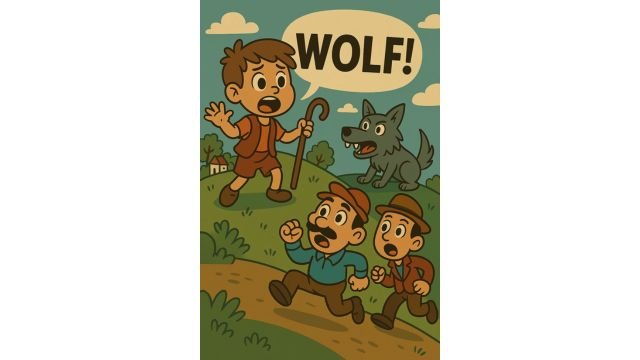
Some later English versions of Aesop’s fable “The Boy Who Cried Wolf” include a darker ending, reminiscent of the grim original tales by the Brothers Grimm or the cynical 1845 illustrated children’s book Der Struwwelpeter by German psychiatrist and writer Heinrich Hoffmann (1809–1894), where stories rarely end happily, and characters often meet harsh fates. In these later retellings, not only are the village’s sheep devoured by the real wolf no one believed in, but the mischievous shepherd is also eaten. From fable to reality, if the media continue deceiving the public, they too may eventually fall victim to their own hubris.
Let us consider the Tai Ji Men case. The power of the media is immense—in this case, as in many others. Media influence customs and behavior, shape markets, and impact politics. The right word at the right time can do great good—just as the wrong word can cause immense harm. More importantly, the harm done often outweighs any good that may later come. Due to the dynamics of the human psyche, good is quickly forgotten, while a lie or a libel tends to persist—no matter how much fact-checking or debunking is done later.
This series of webinars and all the related materials it has generated stand as proof of this. Over the years, scholars, human rights activists, and witnesses have gathered a vast body of documentation and analysis proving the blatant injustice that Tai Ji Men has endured since 1996—despite having been repeatedly declared innocent by every level of the Taiwanese judiciary, including the Supreme Court. This material is a gold mine for the media, offering valuable resources to support the pursuit of justice. Yet, many media outlets prefer the easier path of repeating narratives requiring less scrutiny and effort, amplifying falsehoods. Of course, not all media professionals fall into this category, but the amount of misinformation published almost daily—especially on religion, spirituality, and religious freedom—makes it clear that truly responsible journalism is still the exception rather than the rule.
This, of course, concerns Tai Ji Men, which has been burdened for years by unprofessional work carried out by unscrupulous journalists and reporters. However, it also applies to many other groups targeted by injustice and slandered by the media worldwide. Take, for example, the case of the Jehovah’s Witnesses, or the Family Federation for World Peace and Unification in Japan, which has recently faced an intensification of hostile treatment. A closer examination of these cases reveals that some hostile politicians, lawyers, professional “anti-cult” activists, and sometimes rival religious groups drive the smear campaigns against them. However, in every instance, the significant responsibility of the media is also clear.
The media bear a significant responsibility at an educational level. People rely on them, and the media have the power to mislead easily.
At this point, one might be tempted to conclude that the media are merely an industry of evil, conspiring against truth to undermine society. But that is not the case. The media are simply one aspect of reality in which human beings operate. If the media are flawed and provide poor service, the responsibility lies with the people behind and within them. If the media have become one of the most troubling features of contemporary society, it is because those working in the media are giving poor testimony to their own humanity. In other words, if the media are in decline, it is because people are in decline. If the media have lost their sense of truth, it is because we have lost ours.

Here, Tai Ji Men, a striking victim of the injustice inflicted on society by decadent media, has something important to say. All Tai Ji Men’s teachings emphasize the role of conscience. For Tai Ji Men, conscience is the first and last bastion of truth, and regaining a sense of one’s conscience is, for Tai Ji Men, the key to reforming and improving society.
The world will have bad media and worse information if people find it more rewarding and easier to repeat lies than to seek the truth. The world will continue to suffer this dreadful situation that undermines fundamental human rights, such as freedom of religion, belief, or creed, until human beings regain a deep sense of their true selves. Conscience is the key to this different future. The media will not be reformed until the human beings working within them are reformed. Human beings, not structures, are the real resource.
Tai Ji Men understands this so well that it focuses its entire mission on self-cultivation and on reminding us that conscience is our inner moral compass, and we should learn to listen to it. Conscience is, of course, the remedy to the lies told by the shepherd in Aesop’s fable. It is also the antidote to the wolf that devours all things and human beings, liars included. The media can become the mouthpiece of conscience if reformed human beings take their place within them.

Marco Respinti is an Italian professional journalist, member of the International Federation of Journalists (IFJ), author, translator, and lecturer. He has contributed and contributes to several journals and magazines both in print and online, both in Italy and abroad. Author of books and chapter in books, he has translated and/or edited works by, among others, Edmund Burke, Charles Dickens, T.S. Eliot, Russell Kirk, J.R.R. Tolkien, Régine Pernoud and Gustave Thibon. A Senior fellow at the Russell Kirk Center for Cultural Renewal (a non-partisan, non-profit U.S. educational organization based in Mecosta, Michigan), he is also a founding member as well as a member of the Advisory Council of the Center for European Renewal (a non-profit, non-partisan pan-European educational organization based in The Hague, The Netherlands). A member of the Advisory Council of the European Federation for Freedom of Belief, in December 2022, the Universal Peace Federation bestowed on him, among others, the title of Ambassador of Peace. From February 2018 to December 2022, he has been the Editor-in-Chief of International Family News. He serves as Director-in-Charge of the academic publication The Journal of CESNUR and Bitter Winter: A Magazine on Religious Liberty and Human Rights.