On May 15, 2024, the Grand Master of Tai Ji Men met the leader of the Roman Catholic Church in St. Peter’s—a last and lasting moment.
by Marco Respinti
Everyone cheers the Pope of the Catholic Church; everyone greets him, and always has kind words for him. No matter what religion one belongs to—if any—the Pope is universally regarded as a high moral authority, if not the highest. Respect and gratitude for him come from people of all philosophical persuasions and political backgrounds. Of course, there are also many critical voices, even harsh ones. However, criticism is typically expressed at a distance and often indirectly through the media. When confronted with the Pope in person, it is far more the exception than the rule for critics to speak openly to him.
This may conceal some form of shyness, if not cowardice, but delving deeper into the matter would be ungenerous. The Pope evokes an entirely different sentiment in those who meet him. It is as if something existed beyond words and thoughts, beyond both criticism and praise. It is a spiritual force that touches every heart, regardless of background. Of course, Roman Catholics attribute this to the Pope’s special, divinely originated charisma as the Vicar of Christ and the head of his supernatural institution, the Church. But even non-Catholics agree that “there is something special there.” This is the secret of the Popes.
Pope Francis (1936‒2025), the 266th Pontiff of the Roman Catholic Church, added a second personal secret to this secret of the Popes. Typically, for critics and opponents, the living and reigning Pope is always the “bad” Pope, deserving of disapproval and even condemnation for his theological teachings that go against the tide, for the moral stances of the Church that he embodies and defends, which are considered outdated and controversial, or for his political strategy, which differs from what the rulers of the Earth may desire. While the living and reigning Pope is seen as the “bad” Pope, the “good” Popes, for critics, are always those of the past, the ones long dead. This is a way to resolve contradictions through bias and even slander, forgetting that the “good” Pope, when alive, had once been considered the “bad” Pope. Well, the secret of Pope Francis is that he broke this caricatural rhetoric, becoming the “good” Pope while still alive. This is the truth that runs through Massimo Introvigne’s 2013 book, “Il segreto di Papa Francesco” (“Pope Francis’ secret”).
There is a superficial and even obnoxious way of understanding this “secret of Francis.” It is a cavalier attitude that sees no differences and ignore problems—a foggy day in which all cows are white, to reverse the famous saying, “the night in which all cows are black,” paraphrased from German philosopher Georg Wilhelm Friedrich Hegel’s (1770–1831) 1807 “Phänomenologie des Geistes” (“The Phenomenology of Spirit”). But another understanding is possible. It is to appreciate that the missionary approach of Pope Francis has found a way to the hearts and minds of even ideologically distant people, convincing them of the depth of his message, which spoke to Catholics and non-Catholics. Thus, the secret of the Popes that fascinates many took shape in the secret of Francis— or, to put it another way, Francis made it possible for the reigning Pope to be perceived in his truth, not only through bias. Here, the secret begins to transform into a miracle.
I sincerely don’t know how much of this applies to the sentiment of Dr. Hong Tao-Tze and his disciples (“dizi”) when they met Pope Francis on May 15, 2024. Dr. Hong is the Grand Master of Tai Ji Men, a menpai (similar to a school) of martial arts, Qigong, and self-cultivation that emphasizes the centrality of conscience in all human endeavors and actively works for peace and mutual understanding worldwide. Readers of “Bitter Winter” are likely familiar with Tai Ji Men and its ordeal as a group targeted in the Republic of China (Taiwan), where their right to religious freedom is severely curtailed. On that bright day in the heart of Rome, Tai Ji Men’s Grand Master and dizi stayed under the hot sun for a long time to meet and greet the Pontiff of the Roman Catholic Church.
You can imagine the scene. A select group of Asian citizens, guided by their spiritual leader, comes from the world’s edges to encounter another spiritual leader who also comes from the world’s edges—the opposite edge. They do not share the same religion; they are different. Seemingly. On the contrary, they share a deep affection for the spiritual, leading them to be people of charity, serving all those in need. Both are convinced that the material needs of men and women must be adequately addressed to avoid their suffering, but both know that this is not enough—and sometimes not even the top priority. They both understand that nurturing conscience is the key to a full life, and they especially know that even material aid should not be purely material. They sincerely love their sisters and brothers, regardless of race, skin color, religious background, or convictions. They try to be people of integrity, charity, benevolence, and spiritual fulfillment. They are undoubtedly two different people, but share a profound common element.
I, of course, have no authority to interpret Dr. Hong’s heart and mind on that visit, even less Pope Francis’. But I had the privilege of being there.
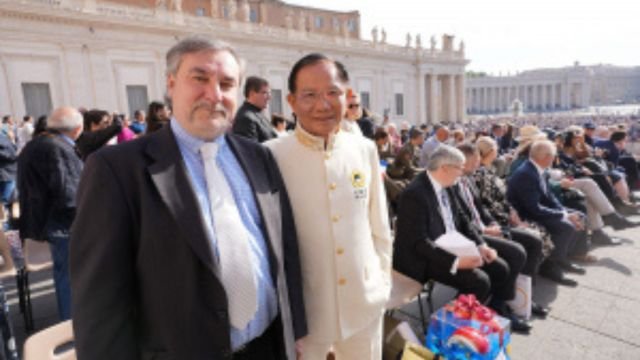
Through the auspices of friends of “Bitter Winter” and CESNUR, its publisher, Dr. Hong, a few other dizi, and the undersigned were granted reserved seats in the churchyard of St. Peter’s Square, the heart of Christianity. The covered stage, where the Pope soon took his place to address the audience, was just in front of us, only a few meters away. We could have easily touched it, had we wished to challenge the rigid protocol and irritate security. We were sitting on the left side of the Pope, facing the audience, in the second row. Several other dizi were in the audience, immediately down the few stairs of the churchyard, among the chanting and greeting crowd.
Many waved small flags, featuring either the face of Pope Francis or the colors of the Vatican: a yellow square beside a white one, with the coat of arms of the Church consisting of the two crossed keys of St. Peter, the Apostle, which are the keys to Heaven.
We waited under the sun and in the heat. Older people among us endured it all genuinely and with a smile. It was a light burden given the reward. Then the Pope entered the scene, smiling as always, saluting and blessing the people on both his right and left sides with his right hand. He took the floor and addressed the crowd. Mercy has been his constant magisterium, and mercy was again the topic of the day, addressed both directly and indirectly, both straightforwardly and with nuances, mixing all as usual to make sense of this profound truth that the world too often forgets.
The Pope’s speech focused on charity, being installment no. 19 of his cycle of catechesis on vices and virtues—a topic that Tai Ji Men understands very well.
The speech was short but dense, as customary for Pope Francis. Once it was finished, he turned to the people in the churchyard to greet them individually. He was unable to walk, his leg always aching. The medical problem he had been suffering from for a long time was soon to result in him being unable to walk. He moved in a wheelchair. He started on his left side, where Dr. Hong and others were. The Pope stopped for a few moments with each person. Everyone had to remain seated at the order of security, but no one obeyed. Everyone stood. We stood too, gently but firmly asked by the guards to sit back down. Yes, we sat. The Pope moved row by row, from the end facing the audience downstairs to the opposite end, facing the basilica. Once he had greeted a guest, security and staff quickly removed that person’s chair to clear the area and allow the Pope to move nimbly in his wheelchair, driven by an attendant.
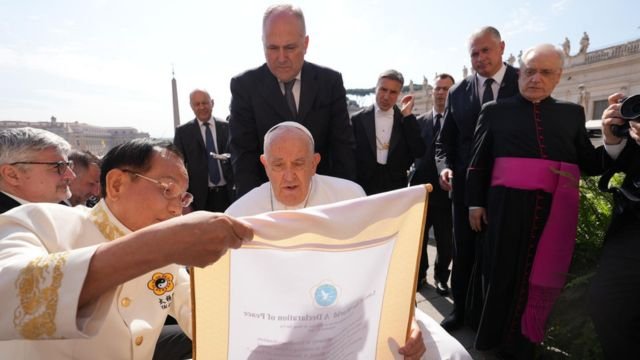
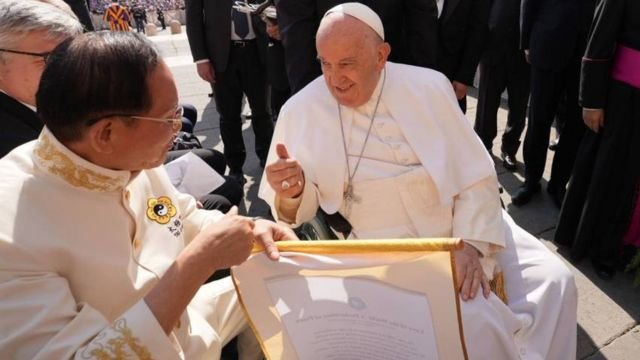
Our turn came. The Pope stopped by Dr. Hong. Time was short, and there were many things that Dr. Hong wanted to convey to the Pope’s heart and mind. Though time remained brief, it seemed to stretch on. It felt as if we were splendidly isolated from the rest of the crowd, making us more effective in reaching the world’s broader audience. Dr. Hong specially presented the Pope with three insightful books: “Conscience: The Wellspring of Wisdom,” “The History of International Day of Conscience,” and “Back to Origin.” Alongside these books, Dr. Hong offered other meaningful gifts, including the “Love of the World: A Declaration of Peace” scroll and the “Tai Ji Men Celestial Drum.” These are central to the message of Dr. Hong and Tai Ji Men.
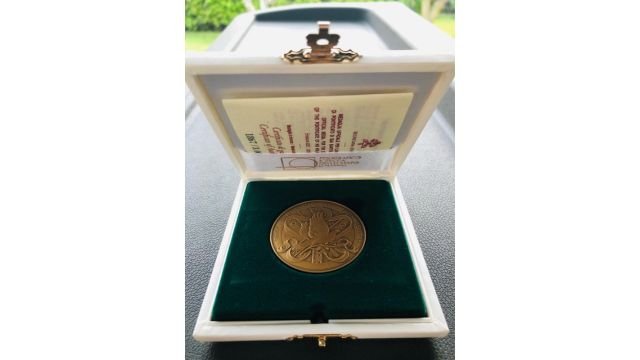
Dr. Hong addressed the Pope in English. Of course, the Pope could understand English, but it has never been his most comfortable language. I provided prompt translations into Italian for him. The Pope understood the core of the message. He smiled and thanked Dr. Hong, not in a mere diplomatic way. We can all see when the flame of passion kindles the eyes of the person we speak to. That short moment seemed to last forever. The Pope thanked and blessed us once more. Pope Francis honored Dr. Hong with a limited edition official medal commemorating the 11th year of his pontificate (2024), which is engraved with the Latin phrase “SIMVL INVENIENDAE SVNT PACIS SEMITAE,” meaning “the peace paths are to be found together.” Only 3,000 such medals were given by the Pope to VIPs during the year.
All was over in a flash, but the memory left a lasting impression on us. It was not merely a sentiment. It was a meeting of consciences, animated by the will to bring good to the world with the highest spiritual motivation. Once again, I cannot interpret Dr. Hong’s and the dizi’s hearts, but this meeting was unlike any other, for them and me.
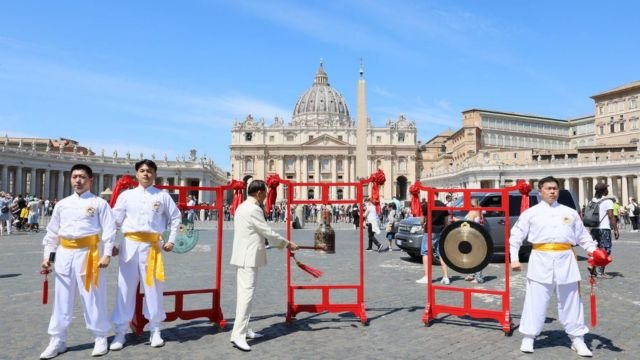
We spent more time in the privileged churchyard and then reunited with the others, many of whom were dizi who had come from afar. As usual, the Pope toured the large St. Peter’s Square, cutting through the pilgrims one last time aboard his special vehicle, before taking the road to the back of the basilica, where no outsiders were allowed. He passed by us again, entering the alley behind St. Peter’s on its left side, if you are facing the basilica itself. We had moved in that direction, patiently waiting for the last steps in the burning sun. The Pope passed just a few meters from us. Shouts from the crowd echoed and multiplied: “Viva il Papa!”, “Long live the Pope!”. Among many flags waved by different people, one could easily spot Tai Ji Men dizi’s banners on “An Era of Conscience,” underlining their message of peace and universal understanding, centered on human conscience. It was our final and lasting moment with him.

Dr. Hong, a few dizi, and I soon gathered to enjoy some typical Roman dishes nearby, just outside the walls of the Vatican—because when you are in Rome, you have to do as the Romans do. It was a celebration, a feast. No one commented, and no one directly addressed the event. We were in awe. We only repeated “Thank you” to one another. That was all that needed to be said on that bright day.
Now that Pope Francis has passed away, mourning and joy mingle. He went, his mission accomplished. We remain with good memories because memory is how humans eternalize fleeting moments. We are all grateful to the Pope for being… the Pope, with all that that means.
His last message to the world, on Easter Day 2025, April 20, 2025, the day before he died, was his final public appearance for the “Urbi et Orbi” benediction, the blessing of the people of Rome and the entire world. He summarized his magisterium. Among the few fundamental things he repeated, freedom of religion looms large. He phrased it very similarly to the customarily accepted scholarly definition, also present in international treaties: “Freedom of religion or belief” (FoRB). He stated it in a strong, stand-alone sentence: “There can be no peace without freedom of religion, freedom of thought, freedom of expression, and respect for the views of others.”
Tai Ji Men dizi know this all too well, from their experience. Their Shifu, Dr. Hong, has worked for this all his life. Pope Francis, wherever he is now, knows it quite well.

Marco Respinti is an Italian professional journalist, member of the International Federation of Journalists (IFJ), author, translator, and lecturer. He has contributed and contributes to several journals and magazines both in print and online, both in Italy and abroad. Author of books and chapter in books, he has translated and/or edited works by, among others, Edmund Burke, Charles Dickens, T.S. Eliot, Russell Kirk, J.R.R. Tolkien, Régine Pernoud and Gustave Thibon. A Senior fellow at the Russell Kirk Center for Cultural Renewal (a non-partisan, non-profit U.S. educational organization based in Mecosta, Michigan), he is also a founding member as well as a member of the Advisory Council of the Center for European Renewal (a non-profit, non-partisan pan-European educational organization based in The Hague, The Netherlands). A member of the Advisory Council of the European Federation for Freedom of Belief, in December 2022, the Universal Peace Federation bestowed on him, among others, the title of Ambassador of Peace. From February 2018 to December 2022, he has been the Editor-in-Chief of International Family News. He serves as Director-in-Charge of the academic publication The Journal of CESNUR and Bitter Winter: A Magazine on Religious Liberty and Human Rights.