Even the quintessentially Chinese Daoism is subject to “Sinicization,” resulting in suppression of monasteries and even tombs.
by Karine Martin*
*An adapted pre-publication excerpt from “Monastic Daoism Transformed: The Fate of the Thunder Drum Lineage” (2025), available from Three Pines Press.
Article 3 of 4. Read article 1 and article 2.
Daoists, as much as devotees of all other religions in China, are severely affected by the Sinicization policies. As the Regulations of Religious Affairs, revised at the 4th meeting of the Standing Council of the Chinese Daoist Association (hereafter CDA) on 28 November 2023 state, all Daoist clergy must “love the motherland, support the leadership of the CCP, support the socialist system, abide by the constitution, laws, regulations, and rules, practice core socialist values, adhere to the directions of sinicization, and preserve national unity, ethnic unity, religious harmony, and social stability.”
More specifically, the rules require that Daoists wear appropriate dress and exhibit correct behavior, “study and implement Xi Jinping Thought and the CCP’s policy on religious work.” All activities, publications, and teachings must be in strict adherence to government policies and are tightly censored, essentially making Daoism—as much as all other religions—into an organ of state doctrine.
As for the concrete impact of Sinicization on Daoism, in 2023, I had the opportunity to travel through many parts of China, spending almost five months in the country. During that time, I visited more than one hundred Daoist temples, traveling over 4000 km across a dozen provinces from the most southern (Guangdong) to the far northern (Heilongjiang), including also the western provinces of Gansu and Qinghai. I began my journey in Guangzhou, visited my old haunts in and around Xi’an, including the temples of the Thunder Drum lineage, and spent quite a bit of time in several places in the northeast. I also attended a CDA conference to honor the birthday of the god Zhenwu 真武 (Perfect Warrior) on Mount Wudang and traveled to Gansu to visit temples there. My field data, therefore, came to include Daoists from many different places and institutions. Sometimes I visited three or more temples in a single day, speaking directly—without any translator or government representative—to the monks and nuns.
Everywhere I went, I found temples in a state of decline and disarray. There were no devotees, much fewer clergy, and minimal activities. Buildings were in disrepair, and there was very little renovation or construction. The overall atmosphere was one of desolation and despair. Some temples, both Buddhist and Daoist, including the Wuzhen guan near my old home temple Leigutai 雷鼓台 (Terrace of the Thunder Drum), were closed completely, their grounds starting to overgrow. Others closed officially on grounds of reconstruction, yet the clergy remained inside, shielding themselves from the outside world. Yet other temples remained open, but their buildings and grounds showed serious decay—a poignant example being the Siwang miao 泗王廟 (Temple of the King of [the River] Si) in Ziyang county, Shaanxi.
The government has made the permit process for any kind of religious building activity so difficult that in fact neither new temples are developed nor existing ones expanded. Even repairs are often not possible, and in some cases, as for example the ancestral temple of the Quanzhen 全真 (Complete Perfection) school, the Chongyang gong 重陽宫 (Palace of Master Chongyang) dedicated to its founder, already permitted and erected structures are subject to demolition.
To give one example, Huang Shizhen spent many years trying to get the authorization to renovate Qinghua gong, which was falling apart and constituted a safety hazard. After years of filing forms with a whole slew of different departments, he eventually managed to get the permits but was not allowed to alter the original structure or design in any way, precluding any form of expansion.
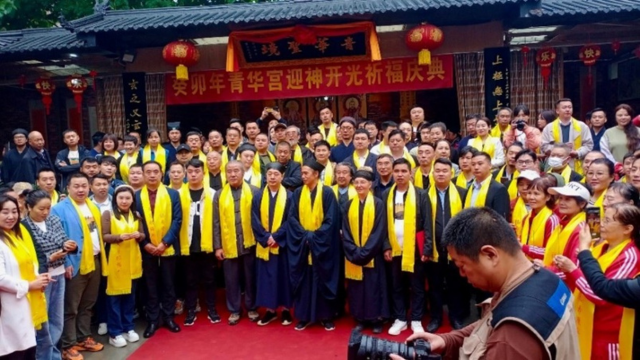
When I was there in the spring of 2023, he was ready to hold an opening ceremony, but again had to file a whole series of complicated forms with different departments that also involved providing the names of everyone attending. In the end, the event happened (as shown above) with rather short-term notice and probably not quite fully official. Also, it was radically censored and neither pictures nor descriptions appeared online. This matches the official policy that only allows four Daoist temples in Shaanxi province to have an online presence. Even for them, every single post must obtain approval through a formal authorization process. As a result, temple websites—so strongly developed just a decade ago—now only speak about Xi Jinping Thought and ways of complying with government guidelines, like the Buddhist set of instructions outlined earlier.
Not only temples but also tombs are subject to suppression. The driving force behind the local Daoist revival, Master Feng Xingzhao 馮興釗 (冯兴钊), passed away at one of the temples he had reconstructed, the Xianyuesi 顯月寺 (Bright Moon Monastery), on February 19, 2023 and was buried nearby.

Although there was no official announcement, thousands of people came to attend his funeral (as shown above), lining the roads three deep and causing the main highway to be closed to regular traffic. All flowers in the greater Xi’an area were sold out completely, and the outpouring of grief was tremendous.
Since he had died sitting up in a state of deep meditation, moreover, he was buried upright in a special earthenware jar, going back to a traditional practice that had not been activated in the modern era.
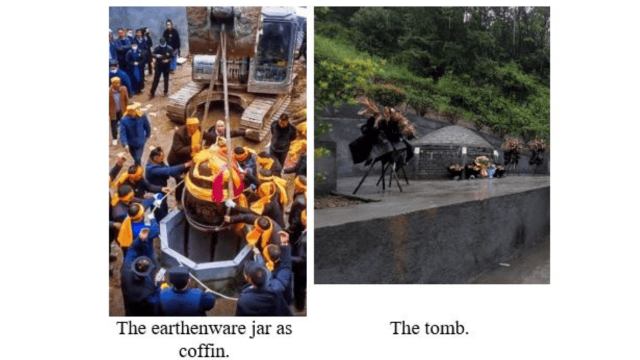
His tomb was accordingly rather small, as shown above. However, when I visited it to pay my respects in April 2024, I learned that the authorities not only prevented his Daoist heirs from adding a small ornamental tower, matching the one at the head temple of the order, the Baiyun guan 白雲觀 (White Cloud Monastery) in Beijing, but claimed that this tomb was too big and should be reduced in size, making it more inconspicuous.
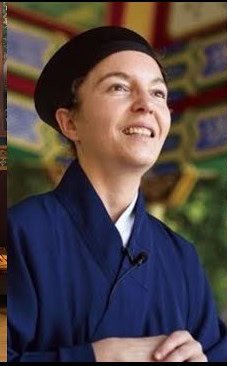
Karine Martin holds doctorates in both Pharmaceutical Sciences (1997) and Religious Studies (2015). While working in neuroscience research in London, she came in contact with Daoism of the Thunder Drum lineage and entered its training. From 2001 to 2016, she lived in Daoist temples of various regions. She is the founder and director of the French Daoist Association, which organizes lectures, workshops, and training courses. A major representative of Daoism in the West, she presents at international conferences, has a strong internet presence, and is interviewed frequently.