The United Nations should advocate for the immediate solution of the Tai Ji Men case. Only if it does, its universal call to uphold human rights will be sincere.
by Marco Respinti*
*Conclusions of the international webinar “The Tai Ji Men Case: Human Rights vs. Human Wrongs,” co-organized by CESNUR and Human Rights Without Frontiers on December 10, 2024, UN Human Rights Day.

Today, the United Nations calls the world to celebrate a special day of observance, honoring human rights. The most remarkable thing of this day is not the initiative of the United Nations that proclaimed it. It is the fact that humanity needs to establish a special day to remind itself that human beings have rights. This is in fact something that we would all prefer to consider as taken for granted by everyone in every place and at every time. Unfortunately, it is not so.
It is indeed a curious situation. We live in a world where rights multiply every single day, and everything seems to have rights. Today, rights are the products of imagination, social consensus, even ideology and power. Each group that has the practical force to impose itself upon society can claim to have established one or more new rights, to which everyone has then to bow. Those who don’t are denounced as backward-looking.
This mechanism, which today has its best ally and weapon in the social media, seems to have almost substituted democracy. Rights are often those decided by the majority, but it may be the majority of those truly convinced of them or of those just scared by a possible reaction by others.
There is also a violent version of this new and quite dubious philosophy of rights and human rights. Tyrants—be they internationally powerful ideocrats, like the leaders of large and dreadful rogue nations, or petty demagogues, as it happens when small countries indulge in local despotism—are convinced that might is right, as the old saying goes. Every time they have, or think to have, an effective might, they use it to impose their will as a right that the international community is asked to recognize immediately. They grab land, invade countries, kill foreign nationals, and destroy societies as they please, convinced that their ideology of superiority and negation of others entitles them to re-write the rules of international coexistence.
This situation shows that humankind is not yet up to its humanity. It has not reached the level of maturity that can grant inherent respect to every human being.
It is a shameful state of affairs. Humans are the only living beings on Earth able to conceptualize and recognize, uphold and revere intangible rights, yet they systematically tread upon them and twist them in ways that no other living being is able to.
The injustice that Tai Ji Men has been suffering for more than a quarter of a century and still suffers in the Republic of China (ROC) in Taiwan for having committed no crime is a substantial part of this unbelievable paradox, which humanity lives by.
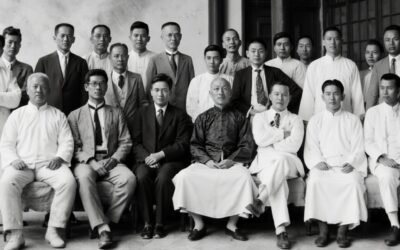
Let us repeat it loud and clear today, on the UN Human Rights Day 2024. Tai Ji Men is a menpai (similar to a school) of qigong, martial arts, and self-cultivation. It is centered on conscience, which it regards, as its Shifu (Grand Master) Dr. Hong Tao-tze teaches, as the key to face and, when possible, solve all problems. As an extension of the educated self that it puts at the core of its effort to produce better human beings, Tai Ji Men considers universal understanding and harmony not only as the natural results of its endeavor to improve humankind, but as the essential conditions in which true human life prospers. Peace, for Tai Ji Men, is not only the consequence of a correct behavior and mutual treatment among humans, but the original and ultimate style of human conduct—the only possible one, if human beings are to avoid wrongdoings.
We could even push the argument so far as to say that for Tai Ji Men human rights are all summarized in the fundamental liberty of all human beings to exercise themselves in becoming more and more human every single day. They strive to build such a humane world that it will know no evil anymore. It is simple, but it is not simplistic or naïve, because there will be no room left for evil when all humans will be fully human.
For this reason, Tai Ji Men is composed of dizi, or disciples, who are peaceful and naturally law-abiding, thinking that just laws are there to help women and men to become better citizens. Consequently, they are also patriotic, since they cultivate no idea of sedition or rebellion, revolt or revolution that can damage their fellow citizens and their communal life.
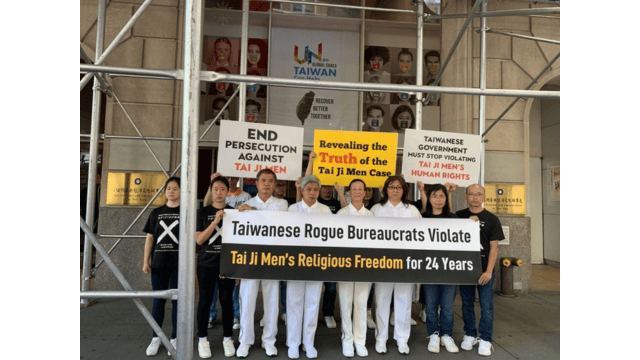
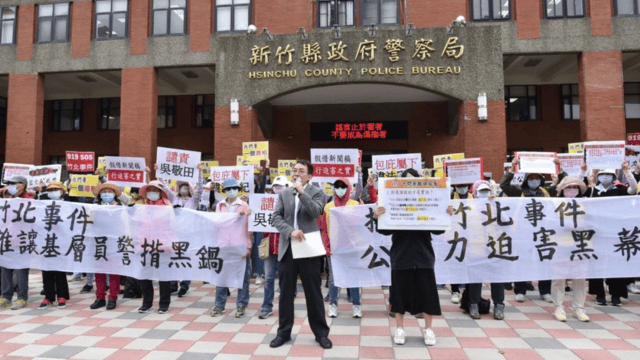
Yet, Tai Ji Men has been devastated by a number of false accusations, ranging from tax evasion, as the most easily understandable (yet false), to raising evil spirits through black magic, as the most absurd. All levels of the Taiwanese justice, including the Supreme Court, have demonstrated that this castle of nonsense stands on fabricated lies, repeatedly clearing Tai Ji Men from all charges in different courts of law. Yet, the consequences of that case still impose a heavy burden on the movement, whose property has been unjustly nationalized. Its members cannot freely enjoy freedom of religion or belief due to the evil action of some corrupt bureaucrats.
The Tai Ji Men case spectacularly exemplifies the denial of human rights that is still so common in our world. Its singularity is that it unites the way of disregarding human rights in the democratic relativistic countries, where everyone can decide what a human right is, and the arrogant way of the despots, who impose on the world their twisted idea of human rights based on power. In fact, the corrupt bureaucrats that started, fueled, and apparently still manage the Tai Ji Men case have both decided what human rights are and used force to impose this insolent view of theirs on others.
But the opposite is the ultimate truth. Human rights are not the product of majorities, votes, imposition, or violence. They are the sacred limit that defines the intangibility of a person. No one can curtail or deny them, twist, or engineer them. Human rights are the indisputable entitlement of every single human being to life and liberty. In fact, if life and liberty are regarded as the sacred limit that defines the intangibility of a person, every infringement of life and liberty is unjustifiable and intolerable. A society built on such premises would be a society where misdeeds are limited and even tend to disappear. This is why the mission of Tai Ji Men for self-cultivation and peace in the world is a supreme contribution to truly and fully respecting human rights.
The United Nations should then quite carefully observe the case of Tai Ji Men in Taiwan and advocate for its immediate solution. The argument that the ROC is not a member state of the UN is only sophistry and an excuse; solutions exist. Only if the UN takes the Tai Ji Men case seriously, its call on upholding human rights will be sincere and effective—and humanity will finally be more human.

Marco Respinti is an Italian professional journalist, member of the International Federation of Journalists (IFJ), author, translator, and lecturer. He has contributed and contributes to several journals and magazines both in print and online, both in Italy and abroad. Author of books and chapter in books, he has translated and/or edited works by, among others, Edmund Burke, Charles Dickens, T.S. Eliot, Russell Kirk, J.R.R. Tolkien, Régine Pernoud and Gustave Thibon. A Senior fellow at the Russell Kirk Center for Cultural Renewal (a non-partisan, non-profit U.S. educational organization based in Mecosta, Michigan), he is also a founding member as well as a member of the Advisory Council of the Center for European Renewal (a non-profit, non-partisan pan-European educational organization based in The Hague, The Netherlands). A member of the Advisory Council of the European Federation for Freedom of Belief, in December 2022, the Universal Peace Federation bestowed on him, among others, the title of Ambassador of Peace. From February 2018 to December 2022, he has been the Editor-in-Chief of International Family News. He serves as Director-in-Charge of the academic publication The Journal of CESNUR and Bitter Winter: A Magazine on Religious Liberty and Human Rights.