A dead woman tried to prevent her greedy daughter from claiming back donations she had freely made. The Supreme Court has now sided with the daughter.
by Massimo Introvigne

In Japan, a virulent anti-cult campaign followed the 2022 assassination of former Prime Minister Shinzo Abe by a man who claimed he wanted to punish him for his cooperation with the Unification Church (now called the Family Federation for World Peace and Unification). The assassin’s mother had gone bankrupt in 2002, allegedly for her excessive donations to the church. Rather than against the assassin and the anti-cultists who might have excited his feeble mind, a public campaign targeted the Unification Church, and we heard time and again that the movement solicited donations through illegal means.
What, however, about Unification Church members who donated freely, hoping that their donations will contribute to the church’s mission and earn spiritual merits for themselves? Surely, these people also exist, and investigative journalist Masumi Fukuda met several of them, who told her they were quite happy of having donated important sums. Similar believers, as well as disgruntled ex-members who regret their donations, can be found in all religions.
How can believers who have donated freely and with joy protect their donations from greedy relatives who, during the donors’ old age and after their death, would try to divert the money toward their own pockets? In the case of the Unification Church, no less greedy anti-cult lawyers, interested in pocketing a part of the loot, incited children to sue and try to recover the money once donated by their incapacitated or dead parents. Perhaps in some cases the parents were not really incapacitated but were maliciously isolated by children who managed to be appointed their guardians.
This happened to a Unification Church believer. Her first daughter started pestering her, claiming she should ask for her donations to be returned. Firm in her beliefs, the woman refused. Suspicious of her daughter’s maneuvers, the woman did something more. She visited a Notary Public where, as other believers had done, she executed a declaration confirming that she had donated to the Unification Church freely and of her own will, and that she will not sue nor authorize others to sue in order to recover the money.
The daughter then took the mother to an isolated location other than her home, and finally to a nursing home that the old woman could not leave freely. She obtained a declaration that her mother had dementia, (which at any rate was dated several months after the notarized statement had been signed). The daughter managed to be appointed as her guardian and sued the Family Federation asking to receive the amount of the donations back. The Tokyo District Court dismissed her claim, noting that the intentions of the old woman had been clearly expressed. She passed away after the first instance decision, at peace with herself and happy that her daughter had not succeeded in subverting her will.
The daughter appealed and lost the appeal as well. Most unfortunately, however, the day after the appeal decision Abe was assassinated. The daughter saw in the incident and the following anti-Unification-Church campaign her golden opportunity. She started taking her story to the media and even testified before the Diet, the Japanese Parliament. Within a general climate where it is impossible for the Family Federation to get a fair trial, finally the daughter has succeeded before the Supreme Court.
The Supreme Court decided that the notarized statement by the mother was invalid, and the case should be returned to the second (appeal) court, which should adopt different standards, i.e., those prevailing after the Abe assassination (applied retroactively), to judge whether the donations had been solicited through illegal means.
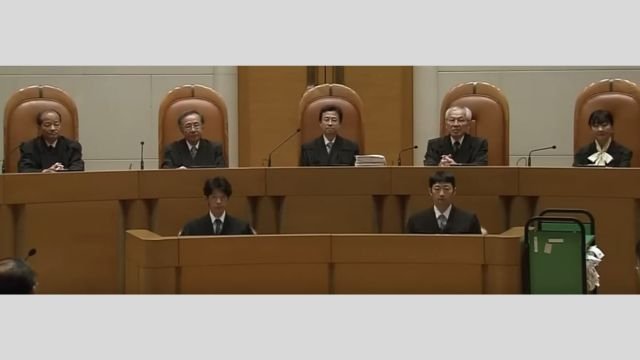
The Supreme Court stated that by being a member of the Unification Church for some ten years, repeatedly traveling to South Korea to participate in rituals, and donating significant amounts, the woman showed that she was under the “psychological influence” of the church. This is yet another way of applying the discredited and pseudo-scientific theory of “brainwashing.” It is applied to a dead woman, who cannot be submitted to a psychiatric examination. Thus, the argument becomes circular. The Supreme Court knows that the woman was “brainwashed” because she was an enthusiastic member of the Unification Church. It also knows that she became and remained an enthusiastic member of the Unification Church because she was “brainwashed.” Against these circular arguments there is no possible defense.
The lower courts had ascertained that the woman had not been threatened, not even with the argument that if she would not donate her life would be negatively affected, therefore her donations were free. But now the Supreme Court says that the lower court should “consider all circumstances,” including her situation of objective weakness and the “psychological influence.” This is reminiscent of the French “abuse of weakness,” an easy tool to attack groups stigmatized as “cults.” But again, the believer is dead and there is no way of knowing whether she really was in a situation of weakness. Accordingly, another circular argument is proposed. We know she was in a situation of weakness because she made significant donations to the Unification Church, and we know why she donated: it was because she was in a situation of weakness. This is tantamount to argue that there were never free members of the Unification Church. By the fact that they were members and donated it can be argued that they were vulnerable and “brainwashed.”
Finally, the daughter is set to win and the dead mother to lose. The old woman’s most cherished wishes will not be respected. Not even being dead protects Unification Church believers from the anti-cult hysteria prevailing in Japan.

Massimo Introvigne (born June 14, 1955 in Rome) is an Italian sociologist of religions. He is the founder and managing director of the Center for Studies on New Religions (CESNUR), an international network of scholars who study new religious movements. Introvigne is the author of some 70 books and more than 100 articles in the field of sociology of religion. He was the main author of the Enciclopedia delle religioni in Italia (Encyclopedia of Religions in Italy). He is a member of the editorial board for the Interdisciplinary Journal of Research on Religion and of the executive board of University of Pennsylvania Press’ Nova Religio. From January 5 to December 31, 2011, he has served as the “Representative on combating racism, xenophobia and discrimination, with a special focus on discrimination against Christians and members of other religions” of the Organization for Security and Co-operation in Europe (OSCE). From 2012 to 2015 he served as chairperson of the Observatory of Religious Liberty, instituted by the Italian Ministry of Foreign Affairs in order to monitor problems of religious liberty on a worldwide scale.