Tai Ji Men dizi promote a culture of conscience, love, and peace throughout the world. They also ask for tax oppression against them to cease.
by Joyce Huang*
*A paper presented at the CESNUR 2024 international conference, Université Bordeaux Montaigne, Bordeaux, France, June 12, 2024.

I am currently a sophomore majoring in Digital Technology Design at the National Taipei University of Education. In addition to my studies, I am also a Tai Ji Men dizi (disciple).
The world is in chaos, and people are anxious. After experiencing the impact of the pandemic, various regions around the globe have faced wars, extreme weather anomalies, earthquakes, wildfires, and other natural and human-made disasters in recent years.
People seem to have grown accustomed to the occurrence of disasters, yet each time an event happens, their hearts are still filled with fear and unease. This emotion pervades society, creating an atmosphere of negativity and depression.
“How can I use the digital knowledge I’ve acquired to help the world?” This is a question I often ask myself. As an information technology student, I realize the responsibility to apply digital technology to address current challenges. The advancing era of digital technology reminds us to continually foster innovative ideas and a positive curiosity to avoid being left behind.
In my role as a dizi in an ancient qigong and martial arts menpai (similar to a school), my Shifu (Grand Master) has taught me valuable lessons. I have learned to grow internally, develop self-awareness, and care for the world around me, and to perceive the world and care for others from a different perspective.
My Shifu, Dr. Hong Tao-Tze, the leader of Tai Ji Men, tells us, “Each of us is a small seed that will gradually grow into a big tree. When these trees come together, they form a forest.” When we sincerely pray for the earth, positive energy spreads out, influencing the entire planet and changing the fate of countless beings.
I feel fortunate to experience the growth and enlightenment that Shifu has imparted to us dizi. I have also become aware of the challenges that spiritual communities face regarding freedom of religion, belief, and thought.
Freedom of religion or belief, and of thought, are integral to human dignity. They encompass individual autonomy, diversity, inclusivity, peaceful coexistence, equality in treatment, freedom of speech, and protection of rights. These rights ensure that everyone can freely choose, practice, and express their beliefs, fostering an open, tolerant, and diverse society.
In August last year (2023), our Shifu led us to actively participate in the 130th Parliament of World Religions held in Chicago, advocating the ideals of love, peace, and conscience. The event brought together representatives from ninety-five countries and various faiths, comprising over 210 groups and more than 8,200 attendees from five continents, with the general theme “A Call to Conscience: Defending Freedom and Human Rights.”

Tai Ji Men also participated in the pre-Parliament “Parade of Faiths.” Performers presented heavenly animals, which symbolize love and peace, including the Tai Chi dragon, the phoenix, the unicorn, and the auspicious lion; and the Eight Immortals and Heavenly Officials of the Taoist tradition.
During the procession, local residents gathered on both sides of the street to watch. I was dressed as a peacock and locked eyes with an elderly lady. I politely nodded and smiled at her, and she touched her chest, tears welling in her eyes, clearly manifesting her emotion. In that moment, I felt deeply moved by the impact my role had on her, and I was touched in return.
I realized the power of a smile, how it could resonate with people’s hearts, instantly bridging the distance between us. It was a mutual, warm exchange of love.
Through my Shifu, I learned that the concept of conveying love and peace knows no barriers or limitations of language, culture, race, or skin color. With genuine sincerity, simple smiles, and words, we can feel each other’s warmth. Love knows no borders.
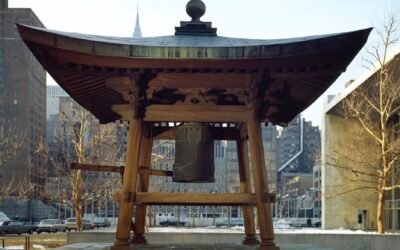
During the Parliament, Tai Ji Men also organized a ceremony called the Global Prayer for World Peace, inviting many distinguished guests to ring the Bell of World Peace and Love, symbolizing love and peace for the world.
Nitin Ajmera, Chair of the Board of Trustees of the Parliament of the World’s Religion, also rang the Bell and congratulated Tai Ji Men for the ceremony. He expresses the wish, “May the vibration of the Bell resonate in all our hearts to create a world full of love, compassion, and gratitude for all.”

At the end, all participants, representing more than a dozen different religions and spiritual traditions, hugged their neighbors and, visibly moved, prayed together for world peace.
Tai Ji Men’s Shifu, brothers, and sisters have traveled to five continents, visited more than one hundred countries, and participated in more than 3,000 domestic and international cultural performances, promoting love, peace and conscience, and bringing Taiwan to the world.
As previously mentioned by several speakers, despite these positive contributions, Tai Ji Men has faced ongoing oppression and persecution from the National Taxation Bureau. This includes the unjust auctioning and nationalization of our sacred land in Miaoli and the prohibition of disposing of the Swiss Villa near Taipei intended for dizi’s physical and mental cultivation. It took nearly 24 years for the government to return the Villa, which is now in ruins, bearing witness to the impact of authoritarian remnants on human rights.
Recalling the day of the land auction of the land in Miaoli, I was also present. We held up banners and signs, loudly demanding that the police bring out the responsible officials to hear the people’s grievances, but they did not come out. I do not understand how a few unscrupulous officials can so brazenly hijack the entire government and disregard the people’s appeals. This is truly outrageous. They did not just sell Tai Ji Men’s land; they also sold off Taiwan’s democracy, rule of law, and national dignity!

It is astonishing that in free and democratic Taiwan, the government officials still disregards court rulings, ignores due legal process, abuses people’s tax rights, and deprives citizens of their freedom to choose and practice their preferred spirituality. I feel deeply disappointed with the flawed tax system and dysfunctional administrative remedies in this land where I grew up.
Finally, we hope that our voices for justice will be heard by the Taiwanese government and that they will correct their mistakes. May conscience education take root in people’s hearts, spreading love, tolerance, and care, and establishing a world of sustainable development, peace, and unity. We also hope that the human rights violations against Tai Ji Men will be redressed soon.

Joyce Huang studies Digital Technology Design at the National Taipei University of Education and is a Tai Ji Men (dizi) disciple. She is also active in advocating for tax and legal reform in Taiwan.