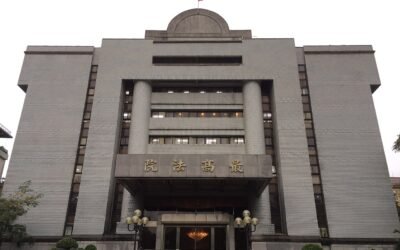
Studying their own case, Tai Ji Men dizi (disciples) discovered a dark side in Taiwan’s tax and legal systems.
by Stella Lin*
*A paper presented at the CESNUR 2024 international conference, Université Bordeaux Montaigne, Bordeaux, France, June 12, 2024.

I am a volunteer for Taiwan’s Tax and Legal Reform League. The League was initiated by a group of experts and scholars who have been long concerned with Taiwan’s tax and legal systems. Our members include advocates for justice and dedicated young individuals. Together, our aim is to promote taxpayers’ rights in Taiwan and support victims of tax and legal injustices, exposing the dark side of Taiwan’s tax and legal systems.
Recently, during job interviews with new graduates and young professionals with one or two years of experience, I noticed that many of them are eager to find positions abroad where they can utilize their English skills. They consider overseas opportunities as a significant part of their career development. This realization struck me profoundly. Although I studied abroad, I chose to return to Taiwan after graduation because I wanted to contribute my knowledge to the land I love most. However, upon returning, I found that many young talents are choosing to leave Taiwan. On further reflection, their decision makes sense. If Taiwan does not have a sound legal and tax system, how can we ensure that people can live and work in peace and enjoy their rights there?
Today, at this significant conference, I want to highlight the urgency and necessity of tax and legal reform in Taiwan through several case studies. One example is the case of Ms. Lin Wang-Yue, who has been mistakenly identified with a “Mr.” Lin Wang-Yue by the tax authorities, despite the difference in gender. She has been pursued with tax bills for over thirty years. Furthermore, despite Ms. Lin having passed away four years ago, her assets remain frozen, and her family continues to receive tax bills. Additionally, exit restrictions were imposed on her.
Law professor Tseng Jian-Yuan experienced a fire caused by a short circuit in the wiring of a dehumidifier due to its faulty design. The dehumidifier manufacturer compensated him with one million NT dollars to cover his losses. However, this compensation was deemed “income” by the National Taxation Bureau, demanding Professor Tseng to pay over 200,000 NT dollars in income tax and fines.
Another case involves Ms. Wu Pei-Chun, who has been harassed by tax bills for over twenty years. She intended to purchase a cram school but did not complete the transaction. However, the tax authorities attributed the cram school’s outstanding tax debt of 1.6 million NT dollars to her. She was then fined an additional amount, doubling the debt to over 3.2 million NT dollars, including interest and penalties. Despite preparing extensive documentation for administrative remedy, the National Taxation Bureau repeatedly issued new tax bills. Ms. Wu has developed hypertension, diabetes, and heart disease, and has suffered from depression, even attempting suicide twice, and was later diagnosed with cancer. Adding to the cruelty, with no income, Ms. Wu’s insurance payout for cancer treatment was also seized for compulsory execution.

These real cases, happening in the Taiwan I know and love, reveal the shocking extent of the chaos in our judicial and tax systems. These tax disaster cases are not isolated incidents but rather widespread issues. Without oversight of tax authorities and with a failing administrative remedy system, businesses and individuals are frequently issued excessive tax bills, leading to company closures, businesses relocating, foreign investment withdrawals, and exit restrictions becoming common occurrences.
After listening to the previous presentations, I believe everyone has a certain understanding of Tai Ji Men and the human rights violations against Tai Ji Men’s Shifu and dizi. This case highlights multiple violations of the basic human rights protected by the Constitution and the two International Human Rights Covenants, which Taiwan incorporated into its domestic law in 2009. It also demonstrates how the Taiwanese government uses taxation as a weapon to discriminate against minority religious and spiritual groups. Some of you may have heard that the Tai Ji Men case is often called “a demon mirror of Taiwan’s tax law,” highlighting many unreasonable and outdated tax regulations. I want to emphasize the specific impact of the Tai Ji Men case on Taiwan’s tax reform. This issue not only concerns the tax rights of the Taiwanese people but also highlights the importance of more people around the world understanding the Tai Ji Men case. As Massimo Introvigne once said, even democratic countries are not immune from violations of human rights, including freedom of religion or belief. And even in these countries there can be rogue bureaucrats and dishonest officials. Through the 28 years of effort by Tai Ji Men, we have seen:
1. The visibility of taxpayers’ rights in Taiwan has been steadily increasing. In 2010, the Legislative Yuan passed the Tax Collection Act, adding a chapter to protect taxpayers’ rights. In 2011, the “White Paper on Taiwan Taxpayers’ Human Rights” was published, and in 2017, the Taxpayer Rights Protection Act officially came into effect.

2. Professor Chen Ching-Hsiu, a prominent tax law expert in Taiwan, publicly stated that because of Tai Ji Men’s efforts, international human rights experts discovered that in Taiwan the Ministry of Finance was freezing all assets and restricting travel abroad, regardless of whether there was a risk of asset transfer or flight. Thanks to Tai Ji Men’s dedicated efforts for tax reform advocacy, Taiwan’s regulations on exit restrictions have been revised. The number of people restricted from leaving the country for tax reasons has dropped from about seven or eight thousand to about two or three thousand.
3. The path of practice for Tai Ji Men dizi is not only about self-cultivation and personal salvation but also about following what Buddhists call the Mahayana way, with the aspiration to help and enlighten others. They turn their sorrow into strength, bravely sharing their stories and pushing for tax reform. They are well-known for promoting the culture of peace with love and conscience, as practitioners who respond to resentment with kindness. They have engaged in citizen diplomacy for Taiwan, making the world notice Taiwan. Their efforts have been praised by successive presidents and officials from the five branches of government.
The path of practice for Tai Ji Men involves enduring hardships, facing challenges, and upholding justice. It is also a compassionate journey aimed at redeeming the corrupt souls of evil officials. This noble spirit is truly admirable and has inspired me to vow to strive for justice for Tai Ji Men.
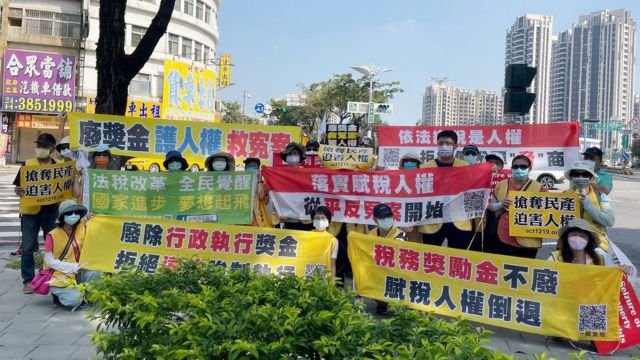
As Willy Fautré, Director and co-founder of Human Rights Without Frontiers, emphasized in his paper during a conference on April 5, “Only the collective power of an international coalition of human rights organizations and official institutions, independent experts, scholars, and think tanks can open the way to a solution” of the Tai Ji Men case. This conference is an opportunity for us to share our experiences and insights accumulated over the years. Moreover, I hope that through today’s discussions and exchanges, we can explore how we can collaborate to improve Taiwan’s legal and tax system, ensuring fairness and justice for Tai Ji Men, and rescuing the people in Taiwan who are struggling with tax issues or facing unfair situations.

Stella Lin works in a public relations agency in Taiwan and is a volunteer of the Tax and Legal Reform League. She is also a Tai Ji Men dizi (disciple).