In Larkana, Sindh, the man was caught red-handed and videotaped while molesting a nine-year-old student.
by Massimo Introvigne

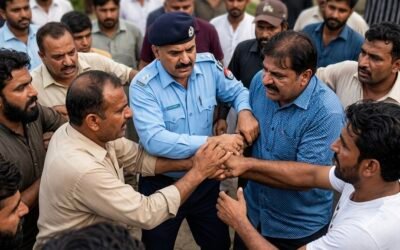
On May 9, Pakistani media reported that police in Larkana, Sindh, Pakistan, had arrested a teacher at the city’s Khalid Bin Waleed Mosque called Naimat Yaseen, also known as Molvi Yaseen (Yasin) Chandio.
A FIR (First Information Report) had been filed by the police by one Baghan Chandio, who reported that his nine-year-old son, a student at the mosque, had been sexually molested by the teacher.
Baghan’s brother and cousin, who were at the mosque for the afternoon prayers, caught the teacher in the act, the boy’s father reported. Part of the assault was recorded in a video, which made its way to some social media but was (rightly) deleted or masked so that what it depicts is not clear. A clear copy was, however, supplied to the police. The teacher tried to escape but was finally caught and arrested.
Both the teacher and the boy’s family belong to the same Chandio tribe. The father reported that he had been submitted to pressures to solve the matter through mediation or arbitration, but refused, believing that only criminal courts can stop the abuse of children in Islamic schools.

The incident created widespread emotion, because it occurred only a few weeks after another father filed a FIR against a prominent Muslim cleric and madrassa teacher. Maulana Abubakar Muavia, after having caught him red-handed in the process of raping his 12-year-old son in Tandlianwala, Faisalabad.
In the case of Muavia, the father was persuaded to resort to arbitration and “forgive” the cleric, although these arbitrations are invalid in the case of crimes according to a 2019 decision by the Pakistani Supreme Court.
Of course, clerics of different religions, including Catholic priests, have been prosecuted and convicted for child sexual abuse. This is hardly an excuse, however, for the leniency Pakistani courts often show to clerics and other Islamic teachers accused of raping both boys and girls within the context of what is becoming a systemic problem in the country.

Massimo Introvigne (born June 14, 1955 in Rome) is an Italian sociologist of religions. He is the founder and managing director of the Center for Studies on New Religions (CESNUR), an international network of scholars who study new religious movements. Introvigne is the author of some 70 books and more than 100 articles in the field of sociology of religion. He was the main author of the Enciclopedia delle religioni in Italia (Encyclopedia of Religions in Italy). He is a member of the editorial board for the Interdisciplinary Journal of Research on Religion and of the executive board of University of Pennsylvania Press’ Nova Religio. From January 5 to December 31, 2011, he has served as the “Representative on combating racism, xenophobia and discrimination, with a special focus on discrimination against Christians and members of other religions” of the Organization for Security and Co-operation in Europe (OSCE). From 2012 to 2015 he served as chairperson of the Observatory of Religious Liberty, instituted by the Italian Ministry of Foreign Affairs in order to monitor problems of religious liberty on a worldwide scale.