An article by an academic in one of the main Spanish newspapers spreads Chinese propaganda and creates a scandal—until you realize it’s an advertorial.
by Massimo Introvigne

An American friend sent to me a strange “editorial” published in “ABC,” one of the most important Spanish newspapers, about the International Religious Freedom Summit that I attended in Washington DC at the end of January.
The article is signed by an academic, Javier Porras Belarra, who teaches at the Law School of Madrid’s private Universidad CEU San Pablo. It is a digest of Chinese propaganda rarely seen in mainline Western media.
The argument is that we all believe in religious liberty but we all also agree that it has limits. Both the notions of religious liberty and of its limits are not universal, Porras Belarra argues, and should be adapted to different traditions and contexts. “It is shocking that the U.S.,” Porras Belarra writes, “in the role of guardian of world freedom tells the rest of the world how to act and when the boundaries of religious freedom are right or wrongly drawn.”
Each society has its own way to religious liberty, the Spanish academic argues, and the IRF Summit was a U.S. attempt to impose the American way to China and other countries. The Spanish academic insists that “it is not appropriate to confuse religious freedom with the justification of terrorism (as in the case of the East Turkestan Islamic Movement affecting the Chinese border) or independence movements as happened in Hong Kong in 2019 and 2020.”
This is, of course, unadulterated Chinese propaganda. China has repeatedly tried to justify its repression of millions of Muslim Uyghurs with the threat of the East Turkestan Islamic Movement (ETIM), a tiny group of Uyghur expatriates that was active in the past century but no longer exists. China, however, continues to play the ETIM card and Chinese agents were caught red-handed in Afghanistan in 2021 when they tried to create a bogus ETIM “cell” to be then “unmasked” and used by CCP disinformation.
The IRF Summit did give voice to growing concerns about religious liberty in Hong Kong. To justify it with the Chinese need to repress the “independence movements of 2019 and 2020” is ridiculous. The churches and individuals whose religious liberty is under threat in Hong Kong in no way support its “independence.” It is Porras Belarra who seems to support the bloody repression of the Hong Kong pro-democracy movement.
The Spanish academic also claims that the IRF Summit was largely an Evangelical affair where “no mention was made of the persecution suffered by Catholics in certain parts of the world.” The IRF Summit allegedly also ignored “the attitude of the Vatican and the Catholic world, [which] are more prone to dialogue and the search for understanding with less like-minded administrations and states: a clear example is the agreement between the Vatican and the People’s Republic of China.”
The statement simply proved that Porras Belarra did not follow the IRF Summit and only relied on press clippings. The persecution of Catholics was discussed in a good dozen of sessions, with moving testimonies of persecuted priests, for example, from Nicaragua (a staunch ally of China). There were plenty of Catholic speakers, including Ján Figeľ, former European Commission Special envoy for the promotion of freedom of religion outside of the European Union, Benedict Rogers of Hong Kong Watch, and the undersigned. As for the Vatican-China deal of 2018, that it failed to achieved its intended results is widely acknowledged inside and outside the Catholic Church. Certainly, it is not a model for other countries or religions.
In a longer version of the article published on “Europa Press” Porras Belarra makes it clearer what he is mostly concerned with. He laments that a forum on religious liberty supported the Uyghur Forced Labor Prevention Act, which in his opinion has nothing to do with freedom of religion and may be “a protectionist measure of the American market against Chinese products.”
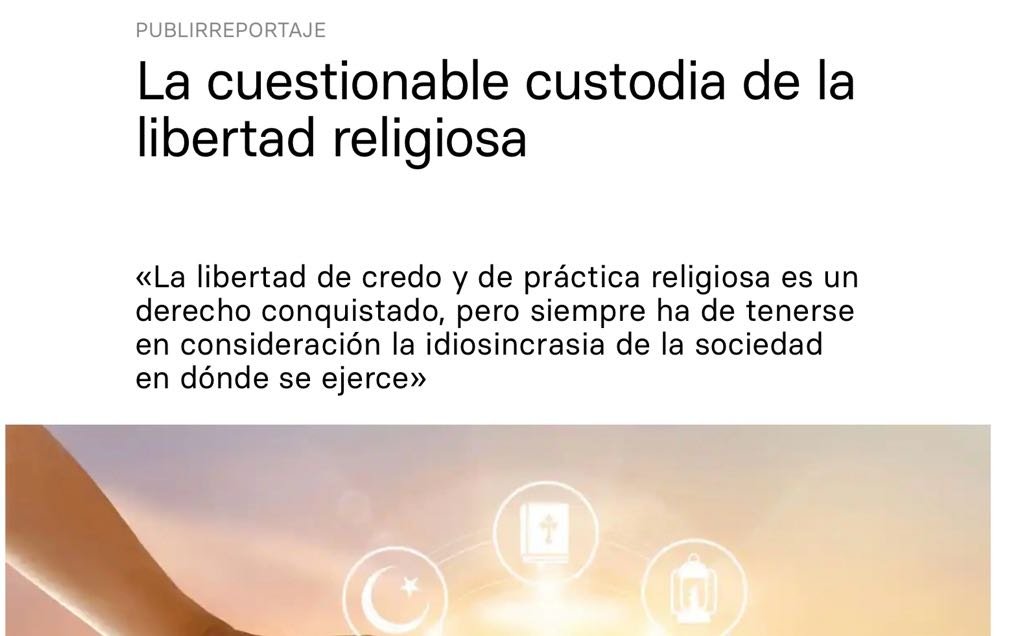
My first reaction after reading the editorial by Porras Belarra is that it was a scandal that a respected newspaper such as “ABC” published such low-level Chinese propaganda. Until I noticed what had escaped me in the first place, as no doubt escaped most readers. In characters designed not to be too much noticed, “ABC” does affix to the editorial the label “Publirreportaje,” which in Spanish means “advertorial,” i.e., an article that looks like a legitimate editorial but is in fact a paid advertisement. Why did “ABC” publish the rubbish? The answer is simple: money.
And who is Porras Belarra, exactly? He is one of the main representatives of something called “Cátedra China,” a think tank promoting good economic and political relations between Spain and China with the help of former diplomats, businesspersons, and academics. The Chinese Embassy to Spain is a frequent partner of its initiatives. It was co-founded in 2012, as we learn again from the friendly “Europa Press,” by Marcelo Muñoz, dean of the Spanish entrepreneurs operating in China, and the German Kurt Grötsch, the Director of the Museum of Flamenco Dance who operates in Seville an organization called Chinese Friendly International. In turn, Chinese Friendly International is the Spanish representative of the Silk Road Chamber of International Commerce (SRCIC), a China-based organization promoting the Belt and Road Initiative and whose press releases are distributed by the Chinese government press agency “Xinhua.”
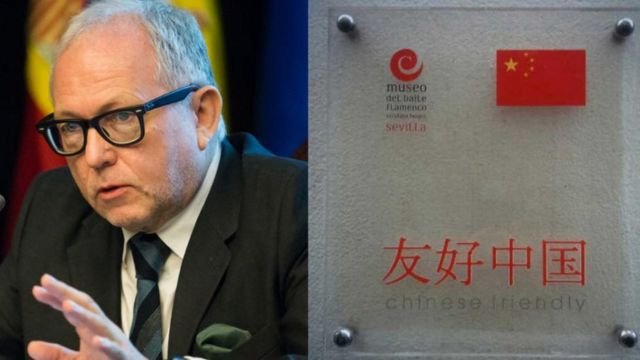
The publication of the false editorial against the IRF Summit on “ABC” may be, in a way, useful. It sheds some light on a broader pro-China lobby operating in Spain and replicating familiar patterns of Chinese disinformation and propaganda.
It is good that “ABC” specified that the unbelievable editorial was in fact an advertorial. It might as well have added “brought to you by the United Front.”

Massimo Introvigne (born June 14, 1955 in Rome) is an Italian sociologist of religions. He is the founder and managing director of the Center for Studies on New Religions (CESNUR), an international network of scholars who study new religious movements. Introvigne is the author of some 70 books and more than 100 articles in the field of sociology of religion. He was the main author of the Enciclopedia delle religioni in Italia (Encyclopedia of Religions in Italy). He is a member of the editorial board for the Interdisciplinary Journal of Research on Religion and of the executive board of University of Pennsylvania Press’ Nova Religio. From January 5 to December 31, 2011, he has served as the “Representative on combating racism, xenophobia and discrimination, with a special focus on discrimination against Christians and members of other religions” of the Organization for Security and Co-operation in Europe (OSCE). From 2012 to 2015 he served as chairperson of the Observatory of Religious Liberty, instituted by the Italian Ministry of Foreign Affairs in order to monitor problems of religious liberty on a worldwide scale.