The CCP did not want the Dalai Lama to endorse the new leader of Mongolian Buddhists. He blessed one of two identical twins. Only, the Chinese don’t know which one.
by Massimo Introvigne
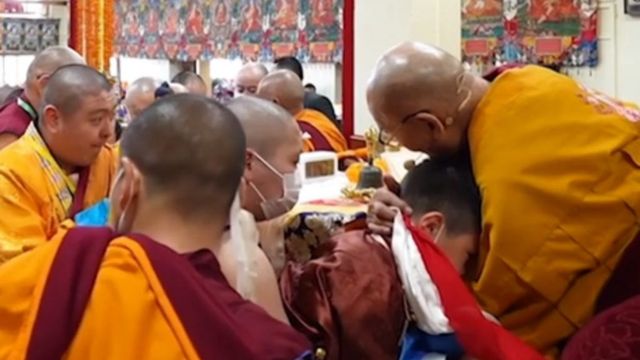
For the believers, reincarnation is determined by superior powers, but it is not disrespectful to note that how a reincarnated Tibetan lama is educated and protected also derives from his mentors’ political skills. Nowhere are they appearing more clearly than on how the Dalai Lama is playing the very delicate game around the 10th Jebtsundamba Khutuktu, the head of the Gelug lineage of Tibetan Buddhism in Mongolia, and the de facto leader of Mongolian Buddhists.
The ninth Jebtsundamba Khutuktu spent most of his life in exile first in Tibet and then in India because of the Communist regime ruling Mongolia. His identity was revealed by the Dalai Lama only in 1990. Even after the fall of the Communist regime in 1992, complicated political situations still made it difficult for him to reside in Mongolia. He came to live there and be enthroned as the leader of Mongolian Buddhists only in 2011, one year before he died in 2012.
By then, the problem was no longer Soviet Union but China. The CCP claims it has the right to select the reincarnations of high lamas not only within Chinese borders but also in Mongolia. The Dalai Lama obviously ignores these claims, but should be extremely careful in not exposing boys he endorses as reincarnations of major lamas to China’s vengeance.
He maintained that the reincarnation of the Jebtsundamba Khutuktu who died in 2012 had been found but did not reveal who he was until March 8, 2023 at a ceremony in Dharamsala. Although they cannot say it too loudly, Mongolian political authorities have accepted the boy endorsed by the Dalai Lama as the 10th Jebtsundamba Khutuktu, as does Mongolian public opinion. China screamed in the beginning, but has not proposed an alternative candidate. It has limited himself to warn the young Jebtsundamba Khutuktu and the Mongolian government that, when he will be old enough to fully assume his functions, he should not be critical of China or too close to the Dalai Lama, or else.
But do we really know who the 10th Jebtsundamba Khutuktu is? In fact, we don’t, and here is the beauty of the Dalai Lama’s move. On March 8, the Dalai Lama introduced as the new Jebtsundamba Khutuktu a boy named “A. Altannar.” Only the initial, “A.” has been revealed, not the full first name. The problem is that there are two “A. Altannar”: they are identical twins and both their first names starts with A. Their names are Achildai Altannar and Agudai Altannar. Which one is the Jebtsundamba Khutuktu? Only five persons know it: the two 8-year-old boys, their father and mother (a college professor of Mathematics and the heir of a mining fortune), and the Dalai Lama.
After resisting the selection, since they had dreamed for both twins a bright business career, the parents came to accept that a sacrifice is demanded for the sake of their country and their religion. They keep their mouths shut. The twins are mostly seen in public together, they dress in the same way, they attend the same school, and they are both trained to be the Jebtsundamba Khutuktu (although one of them knows he has no claims to the position).
Adding insult to injury for the CCP, the twins are born in the United States and have both an American passport. If the Chinese decide to kidnap them as they did with the Panchen Lama, they should abduct both twins and engage in the risky business of kidnapping American citizens. Of course, Beijing may still find ways of putting pressure on Mongolia’s political authorities. But so far the Chinese authorities appear to have been outsmarted by the Dalai Lama—and by the mysterious process governing the reincarnation of the high lamas, which devotees believe is controlled by forces and entities that no human government, and certainly not an atheistic one, can fool.

Massimo Introvigne (born June 14, 1955 in Rome) is an Italian sociologist of religions. He is the founder and managing director of the Center for Studies on New Religions (CESNUR), an international network of scholars who study new religious movements. Introvigne is the author of some 70 books and more than 100 articles in the field of sociology of religion. He was the main author of the Enciclopedia delle religioni in Italia (Encyclopedia of Religions in Italy). He is a member of the editorial board for the Interdisciplinary Journal of Research on Religion and of the executive board of University of Pennsylvania Press’ Nova Religio. From January 5 to December 31, 2011, he has served as the “Representative on combating racism, xenophobia and discrimination, with a special focus on discrimination against Christians and members of other religions” of the Organization for Security and Co-operation in Europe (OSCE). From 2012 to 2015 he served as chairperson of the Observatory of Religious Liberty, instituted by the Italian Ministry of Foreign Affairs in order to monitor problems of religious liberty on a worldwide scale.