Shazia Bibi was raped and murdered on June 6 in Lahore, but the news was only reported on July 1. The police said the murder was “not religious.” Anglican Bishops disagree.
by Massimo Introvigne

On June 6, a Christian woman called Shazia Bibi, who worked at the Lahore University of Management Sciences (LUMS), went missing in Lahore, Pakistan, and was later found dead. The news was reported on social media only on July 1, after the police had arrested a suspect.
The Punjab Police issued a statement where it blamed the victim. It claimed that the woman, a widow, had started a relationship with the accused and had tried to blackmail him, until she killed her.
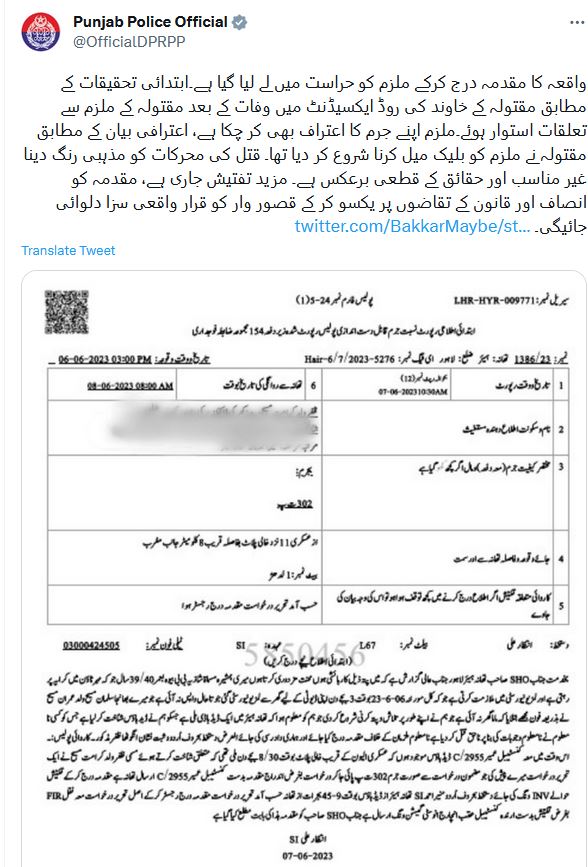
The Punjab Police stated that, “Giving a religious color to the motives behind the killing is inappropriate and completely contrary to the facts. Further investigation is going on, the case will be brought together according to the requirements of justice and law, and the guilty will be punished.”
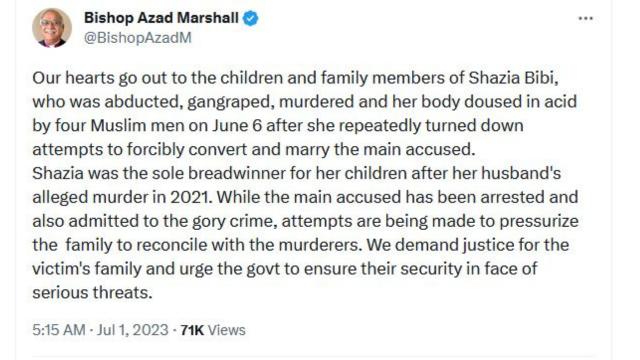
However, the Anglican community, to which Shazia Bibi belonged, carried out its own investigation and plainly stated that the police is lying. Bishop Azad Marshall, the Moderator Bishop of the Church of Pakistan (Anglican), stated that “Shazia Bibi was abducted, gangraped, murdered and her body doused in acid by four Muslim men on June 6 after she repeatedly turned down attempts to forcibly convert and marry the main accused.”

Massimo Introvigne (born June 14, 1955 in Rome) is an Italian sociologist of religions. He is the founder and managing director of the Center for Studies on New Religions (CESNUR), an international network of scholars who study new religious movements. Introvigne is the author of some 70 books and more than 100 articles in the field of sociology of religion. He was the main author of the Enciclopedia delle religioni in Italia (Encyclopedia of Religions in Italy). He is a member of the editorial board for the Interdisciplinary Journal of Research on Religion and of the executive board of University of Pennsylvania Press’ Nova Religio. From January 5 to December 31, 2011, he has served as the “Representative on combating racism, xenophobia and discrimination, with a special focus on discrimination against Christians and members of other religions” of the Organization for Security and Co-operation in Europe (OSCE). From 2012 to 2015 he served as chairperson of the Observatory of Religious Liberty, instituted by the Italian Ministry of Foreign Affairs in order to monitor problems of religious liberty on a worldwide scale.