Archeology and philanthropy disguise an anti-Indian and anti-Dalai-Lama strategy.
by Massimo Introvigne
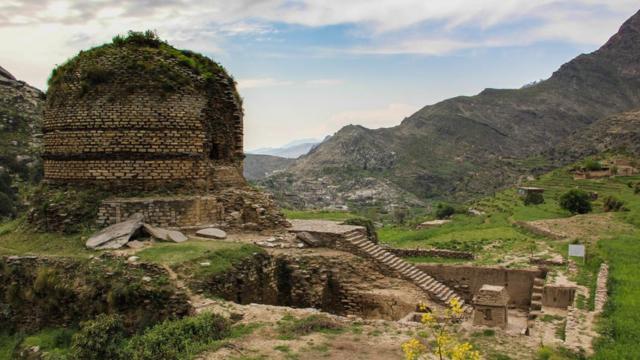
If you would be requested to name Buddhist countries in Asia, you would probably not include Pakistan. There are just a few thousand Buddhists there. Yet, Pakistan is increasingly promoted as a pilgrimage place and historical center international Buddhists cannot miss. Promoted by Pakistan’s travel agencies? Yes, also. But the main sponsor of “Pakistani Buddhism” is China.
China has generously funded archeological and restoration work in Buddhist sites in Pakistan, Gandhara University in Peshawar, and Chinese and international tourism to Pakistan as the “ancient heartland of Buddhism”—and particularly of Tibetan Buddhism. It is claimed that Padmasambhava, the central figure in the transmission of Buddhism to Tibet in the 8th century CE, was born in Swat district in Pakistan’s Khyber Pakhtunkhwa province. This is by the way not sure, since tradition has the mythical Oddiyana as the birthplace of Padmasambhava. Many scholars do believe that Oddiyana included present-day Swat district, while others place it in India’s Orissa state or in Kashmir, and some prefer to think that it lies outside our physical world just as the mythical Shambhala—or that Oddiyana and Shambhala are one and the same.
Be it as it may be, China wants us to believe that Padmasambhava was born in Pakistan and that Pakistan played a central role in the early history of Buddhism. They do not insist on it because of philanthropy or their political alliance with Pakistan only.
As Indian scholar Chandan Kumar explained in an article of June 11, it is part of China’s soft diplomacy to try to make inroads into international Buddhist organizations. Its aims are to substantiate the false claim that there is freedom of religion for Buddhists in China, to downplay India as the birthplace of Buddhism promoting instead China as the main international center of the religion, and to promote its puppet Tibetan Buddhist leaders hoping they may really became a serious challenge to the Dalai Lama.
There is a “Buddhist Belt and Road Initiative,” and China is completing lavish permanent premises for the World Buddhist Forum it has promoted on the Taihu Lake, Wuxi, Jiangsu province.

As Chandan Kumar writes, China “has gained considerable sway over the International Council of Day of Vesak (ICDV), the World Fellowship of Buddhists, and other organizations in Korea and Taiwan. This influence is evident in the Common Text Project (CTP) undertaken by the ICDV, where Tibetan scholars have been marginalized, and Chinese texts have been given prominence over traditional Tibetan sources. In 2021, China started South China Sea Buddhism Foundation to influence Buddhist countries of South China Sea. The first South China Sea Roundtable was organized in Shenzhen in 2021 and second was organized in Phnom Penh, Cambodia. The aim of the roundtable is to cooperate with Buddhist temples and monasteries in the South China Sea.”
In short, China is devoting considerable resources to hijack international Buddhism and marginalize Tibetan Buddhists loyal to the Dalai Lama and other Buddhists who look at the government-controlled China Buddhist Association and see what it is: a tool of the CCP to promote, organize, and justify repression of religious liberty and of any expression of Buddhism in China that refuses to be a mere tool of the regime and the Party.

Massimo Introvigne (born June 14, 1955 in Rome) is an Italian sociologist of religions. He is the founder and managing director of the Center for Studies on New Religions (CESNUR), an international network of scholars who study new religious movements. Introvigne is the author of some 70 books and more than 100 articles in the field of sociology of religion. He was the main author of the Enciclopedia delle religioni in Italia (Encyclopedia of Religions in Italy). He is a member of the editorial board for the Interdisciplinary Journal of Research on Religion and of the executive board of University of Pennsylvania Press’ Nova Religio. From January 5 to December 31, 2011, he has served as the “Representative on combating racism, xenophobia and discrimination, with a special focus on discrimination against Christians and members of other religions” of the Organization for Security and Co-operation in Europe (OSCE). From 2012 to 2015 he served as chairperson of the Observatory of Religious Liberty, instituted by the Italian Ministry of Foreign Affairs in order to monitor problems of religious liberty on a worldwide scale.