The book in the Cambridge Elements series may one day be remembered as the first textbook of “Scientology Studies 2.0.”
by Massimo Introvigne

Cambridge Elements were launched by Cambridge University Press in 2019 as an ambitious new concept in scholarly publishing. The idea was to ask leading scholars in a large variety of fields to write a short peer-reviewed guide of the topic they specialize in, hoping it will become a key reference for college students for years to come.
Donald Westbrook had already published in 2018 an important book on Scientology with Oxford University Press called “Among the Scientologists: History, Theology, and Praxis.” Rather than on the celebrity members of the Church of Scientology who are often mentioned in the media, that book focused on the “ordinary Scientologists,” who remain largely invisible but sustain the Church’s daily activities and growth. “Ordinary Scientologists” should be less controversial than the celebrities, yet Westbrook’s 2018 work had to consider the opposition in some quarters to any attempt at studying Scientology in a non-hostile way. In fact, anti-cult opponents of Scientology promptly expressed their dislike of the book.
Westbrook had repeatedly expressed the opinion that it is great time to pass to a phase of “Scientology Studies 2.0,” an expression I coined myself in 2017, i.e. a study of the Church of Scientology and its founder, L. Ron Hubbard that, while not ignoring the controversies, would not make them the main focus of the research and would explore Scientology and Hubbard as one would do with any other religion and its founders.
With the Cambridge Elements “L. Ron Hubbard and Scientology Studies” (2022), Westbrook goes one step further. Rather than simply discussing how desirable “Scientology Studies 2.0” would be, he resolutely engages in the new approach. His book is not a biography of Hubbard, nor a synthesis of his religious ideas, but a manual teaching researchers and students how Scientology should be studied.
In the first section, Westbrook reviews the story of Scientology studies. He mentions problems and misunderstandings in the early years of the academic study of Scientology, but he warns that comments based on incidents opposing the Church of Scientology and some academic scholars forty or fifty years ago do not accurately describe the situation today. While the Church regards certain documents as confidential, as do many other religions, it is willing to cooperate with bona fide scholars. Westbrook describes his own experience, which has been positive and not very much different from what academics encounter when doing fieldwork on other religions.
Westbrook also mentions that valuable studies of Scientology have been produced, such as the books by J. Gordon Melton and Aldo Natale Terrin and several articles, among which he lists those published in “The Journal of CESNUR,” a scholarly journal of which I am the editor. Other studies were influenced by the anti-cultists and apostate ex-members, but still offered the opportunity for scholarly discussions on important aspects of Scientology.
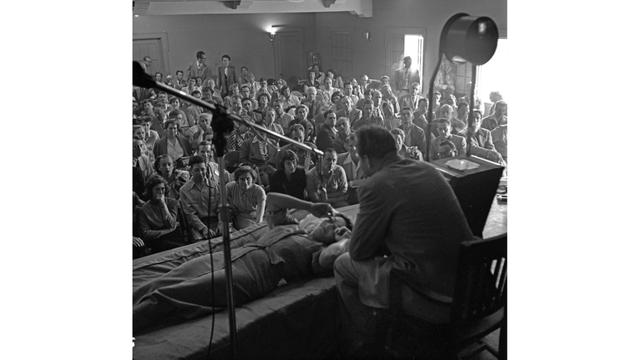
In the second section, Westbrook describes how Hubbard is perceived by present-day Scientologists, including a generation that has not met him personally or was not even born when the founder of Scientology died in 1986. While one can have the superficial expression that Hubbard has been “deified” after his death, Westbrook explains that to the Scientologists he is “no more divine than all Scientologists can become” by using the “technology” “he designed, codified, and refined during his lifetime.” Hubbard saw himself as “an explorer and engineer of the mind and spirit,” and this is how Scientologists continue to see him. They tend not to use words such as “belief” or “faith” when describing their relationship with Hubbard’s teachings, Westbrook notes. They prefer “such terms as knowledge, technology, and workability,” indicating that becoming a Scientologist is not a question of faith but of coming to the experiential knowledge that Hubbard’s spiritual technology works.
In the third part of the book, Westbrook guides us in a fascinating pilgrimage to the sites where Hubbard developed his technology and others that are crucial to the history of Scientology. The word “pilgrimage” here is not metaphorical only. Like other religions, Scientology has devoted considerable resources to preserve, restore, and open to the public the locations where Hubbard lived, worked, and developed Dianetics and Scientology. Scientologists, and non-Scientologists as well, can learn many details about Hubbard and the Church by visiting these places, which in a way become “holy” ad “pilgrimage sites” for Hubbard’s followers.

The fourth sections lists a number of libraries and archives that have important collections about L. Ron Hubbard and Scientology. The list is not for the scholars only, and dispels the myth that Scientology cannot be studied for lack of primary documents, so that one is reduced to rely on the hostile accounts of apostate ex-members. In fact, while Westbrook hopes that one day Scientology may grant a larger access to its own archives, he explains that scholars ready to do their homework have thousands of primary documents to work with.
It is thus, as Westbrook explains in the concluding fifth part, not the lack of sources but biases and prejudices and the malevolent pressure by opponents that sometimes prevents scholars from studying Scientology. However, “Scientology Studies 2.0” have now appeared (in fact, thanks also to Westbrook himself), together with promising subfields for the research, such as the adaptation of Scientology to non-American contexts, its influence on the arts, and its “social engagement and humanitarian outreach,” on which the author mentions the pioneer studies of French scholar Bernadette Rigal-Cellard. The volume is completed by a glossary, a chronology, and a bibliography.
Cambridge Elements are short in nature. They do not offer an encyclopedic view of their subject, but indicate how it should be studied. Once the purpose is understood, one cannot but conclude that Westbrook succeeds admirably. In the future, it would be difficult to seriously study Scientology without considering the methodological indications of this text and engaging with them. Westbrook’s Element may well one day be remembered as the first real book written in “Scientology Studies 2.0” style. It proves that “Scientology Studies 2.0” is an idea whose time has come.

Massimo Introvigne (born June 14, 1955 in Rome) is an Italian sociologist of religions. He is the founder and managing director of the Center for Studies on New Religions (CESNUR), an international network of scholars who study new religious movements. Introvigne is the author of some 70 books and more than 100 articles in the field of sociology of religion. He was the main author of the Enciclopedia delle religioni in Italia (Encyclopedia of Religions in Italy). He is a member of the editorial board for the Interdisciplinary Journal of Research on Religion and of the executive board of University of Pennsylvania Press’ Nova Religio. From January 5 to December 31, 2011, he has served as the “Representative on combating racism, xenophobia and discrimination, with a special focus on discrimination against Christians and members of other religions” of the Organization for Security and Co-operation in Europe (OSCE). From 2012 to 2015 he served as chairperson of the Observatory of Religious Liberty, instituted by the Italian Ministry of Foreign Affairs in order to monitor problems of religious liberty on a worldwide scale.