Reactions to the events in Ukraine prove that there is still excessive permissiveness in the religious field, the Putin-chaired national security body said.
by Massimo Introvigne
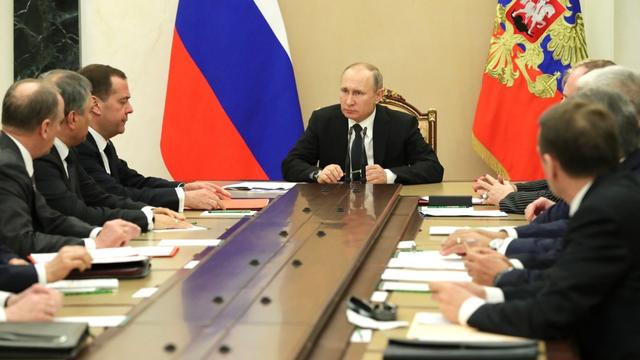
The reactions critical of the war in Ukraine proved that there is still too much religious liberty in Russia and new, harsher laws against “non-traditional” religions are needed. This is not a private opinion of some radical, but the conclusion of a meeting on July 12 of the Security Council of the Russian Federation, a body chaired by Vladimir Putin himself and including the heads of all defense and security agencies.
The Council met to discuss “how to neutralize internal threats to national security” that emerged in recent months and weeks, as the dissent against the so-called “special military operation” in Ukraine grew.
The Council “emphasized” that a main problem is a misinterpretation of the notions of “freedom of conscience” and religious liberty. Clearly, these have been used to criticize the government and have had “a negative impact on the defense of the country and the security of the state.”
One problem is that several religious organizations that operate in Russia are in fact not Russian but have their leaderships abroad. According to the official press release, “the meeting presented the facts of the negative impact on the situation in the country of some foreign organizations and Russian organizations controlled by foreigners, carrying out their destructive activities under the guise of humanitarian, educational, cultural, national and religious projects.” This, the Security Council said, cannot continue. The Council insisted that “foreign states use the activities of religious associations to interfere in the internal affairs of our country.” Some within the Council no doubt favors a ban of all religious organization having their top leadership abroad, which would correspond to the Chinese model.
The Council noted the prevalence of a wrong and dangerous “permissiveness in the religious sphere,” which leads to “religious beliefs been used for negative purposes” and “the practice of religious extremism.” As Bitter Winter readers know, “religious extremism” in Russian law does not mean religion-based violence or incitement to violence only, but includes any assertion that a religion offers a higher way of salvation with respect to other religions (meaning the Russian Orthodox Church). Laws against “religious extremism” have been used to “liquidate” peaceful and non-violent organizations such as the Jehovah’s Witnesses.
The Security Council noted that “religious extremism” is already forbidden in Russia, but a new proposed law should also ban “religious radicalism” and “religious fundamentalism,” implying that even groups that are not “extremist” under the extensive Russian concept may nonetheless be “radical” or “fundamentalist” and should also be banned.
The new law, the Security Council say, should also establish categories for different religious groups, creating five levels with “traditional religious organizations” at the top and banned “religious destructive cults” at the bottom, with “non-traditional religious organizations” and “foreign religious organizations” in the middle, as groups that cannot be equated with “traditional religious organizations” and whose activities may be identified as endangering national security and prohibited.

Massimo Introvigne (born June 14, 1955 in Rome) is an Italian sociologist of religions. He is the founder and managing director of the Center for Studies on New Religions (CESNUR), an international network of scholars who study new religious movements. Introvigne is the author of some 70 books and more than 100 articles in the field of sociology of religion. He was the main author of the Enciclopedia delle religioni in Italia (Encyclopedia of Religions in Italy). He is a member of the editorial board for the Interdisciplinary Journal of Research on Religion and of the executive board of University of Pennsylvania Press’ Nova Religio. From January 5 to December 31, 2011, he has served as the “Representative on combating racism, xenophobia and discrimination, with a special focus on discrimination against Christians and members of other religions” of the Organization for Security and Co-operation in Europe (OSCE). From 2012 to 2015 he served as chairperson of the Observatory of Religious Liberty, instituted by the Italian Ministry of Foreign Affairs in order to monitor problems of religious liberty on a worldwide scale.