In 2020 and 2021, it was stopped by COVID. Now, pilgrims to this Shiva shrine in Kashmir are afraid of anti-Indian terrorism.
by Massimo Introvigne

Amarnath Yatra is one of the most fascinating pilgrimages of Hinduism. What is known as Amarnath Temple is in fact a cave at an altitude of 12,756 ft, almost 4,000 m, high in the mountains of Himalaya, 88 miles from Srinagar, in the Indian state of Jammu and Kashmir.
Water melting in the Himalaya glaciers make drops fall into the cave, creating vertical ice stalagmites that grow upward from the floor. They generally grow in summer, and start melting around the end of August.
One giant stalagmite has been identified with the lingam, a penis-shaped symbol and at the same time a manifestation of Shiva, since very old times. Written references to the stalagmite date back to the Middle Ages, and in the 17th century French traveler François Bernier was the first Westerner to visit it.
However, Hindus believe that the Amarnath ice lingam is as old as Hinduism. According to what may be a legend, the pilgrimage ceased in Mogul India. It started again in 1850, after a Muslim shepherd called Buta Malik was miraculously led by Shiva himself to rediscover the cave.
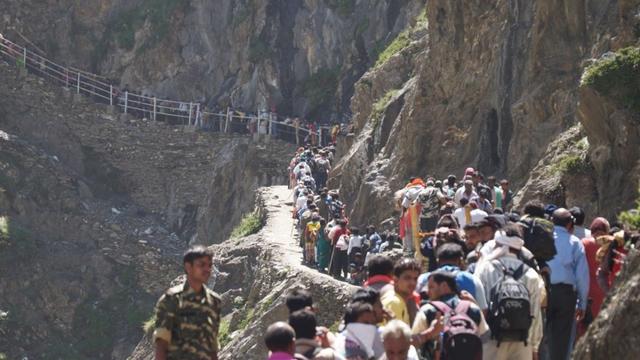
There are no reliable statistics about old pilgrimages, but in the late 20th and 21st centuries the number of pilgrims grew due to the availability of modern transportation. By 2011, it had reached 600,000.
In 2020 and 2021, the pilgrimage was suspended due to COVID-19. It has been officially re-opened on June 29, 2022. Since many delayed making the pilgrimage because of the COVID, local authorities expect this year a record participation, from 600,000 to 800,000 pilgrims.
However, another danger, not less insidious than COVID, now threatens the pilgrims. Anti-Indian terrorist organizations have warned pilgrims that they “forbid” the pilgrimage, and the Indian police has found IED explosive devices along the pilgrims’ traditional route.

Exceptional security measures have been deployed to protect the pilgrims. However, the police has recommended caution, reminding the pilgrims that 53 of them have been killed and more than 160 injured in terrorist attacks against the Amarnath Yatra in past years.
Whether or not a massive Hindu pilgrimage can take place in Kashmir has now become a political issue between Pakistan-backed separatists and India.

Massimo Introvigne (born June 14, 1955 in Rome) is an Italian sociologist of religions. He is the founder and managing director of the Center for Studies on New Religions (CESNUR), an international network of scholars who study new religious movements. Introvigne is the author of some 70 books and more than 100 articles in the field of sociology of religion. He was the main author of the Enciclopedia delle religioni in Italia (Encyclopedia of Religions in Italy). He is a member of the editorial board for the Interdisciplinary Journal of Research on Religion and of the executive board of University of Pennsylvania Press’ Nova Religio. From January 5 to December 31, 2011, he has served as the “Representative on combating racism, xenophobia and discrimination, with a special focus on discrimination against Christians and members of other religions” of the Organization for Security and Co-operation in Europe (OSCE). From 2012 to 2015 he served as chairperson of the Observatory of Religious Liberty, instituted by the Italian Ministry of Foreign Affairs in order to monitor problems of religious liberty on a worldwide scale.