In an important speech, the Chinese President explains that China is democratic—if you just change the meaning of the word “democracy.”
by Massimo Introvigne
“When I use a word, Humpty Dumpty told Alice in Lewis Carroll’s Through the Looking Glass, it means just what I choose it to mean — neither more nor less.” “The question is,” said Alice, “whether you can make words mean so many different things.” “The question is,” retorted Humpty Dumpty, “which is to be master—that’s all.”
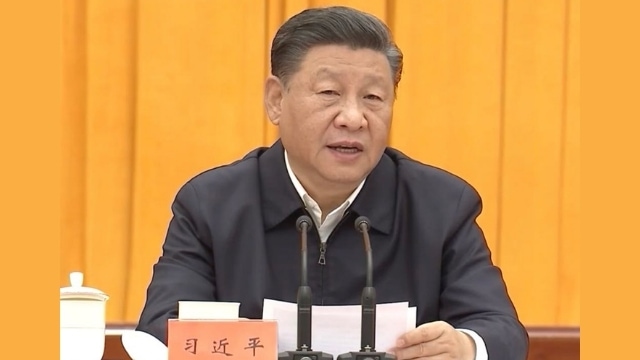
Humpty Dumpty exercises are common in China, but on October 13 and 14 Xi Jinping organized an especially Humpty Dumptyish special event, called the “Central conference on work related to People’s congresses.” These are theoretically elected legislative bodies in China at the national and local level. Everybody understands that elections in China, like in all totalitarian regimes, are a sideshow, the real power is elsewhere, and who is elected is decided in advance by the CCP.
Xi, however, called the system of People’s congresses “a great creation in the history of political systems as well as a brand new system of great significance in the political history of both China and the world.” In fact, Xi said, the system proves that “democracy is a key tenet unswervingly upheld by the Chinese Communist Party.” He added that China is winning the “institutional competition” with other countries by proving that it is more democratic and its democracy is more effective.
Back to Humpty Dumpty. How can Xi pretend that a country where all dissidents go to jail or worse is democratic, indeed the best democracy in the world? By changing the meaning of the words.
Xi explained the Humpty Dumpty methodology first. It consists in undermining the common sense idea that words have a generally accepted meaning. Not so, says the Chinese President. “There are many ways to achieve democracy, and there can be no cookie-cutter approach. It is inherently undemocratic to use a single yardstick to measure the widely different political systems of the world, and examine the many colors of the world’s political civilizations of mankind with eyes attuned only to black and white.” There is no “patent” on democracy, Xi insisted, nor authorities who can decide who is democratic and who is not.
This may elicit the sympathy of many dictators throughout the world, but ultimately means that “democracy” is a word whose meaning does not correspond to a reasonable definition but, in Humpty Dumpty’ terms, depends on “which is to be master.” Since the CCP has all power in China, it has also the power to define what democracy is. Democracy in China is what the CCP says it is.
If some believe that the test for democracy is that legislators and governments are elected in free and fair elections (precisely what does not happen in China), they are mistaken, Xi said. Criticizing the West, he stated that, “Democracy is not true if the people are awakened only at the time of voting and then go to sleep, if they listen to the hype only at the time of campaigning and then have no voice after the election, if they are favored only at the time of campaigning and then are left out after the election.”
“Democracy is not for decoration, but for solving problems that the people need to solve,” Xi said. Democracy in China means that “the people is the master of the country.” This is the etymological meaning of “democracy,” but how does the people speak and is represented? In China, Xi answered, this happens through “the leadership of the Party.” Evidence that the Party represents the people is offered by the “economic miracles” and the building of a powerful and stable nation.
These are not the tests to ascertain whether a country is democratic. Before World War II, Nazi Germany was generally regarded as a powerful, prosperous, and stable country. That did not make it democratic. How does the CCP prove that China is democratic? By changing the meaning of the word “democracy.” Humpty Dumpty, again.

Massimo Introvigne (born June 14, 1955 in Rome) is an Italian sociologist of religions. He is the founder and managing director of the Center for Studies on New Religions (CESNUR), an international network of scholars who study new religious movements. Introvigne is the author of some 70 books and more than 100 articles in the field of sociology of religion. He was the main author of the Enciclopedia delle religioni in Italia (Encyclopedia of Religions in Italy). He is a member of the editorial board for the Interdisciplinary Journal of Research on Religion and of the executive board of University of Pennsylvania Press’ Nova Religio. From January 5 to December 31, 2011, he has served as the “Representative on combating racism, xenophobia and discrimination, with a special focus on discrimination against Christians and members of other religions” of the Organization for Security and Co-operation in Europe (OSCE). From 2012 to 2015 he served as chairperson of the Observatory of Religious Liberty, instituted by the Italian Ministry of Foreign Affairs in order to monitor problems of religious liberty on a worldwide scale.