The incident happened in the Rahim Yar Khan area, notorious for violence against religious minorities.
by Massimo Introvigne

Last week, the family of Alam Ram Bheel, a Hindu from Basti Kahoor Khan, which is in the suburbs of the city of Rahim Yar Khan in Punjab, went to pick raw cotton in a field of Chak 106-P. Ram. Picking raw cotton is a common activity among the poor families of Rahim Yar Khan.
The day was hot, and the family had finished its water. There was a tap outside a nearby mosque. As Hindus, the Bheel family would not enter the mosque, but the tap was outside, and they used it to refill their bottles.
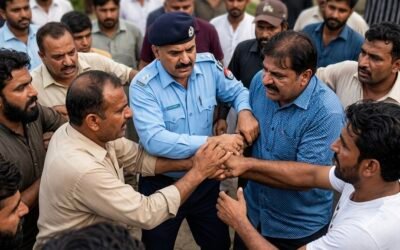
However, some local Muslims regarded this as disrespectful, and beat the Hindu family. When they were returning home, they were ambushed again by the same Muslim men, who took them to their dera and tortured them, including Bheel’s wife. Finally, some Muslims from Basti Kahoor Khan who knew the Bheels intervened, and they were released.
Their problems had just started. They went from one authority to another trying to have their torturers prosecuted but to no avail. The Bheels and their relatives even staged a sit-in outside the airport police station, responsible for the area.
One of their relatives, Peter Jhon Bheel, is a member of the District Peace Committee, but he failed to persuade his fellow committee members to hold an emergency meeting about the incident.
A FIR (First Information Report) was finally registered by the police after the intervention of Peter Jhon Bheel but it is unclear whether any action will be taken.
The area is notorious for the discrimination and bullying of poor families belonging to religious minorities by rich Muslim landlords, protected by local politicians. The Bheel family was told in so many words that the Muslims they wanted to denounce were connected to members of the ruling party, PTI and that insisting to have them prosecuted might be dangerous.

Massimo Introvigne (born June 14, 1955 in Rome) is an Italian sociologist of religions. He is the founder and managing director of the Center for Studies on New Religions (CESNUR), an international network of scholars who study new religious movements. Introvigne is the author of some 70 books and more than 100 articles in the field of sociology of religion. He was the main author of the Enciclopedia delle religioni in Italia (Encyclopedia of Religions in Italy). He is a member of the editorial board for the Interdisciplinary Journal of Research on Religion and of the executive board of University of Pennsylvania Press’ Nova Religio. From January 5 to December 31, 2011, he has served as the “Representative on combating racism, xenophobia and discrimination, with a special focus on discrimination against Christians and members of other religions” of the Organization for Security and Co-operation in Europe (OSCE). From 2012 to 2015 he served as chairperson of the Observatory of Religious Liberty, instituted by the Italian Ministry of Foreign Affairs in order to monitor problems of religious liberty on a worldwide scale.