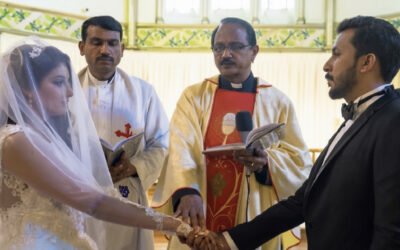
The ancient Christian community is both manipulated by Azerbaijan for anti-Armenian and anti-Georgian purposes and misunderstood by Armenians.
by Massimo Introvigne

“The restoration of the Albanian Apostolic Church will be the final blow to Armenia,” and make Azerbaijan’s victory in the Second Karabakh War of 2020 definitive and irreversible. This declaration may sound strange, but it was published in the official site of the Azerbaijan National Academy of Science, which is part of the local government. These were words of Robert Mobili, chairman of the Albanian-Udi Christian Religious Community of the Republic of Azerbaijan, who these days is often seen with Azerbaijani President Ilham Aliyev.
What is this all about? “Caucasian Albanians” have nothing to do with the European country of Albania. The name “Albanians” was given by Greek historians around the time of Jesus Christ to a kingdom that probably has been in existence from several centuries before them, and included present-day Azerbaijan and parts of Georgia, the Russian Federation, and Armenia.
The Caucasian Kingdom of Albania converted to Christianity in the fourth century, and the autocephalous Albanian Apostolic Church flourished for several centuries. Between the 7th and the 9th century CE, the Kingdom of Albania collapsed under Muslim attacks, and the Albanian Apostolic Church was merged into the Armenian Apostolic Church, although the title of the Albanian Catholicos formally remained alive until 1836, when it was abolished by a Russian Tsarist decree. Even the venerable Caucasian Albanian language became extinguished and was regarded as lost forever.
One tribe, however, remained. The Udi, a Christian people of 10,000 with a distinctive language and traditions living in villages in Azerbaijan and the Russian Federation, with smaller communities in other countries including Georgia, Armenia, and Ukraine, insisted that they were the descendants of the Caucasian Albanians.
This was largely regarded as a legend until in 1996 a Georgian scholar made one of the linguistic discoveries of the century. He found in the Sinai monastery of Saint Catherine a text written in an unknown script and language, which might well have been the oldest surviving Christian lectionary. German scholars deciphered it and proved it was written in the lost Caucasian Albanian language. Two additional texts in the same language were discovered in the same monastery in 2017. The Caucasian Albanian language was no longer unknown, and that it was the ancestor of the Udi language was also proved.
That made the Udi, all of a sudden, politically important. Nagorno-Karabakh is a region disputed between Armenia and Azerbaijan since the end of the Soviet Union. The dispute revived a conflict that had erupted after the fall of the Ottoman Empire and had ended in 1921 when both Armenia and Azerbaijan became part of the Soviet Union.
Roughly three quarters of Nagorno-Karabakh’s population in 1989 belonged to the Armenian Apostolic Church. However, as discoveries were made about the Caucasian Albanian and Udi languages, a revisionist historiography emerged in Azerbaijan. It claimed that all ancient churches in Nagorno-Karabakh originally belonged to the Albanian Apostolic Church, which—contrary to what “official” history claims—continued to exist until the 1836 Tsarist abolition. According to this version, only in the 19th century the Armenians, with Russian complicity, erased the inscriptions and other evidence of the Albanian origin of the ancient churches and camouflaged them as Armenian churches.
There is really no evidence that this happened, and that the Armenian Apostolic Church survived in the second millennium except in name, but this revisionist history has been officially adopted by the Azerbaijani President Aliyev. And it is continuously growing, with Azerbaijani historians claiming that even churches in Armenia and in Georgia, and certainly in border areas disputed between Georgia and Azerbaijan, were originally Albanian Apostolic and were “stolen” in the 19th century by the Armenian and Georgian churches.
Udi leaders such as Robert Mobili, with their dreams of reconstructing the Albanian Apostolic Church around the surviving Udi Christian communities, which have some support from the bishop of the Syriac Orthodox Church in Mardin, Turkey, became politically important and nationally prominent, after centuries of marginalization of their people and language.
If Azerbaijan’s claims are historically untenable, Armenian reactions that try to deny the connection between the Udi and the Caucasian Albanian Christians are also no longer acceptable after the post-1996 linguistic discoveries. They also perpetuate ancient ill feelings between Udi and Armenian Christians, who are theologically very close. As usual in these regions, Christianity is caught in a political crossfire, and no easy solution is at hand.
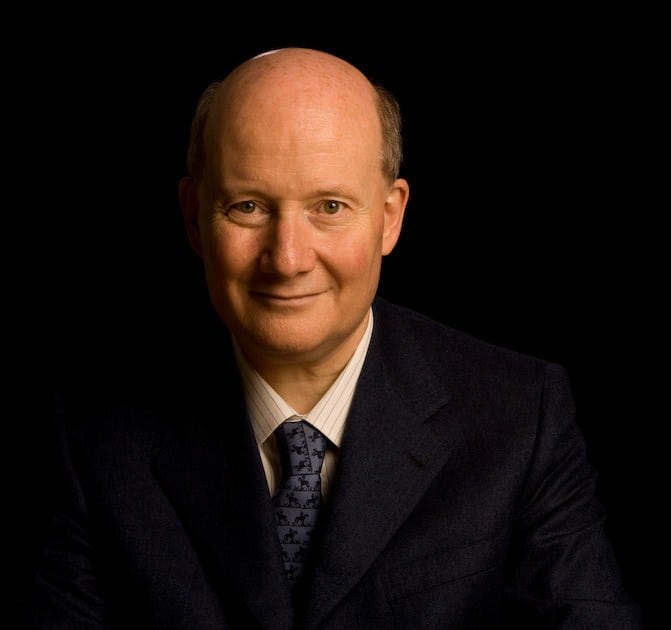
Massimo Introvigne (born June 14, 1955 in Rome) is an Italian sociologist of religions. He is the founder and managing director of the Center for Studies on New Religions (CESNUR), an international network of scholars who study new religious movements. Introvigne is the author of some 70 books and more than 100 articles in the field of sociology of religion. He was the main author of the Enciclopedia delle religioni in Italia (Encyclopedia of Religions in Italy). He is a member of the editorial board for the Interdisciplinary Journal of Research on Religion and of the executive board of University of Pennsylvania Press’ Nova Religio. From January 5 to December 31, 2011, he has served as the “Representative on combating racism, xenophobia and discrimination, with a special focus on discrimination against Christians and members of other religions” of the Organization for Security and Co-operation in Europe (OSCE). From 2012 to 2015 he served as chairperson of the Observatory of Religious Liberty, instituted by the Italian Ministry of Foreign Affairs in order to monitor problems of religious liberty on a worldwide scale.