Buddhist and Taoist temples fall victim to increasing religious suppression in the name of “sinicization.” If not destroyed, they are turned into propaganda venues.
by Wang Yichi
Just like during the Cultural Revolution, when the campaign to get rid of the “Four Olds” – old customs, culture, habits, and ideas – was actively implemented across China, the current regime is building the new Chinese Socialism by destroying anything related to religion, replacing it with Party propaganda. Buddhist and Taoist temples are no exception: they are being demolished under a variety of trumped-up pretexts; those that are lucky to survive, are shut down or “sinicized,” leaving them to exist in the name only.
“Buddhist Holy Land” turns patriotic
The suppression of venues for worship has intensified even more as the central government is sending inspection teams to check how the religion suppression policies are implemented on the provincial and local level. As was the case recently in the eastern province of Shandong.
Lushen Temple in Shandong’s Pingdu city ceased to be Buddhist in May. Claiming that the temple occupies the land illegally, the local authorities closed it down and put up the sign: “This venue is a folk belief venue. Setting up donation boxes to collect religious donations not allowed, and religious activities must not be held.” According to a local Buddhist, officials have been harassing the temple repeatedly, for six months or so, demanding to make it “more patriotic.” If the changes were not implemented, the authorities threatened to tear it down. And so, the Buddhist symbols inside the temple were replaced with CCP propaganda.

Political propaganda slogans have been posted on the bulletin board of Lushen Temple.
The six-character Buddhist mantra “Om Mani Padme Hum” on a stone tablet was replaced with the six Chinese characters for “We are pursuers of dreams” – a response of the local Party bureaucrats to President Xi Jinping’s call to construct the “Chinese Dream.”

The Chinese characters for “We are pursuers of dreams” are now displayed in the temple.
The Chinese characters for “Buddhist Holy Land” on the temple’s memorial gateway were altered to “Patriotic Holy Land,” and the yellow walls– the traditional color of temples – were painted white.

The sign “Patriotic Holy Land” has replaced the one reading “Buddhist Holy Land.”
Temples closed, monks evicted
On April 23, Pingdu’s Religious Affairs Bureau ordered the closure of Yuanming Temple under the pretext of “rectifying Taoism and Buddhism.” A statue of a Buddhist deity and the incense burner inside the temple were covered with red galvanized-iron sheets. The monks who lived at the temple year-round were driven out, forced to return to secular life.

The Buddhist statue and the incense burner in Yuanming Temple were covered with red galvanized-iron sheets.
According to sources, the temple was built with personal investments and fundraising at the cost of over one million RMB (about $ 150,000). Every year, many people came to the temple to worship and burn incense.

A Bodhisattva statue in Gaofu Temple in Pingdu city was covered after the temple was shut down.
In May, three temples were shut down in Pingdu. Yunshan Temple – a Taoist place of worship was closed on the grounds that it was unlicensed. Two Buddhist temples – Gaofu Temple and Cihang Temple – were sealed off because they allegedly “violated building laws.” The former temple was built at the cost of nearly one million RMB (about $ 150,000); its incense burner was torn down, and a 10-meter-tall Bodhisattva statue was covered after the closure.

The Buddhist statues in Cihang Temple have been covered up.

The door of the palace hall in Cihang Temple has been sealed off.
Over in the northern province of Shanxi, Shanyuan Temple in Pinglu district of Shuozhou city was one of the largest temples in the area. Built with government’s consent in 2013, the temple was sealed off by the district authorities in early May, claiming that it was unlicensed. The Guanyin statue on the premises was ordered to be demolished because it was too tall. Officials from the Religious Affairs Bureau supervised the entire dismantling process, the cost of which – 14,000 RMB (about $ 2,100) – had to be covered by the temple’s owner. The officials also drove out all the monks from the temple prohibited anyone from entering it.

Guanyin statue in Shanyuan Temple before and after its demolition.
“There is really no way to reason things out,” one of the evicted monks said helplessly. “Now that the temple has been sealed off, we have to look for another place to live.”
On April 11, Miaoxiang Temple in Guodian town, in the central province of Henan, was sealed off. About 20 local government personnel stormed into the temple: They covered with a red cloth the three Chinese characters for “Miaoxiang Temple” on the gate and the Buddhist statues inside the hall, destroyed the incense burner, and used iron sheets to obscure the doors and a large bell.

The temple’s doors were sealed off with iron sheets, and the incense burner was destroyed.
“If we didn’t let them shut down the temple, the government would arrest us. The central government has the power, but we don’t. We can’t stop them,” said a local Buddhist. “Many Christian churches, Buddhist and other temples have been sealed off as the state is restricting religious belief. This is the case throughout the country.”
Authorities across the country continue to tear down religious statues restlessly. A roughly 16-meter-tall Guanyin statue inside Wofo Temple (literally, the Temple of Reclining Buddha) in Ganjingzi district of Dalian city, in the northeastern province of Liaoning, was recently dismantled. So was the statue of Amitabha Buddha in a temple on Jingzhong Mountain, located in Qianxi county, under the jurisdiction of Tangshan city, in the northern province of Hebei.
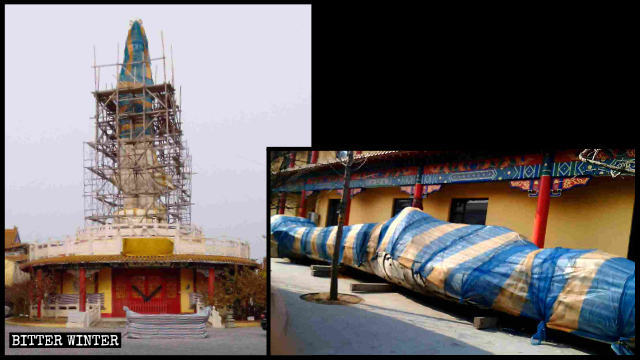
The dismantled Guanyin statue inside Wofo Temple in Liaoning.
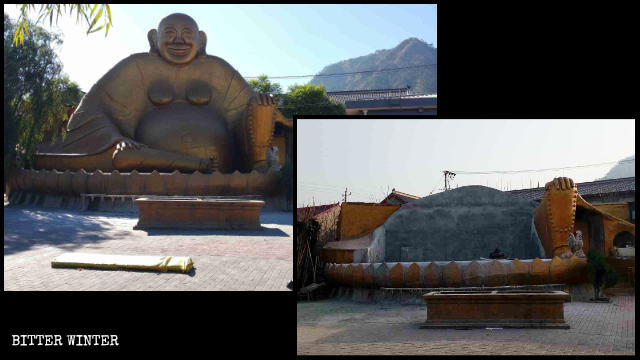
The Amitabha Buddha in a temple on Jingzhong Mountain was demolished.

Uses a pseudonym for security reasons.