Fearing admonishment by higher authorities, Shandong’s officials intensified crackdowns on temples and outdoor religious venues, eliminating statues of deities.
Li Mingxuan
The visit by the central religion inspection team in the eastern province of Shandong last month has resulted in the demolition of churches and temples as well as large numbers of dismantled religious symbols. According to the newly received reports, many Buddhist statues also fell victim to the persecution as provincial officials were getting ready for the visit by the central government.
No statues allowed in Buddhist temples
In early April, Shandong’s provincial religion inspection team drove out the abbot of Shiyu Temple (literally, Stone Valley Temple) in Zhangqiu district of Ji’nan city. One month later, the village Party secretary led more than ten villagers to smash and destroy all of the temple’s statues that were later buried in the specially dug out pits. “If anyone discloses these things, they will be handcuffed and arrested!” threatened the bureaucrat.

Shiyu Temple before and after the statues inside it were removed.
Yuantong Temple, located on Mount Zhe in Zhangqiu district, was also unable to escape suppression. A villager from the area told Bitter Winter that the temple’s owner had initially planned to hold a ceremony to consecrate the new statues of Buddha and other deities on May 1. He couldn’t even anticipate that a few days before the event, government officials would order him to remove all Buddhist statues on the absurd excuse that “there cannot be Buddhist statues inside temples.”
After the owner refused, officials from the district’s Ethnic and Religious Affairs Bureau forcibly locked the temple’s door, built a wall to seal it off, and cut off the temple’s water and electricity supply, coercing the owner to agree that the statues would be dismantled.
The owner invested more than 10 million RMB (about $ 1,500,000) in building the temple. Seeing it completely empty, he lamented that there is no way to resist the government’s actions, and he has no chance to redress his grievances.

Buddhist statues in Yuantong Temple were covered up and later removed.
On May 16, statues in Shengquan Temple (literally, Holy Spring Temple), located in Xianggongzhuang town in Zhangqiu district, were also removed, many smashed into pieces.

Guanyin statue in Shengquan Temple before and after it was dismantled.
“Xi Jinping is now following the path of Mao Zedong. Just like during the Cultural Revolution, temples and Buddhist statues are being demolished,” said a villager.

Buddhist statues in Shengquan Temple’s Hall of Great Strength before and after being destroyed.
Location of outdoor statues tracked through aerial surveillance
Large open-air religious sculptures are even bigger eyesores for the CCP, Shandong authorities tracking their sites using airplanes. In an attempt to protect them from demolition, local Buddhists are trying to conceal the statues from vigilant inspectors.
On April 20, government personnel from Longquan town of Zichuan district, under the jurisdiction of Zibo city, told the committee of Shangzhuang village that the cement Buddha statue on the Panlong Mountain was too tall. It has been aerially photographed, and the district’s Ethnic and Religious Affairs Bureau demanded it to be dismantled. Villagers were unwilling to part with the statue that they had worked so hard to build, so they covered it with a rain tarp.

The Buddha statue of Shangzhuang village before and after it was concealed.
A Maitreya statue in the Liuxian Valley Scenic Area, located in Zichuan district’s Zhaili town was also ordered to be demolished after it was aerially photographed last October. Local believers had invested over 200,000 RMB (about $ 30,000) to build the statue, so they too decided to cover it with a sunshade net.
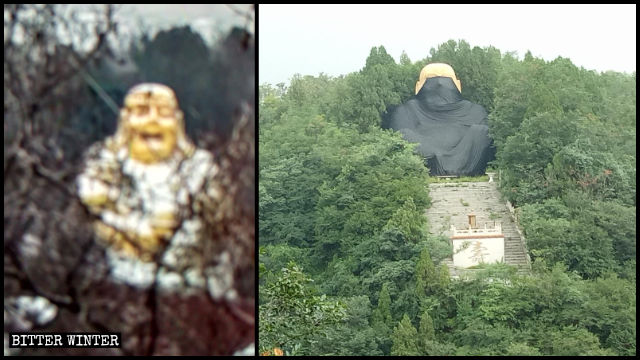
The Maitreya statue in Liuxian Valley before and after it was covered up.
On May 15, the government used a black net to forcibly cover a 40-meter-tall Maitreya Buddha statue in the Ink Stone Mountain Scenic Area in Xintai, a county-level city under the jurisdiction of Tai’an city.

The Maitreya statue on Ink Stone Mountain before and after it was covered
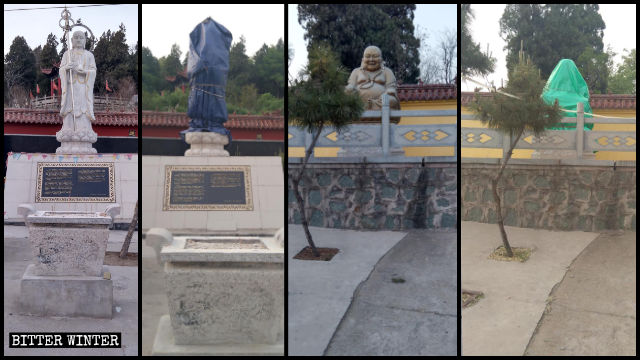
Two outdoor Buddhist statues—Kṣitigarbha Bodhisattva and Maitreya Buddha—in a temple on Kunlun Mountain in Zichuan district’s Kunlun town were also covered.
The concealed statues are awaiting their fate, which doesn’t look optimistic. After 500 Arhat statues at the famous Qibugou Scenic Area in Wu’an city in Hebei were listed for removal, local Buddhists creatively hid them, but, in the end, more than half of them didn’t escape demolition.

Uses a pseudonym for security reasons.