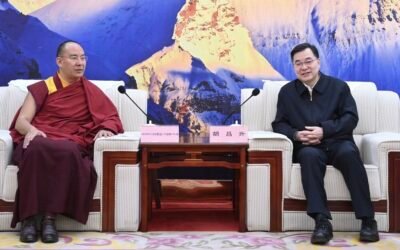
Often chased from public schools, the Tibetan language is taught in monasteries. The CCP claims this is forbidden.

Image credits: Antoine Taveneaux – CC BY-SA 3.0
Massimo Introvigne
Human Rights Watch has published a local government order from Nangchen County in Eastern Tibet, titled: “Urgent notice concerning stopping illegal study classes in monasteries.”
The order deals with “Tibetan language study classes” that monasteries offer during the Winter break of public schools. The context is the increased “sinicization” of Tibet, which makes learning the Tibetan language and receiving education in Tibetan at school increasingly difficult.
The order, dated 25 December 2018, states that “ the holding of classes by monasteries must be rectified and strictly prohibited.” Authorities should punish the monks who do not respect the prohibition and keep in mind the “harmful nature” of monastic education. CCP cadres should “hold the fort of ideological education for children and youth, firmly uphold the leading role of the Party and government in education.”
These incidents, according to the order, should “serve as a warning,” that “the ideological education of parents and children must be improved, so as to reduce the strength of opposition in society.”
The order explains that monks who are found to be responsible for teaching children will lose their monastic ID card, meaning they could no longer identify themselves as monks nor live in monasteries.
It is believed that similar policies are being implemented in other provinces of Tibet as well.
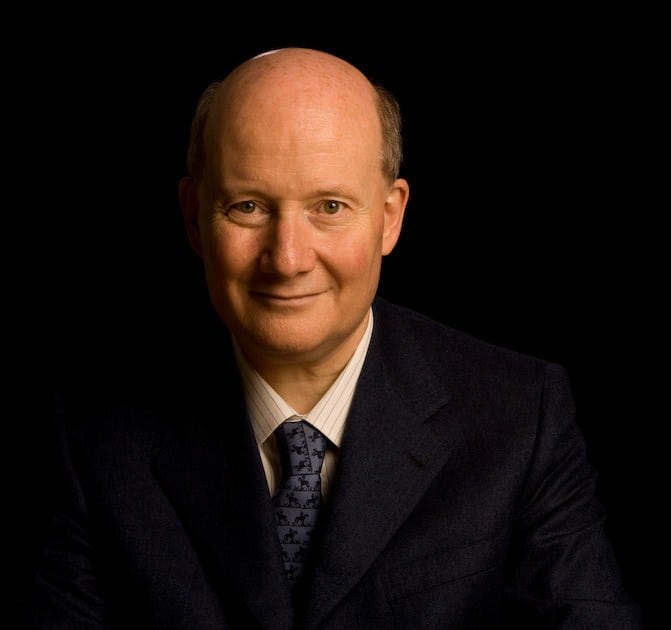
Massimo Introvigne (born June 14, 1955 in Rome) is an Italian sociologist of religions. He is the founder and managing director of the Center for Studies on New Religions (CESNUR), an international network of scholars who study new religious movements. Introvigne is the author of some 70 books and more than 100 articles in the field of sociology of religion. He was the main author of the Enciclopedia delle religioni in Italia (Encyclopedia of Religions in Italy). He is a member of the editorial board for the Interdisciplinary Journal of Research on Religion and of the executive board of University of Pennsylvania Press’ Nova Religio. From January 5 to December 31, 2011, he has served as the “Representative on combating racism, xenophobia and discrimination, with a special focus on discrimination against Christians and members of other religions” of the Organization for Security and Co-operation in Europe (OSCE). From 2012 to 2015 he served as chairperson of the Observatory of Religious Liberty, instituted by the Italian Ministry of Foreign Affairs in order to monitor problems of religious liberty on a worldwide scale.